

Ukraine may be shifting some long-range drone communications away from Starlink and Starshield toward Israeli HiSKY satellite links, potentially reducing exposure to US-imposed restrictions.
The report noted that claims of Ukrainian HiSKY use first appeared in Russian military media in late October and have not been independently confirmed.
Russian military analyst Konstantin Malofeev in a recent report said that a HiSKY-equipped drone operating over Russia is unjammable because the system automatically hops from commercial satellite to commercial satellite if the signal degrades. The Ukrainian shift away from SpaceX’s Starlink system was driven by a Musk decision to block Ukrainian use of Starlink coverage over Russia “because otherwise Russia would shoot down Musk’s satellites,” he said.

The shift to HiSKY helped Ukrainian drone operators make unimpeded swarm attacks against Russian oil refineries and to pilot multiple aircraft to single out and hit vulnerable locations of the plants, Malofeev said.
The Russia-associated Coordination Center for the Assistance of New Russia (CCANR), in an Oct. 29 analytical video published on RuTube, said that authorities had obtained “confirmed information” that Ukraine’s drone forces had begun using HiSKY technology in attacks on Russia:
“This is not Starlink. This is European equipment that allows, using European communications networks, the piloting of long-range drones and other devices, like crewless boats, against the entire territory of the Russian Federation,”
said CCANR Director Aleksandr Liubimov.
“There are no limitations to the capacities of this equipment like there are on Starlink, which doesn’t work in Russia.”
“According to our information [the Ukrainians] are testing this technology in border regions of Russia with the objective of using it more widely,”
“We [Russia] can expect mass use of drones [equipped with HiSKY terminals] against any point in the Russian Federation using this space communications system, specifically that does not belong to [SpaceX CEO Elon] Musk, but to Europe.”
HiSKY, according to corporate-published information, is an Israeli company with a British subsidiary, hiSkySat Ltd., operating an R&D center at Harwell in Oxfordshire. The UK Space Agency is funding the project with £9 million ($12 million) allocated through the European Space Agency (ESA), a UK government statement said.
Serhiy “Flash” Beskresnikov, a Ukrainian military communications expert and advisor to President Volodymyr Zelensky on military electronics, in Sunday comments to Euromaidan Press said:
“I do not confirm or deny this information from the Russians. I do not know why this caused such a stir in Russian media since such technologies have long been nothing unique.”
The AFU, according to Ukrainian media reports, began employing HiSKY’s smallest and lowest-cost terminal, a 6-kilogram (13-pound) device called a Sirius 16×16 Ku, in drone strikes against Russia in mid-October while the Musk/White House-imposed limits to SpaceX-provided service still were in effect. The first debris of a Ukrainian HiSKY-equipped drone was shot down by Russian air defense forces shortly before the end of the month, those reports said.
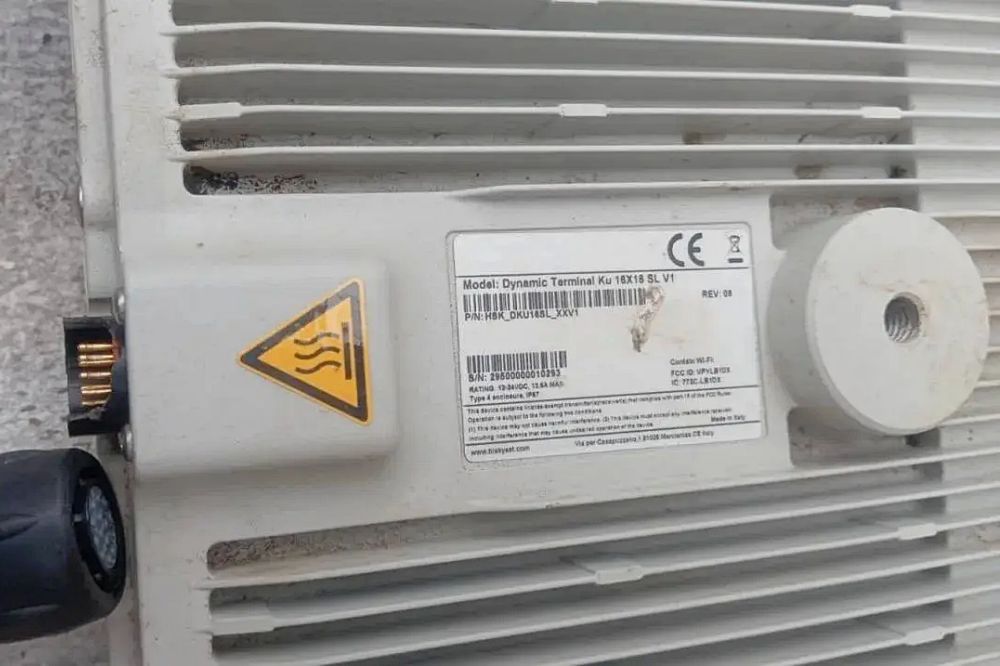
The flat SmartLite Sirius terminal from HiSky. Source: Serhii “Flash” Beskrestnov
According to a Sunday article by the Ukrainian research group DP Defpulse, AFU use of HiSKY technology is not fully confirmed but highly probable. The system gives AFU operators the advantage of communications links transferring 2 Mbps of data in concentrated beams that hop from high-orbit geostationary satellite to geostationary satellite as needed, making the electronic tether between drone and operator almost impossible to jam, the report said.
The main disadvantage to Ukrainian pilots is that Starlink or Starshield terminals using the SpaceX network and a massive constellation of moving, low orbit satellites offer 50-250+ Mbps data transfer capacity, making piloting a long-range drone visually possible only via Starlink, because data transfer volume using HiSKY technology is too limited.
A lower-volume HiSKY link would nonetheless be capable of transferring course corrections to a drone in flight, making possible redirection of individual drones in a drone strike package to a precise target, the report said.
Sources: Kyiv Post; EUROMAIDAN Press