
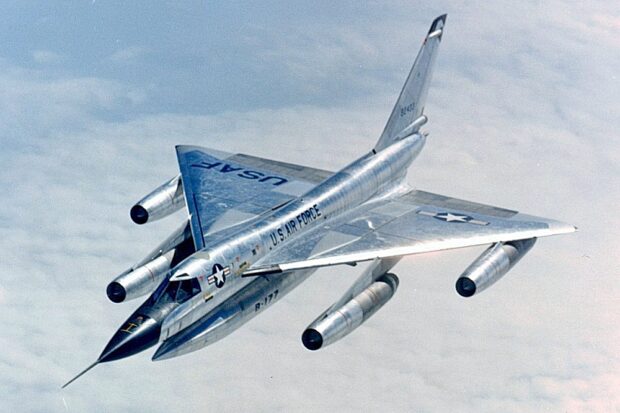
During the Cold War, the United States developed one of the most radical and dangerous bombers ever built: the Convair B-58 Hustler, America’s first operational supersonic bomber, capable of carrying nuclear weapons at nearly twice the speed of sound.
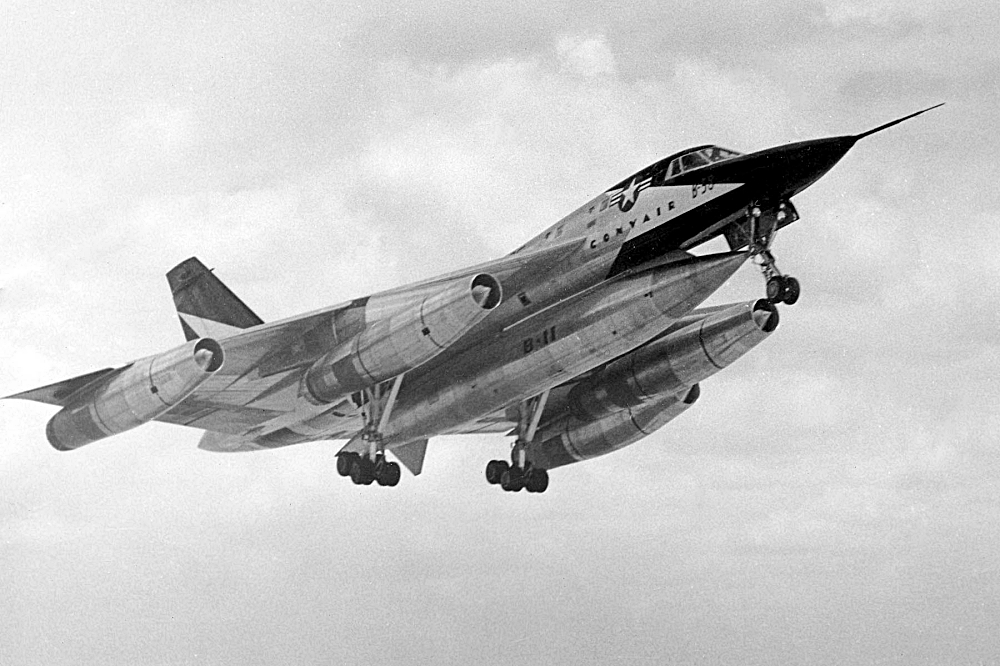
XB-58 prototype during takeoff
But the Hustler’s extraordinary performance came at a terrifying price. With limited range, unforgiving flight characteristics, and dangerous landing procedures, the aircraft was as challenging to operate as it was impressive to watch. During the Cuban Missile Crisis of 1962, the B-58 was sent toward Cuba to gather intelligence on Soviet missile installations, proving its capabilities during one of the most dangerous confrontations of the Cold War.
It later shattered aviation records, including an extraordinary supersonic flight from Tokyo to London. Yet the bomber’s greatest threat would eventually come from within. In December 1964, a nuclear-armed B-58 crashed during a readiness exercise at an Indiana airbase, triggering a devastating fire that killed a crewman and threatened to turn an ordinary military accident into a nuclear catastrophe. Despite its incredible speed and technological achievements, the Hustler’s high operating costs, alarming accident rate, and rapidly changing Soviet defences ultimately sealed its fate.
This is the extraordinary story of America’s supersonic nuclear bomber, an aircraft built to survive the deadliest Soviet weapons but whose revolutionary design became one of its greatest weaknesses.
The Convair B-58 Hustler is a supersonic strategic bomber, the first capable of Mach 2 flight. Designed and produced by American aircraft manufacturer Convair, a division of General Dynamics, the B-58 was developed during the 1950s for the United States Air Force (USAF) Strategic Air Command (SAC).
To achieve the high speeds desired, Convair chose a delta-wing design used by contemporary interceptors such as the Convair F-102. The bomber was powered by four General Electric J79 engines in underwing pods. It had no bomb bay; it carried a single nuclear weapon plus fuel in a combination bomb/fuel pod underneath the fuselage. Later, four external hardpoints were added, enabling it to carry up to five weapons such as one Mk 53 and four Mk 43 warheads.
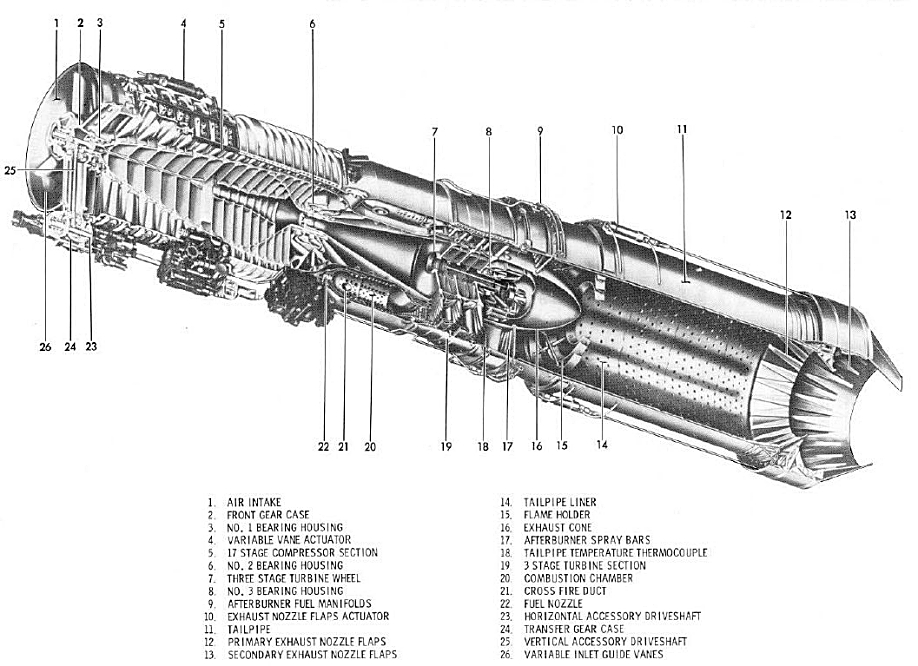
Cutaway diagram of the J79 with components labeled
The B-58 entered service in March 1960 and flew for a decade with two SAC bomb wings, the 43rd Bombardment Wing and the 305th Bombardment Wing. It was considered difficult to fly, imposing a high workload upon its three-man crews. Designed to replace the subsonic Boeing B-47 Stratojet strategic bomber, the B-58 became notorious for its sonic boom heard on the ground by the public as it passed overhead in supersonic flight.
The B-58 was designed to fly at high altitudes and supersonic speeds to avoid Soviet interceptors, but with the Soviet introduction of high-altitude surface-to-air missiles, the B-58 was forced to adopt a low-level penetration role that severely limited its range and strategic value. It was never used to deliver conventional bombs. The B-58 was substantially more expensive to operate than other bombers, such as the Boeing B-52 Stratofortress, and required more frequent aerial refuelling.
The B-58 also suffered from a high rate of accidental losses. These factors resulted in a relatively brief operational career of 10 years. The B-58 was succeeded in its role by the smaller, also problem-beset, swing-wing FB-111A.
Sources: YouTube; Wikipedia