
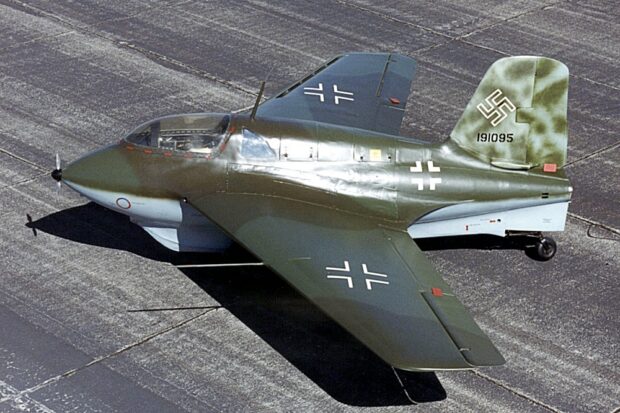
During World War II, Nazi Germany developed one of the most terrifying and dangerous aircraft ever built: the Messerschmitt Me 163 Komet, a revolutionary rocket-powered interceptor capable of flying faster and climbing higher than almost anything the Allies had ever encountered.
With a top speed exceeding 600 miles per hour, the tiny, tailless fighter could reach American bomber formations in just minutes, leaving even the legendary P-51 Mustang struggling to keep up. But behind its incredible performance was a deadly engineering nightmare.
Powered by two highly volatile chemicals that could explode upon contact, the Komet carried only a few minutes of rocket fuel, forcing pilots to attack enemy bombers at tremendous speeds before gliding back to the ground without an engine. Its acceleration was so extreme that pilots barely had time to aim their cannons, and its dangerous landing system and unpredictable rocket motor caused numerous fatal accidents before the aircraft could even prove itself in combat.
In 1944, American bomber crews began encountering these mysterious machines over Germany, watching helplessly as they climbed almost vertically, attacked at extraordinary speeds, and disappeared before escort fighters could respond.
Yet the Komet’s greatest advantage quickly became its biggest weakness: it was simply too fast to fight effectively. German engineers even experimented with an extraordinary automatic weapon called the Jägerfaust, designed to fire upward when the aircraft passed beneath an enemy bomber’s shadow. Despite occasional victories against American heavy bombers, the Komet’s short endurance, catastrophic fuel hazards, and devastating losses prevented it from changing the course of the war.
By 1945, Germany’s fastest fighter was increasingly trapped on the ground, unable to fly as Allied bombers destroyed the very infrastructure needed to keep it operational. This is the incredible story of Hitler’s insane rocket-powered fighter, an aircraft that shattered aviation records, terrified Allied pilots, and became so dangerous that it could be deadlier to its own crews than to the enemy.
The Messerschmitt Me 163 Komet is a rocket-powered interceptor aircraft primarily designed and produced by the German aircraft manufacturer Messerschmitt. It is the only operational rocket-powered fighter aircraft in history as well as the first piloted aircraft of any type to exceed 1,000 kilometres per hour (540 knots) in level flight.
Development of what would become the Me 163 can be traced back to 1937 and the work of the German aeronautical engineer Alexander Lippisch and the Deutsche Forschungsanstalt für Segelflug (DFS). Initially an experimental programme that drew upon traditional glider designs while integrating various new innovations such as the rocket engine, the development ran into organisational issues until Lippisch and his team were transferred to Messerschmitt in January 1939.
Plans for a propeller-powered intermediary aircraft were quickly dropped in favour of proceeding directly to rocket propulsion. On 1 September 1941, the prototype performed its maiden flight, quickly demonstrating its unprecedented performance and the qualities of its design. Having been suitably impressed, German officials quickly enacted plans that aimed for the widespread introduction of Me 163 point-defence interceptors across Germany. During December 1941, work began on the upgraded Me 163B, which was optimized for large-scale production.
During early July 1944, German test pilot Heini Dittmar reached 1,130 km/h (700 mph), an unofficial flight airspeed record that remained unmatched by turbojet-powered aircraft until 1953. That same year, the Me 163 began flying operational missions, being typically used to defend against incoming enemy bombing raids. As part of their alliance with the Empire of Japan, Germany provided design schematics and a single Me 163 to the country; this led to the development of the Mitsubishi J8M. By the end of the conflict, roughly 370 Komets had been completed, most of which were being used operationally.
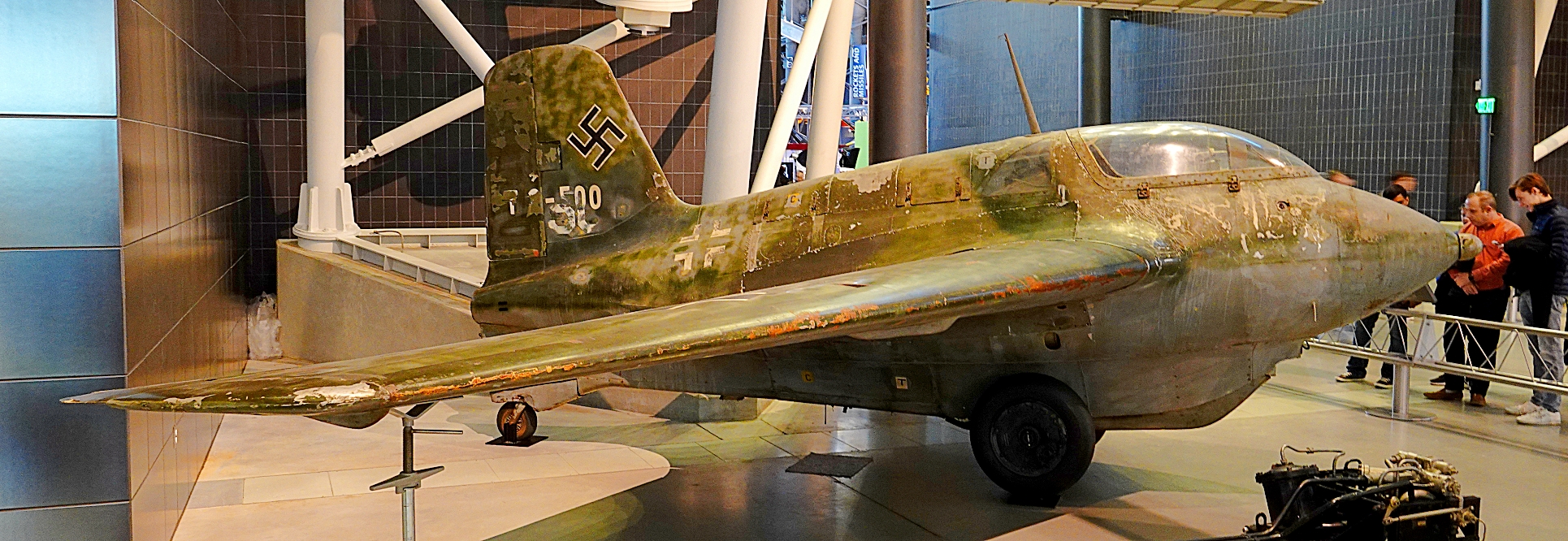
Unrestored Messerschmitt Me 163B Komet at the Udvar-Hazy center
Some of the aircraft’s shortcomings were never addressed, and it was less effective in combat than predicted. Capable of a maximum of 7.5 minutes of powered flight, its range fell short of projections and greatly limited its potential. Efforts to improve the aircraft were made (most notably the development of the Messerschmitt Me 263), but many of these did not see actual combat due to the sustained advance of the Allied powers into Germany in 1945.
After being introduced into service the Me 163 was credited with the destruction of between 9 and 18 Allied aircraft against 10 losses. Aside from combat losses, numerous Me 163 pilots were killed upon takeoff or during testing and training flights. This high loss rate was, at least partially, a result of the later models’ use of rocket propellant which was not only highly volatile but also corrosive and hazardous to humans.
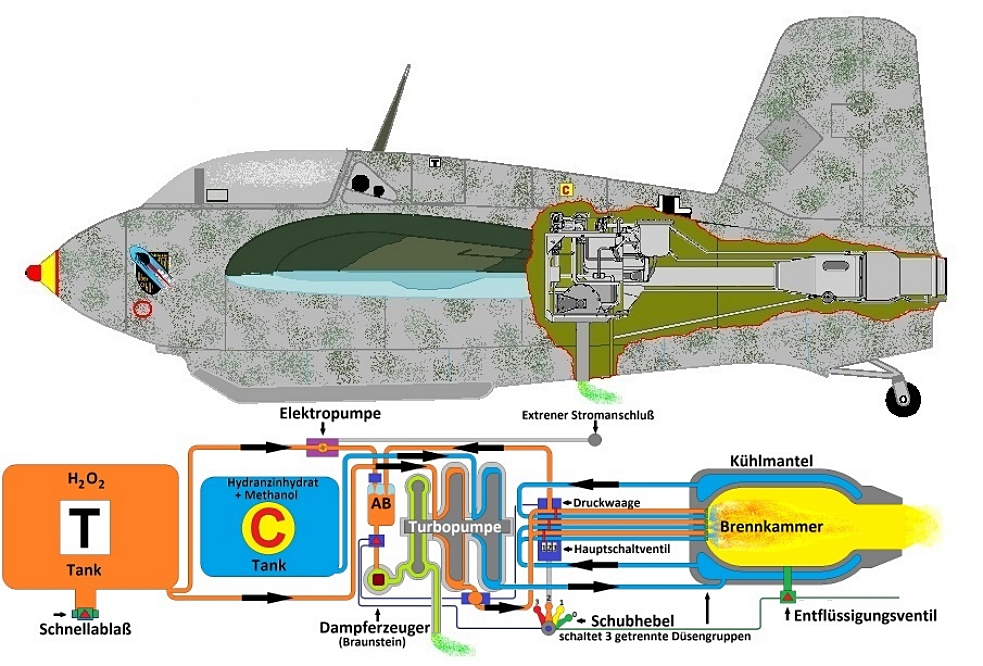
Position of the Walter HWK 109-509A-1 rocket motor
One noteworthy fatality was that of Josef Pöhs, a German fighter ace and Oberleutnant in the Luftwaffe, who was killed in 1943 through exposure to T-Stoff in combination with injuries sustained during a failed takeoff that ruptured a fuel line. Besides Nazi Germany, no nation ever made operational use of the Me 163; the only other operational rocket-powered aircraft was the Japanese Yokosuka MXY-7 Ohka which was a manned flying bomb.
Top Photo: A German Messerschmitt Me 163B Komet rocket-propelled fighter (s/n 191095) at the National Museum of the United States Air Force, Dayton, Ohio (USA).
Sources: YouTube; Wikipedia