
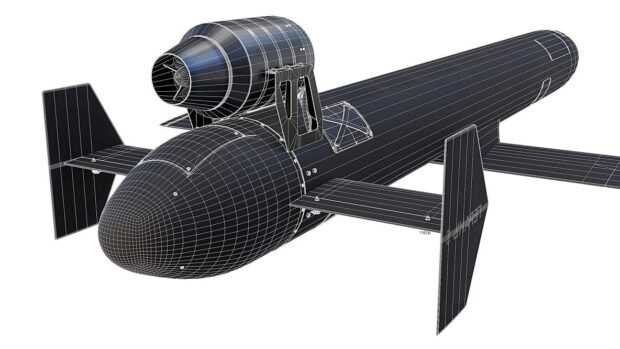
Russia is striking Ukraine with a new generation of jet-powered attack drones that are faster, harder to intercept, and equipped with Chinese-made engines. According to Beijing’s assurances, these should not have reached Russia under its stated export-control rules.
Now Ukrainian intelligence is reporting the next step: the Russian manufacturer in Alabuga is installing its own version of the Telefly engine, potentially enabling the technology to spread further among Russia’s allies.
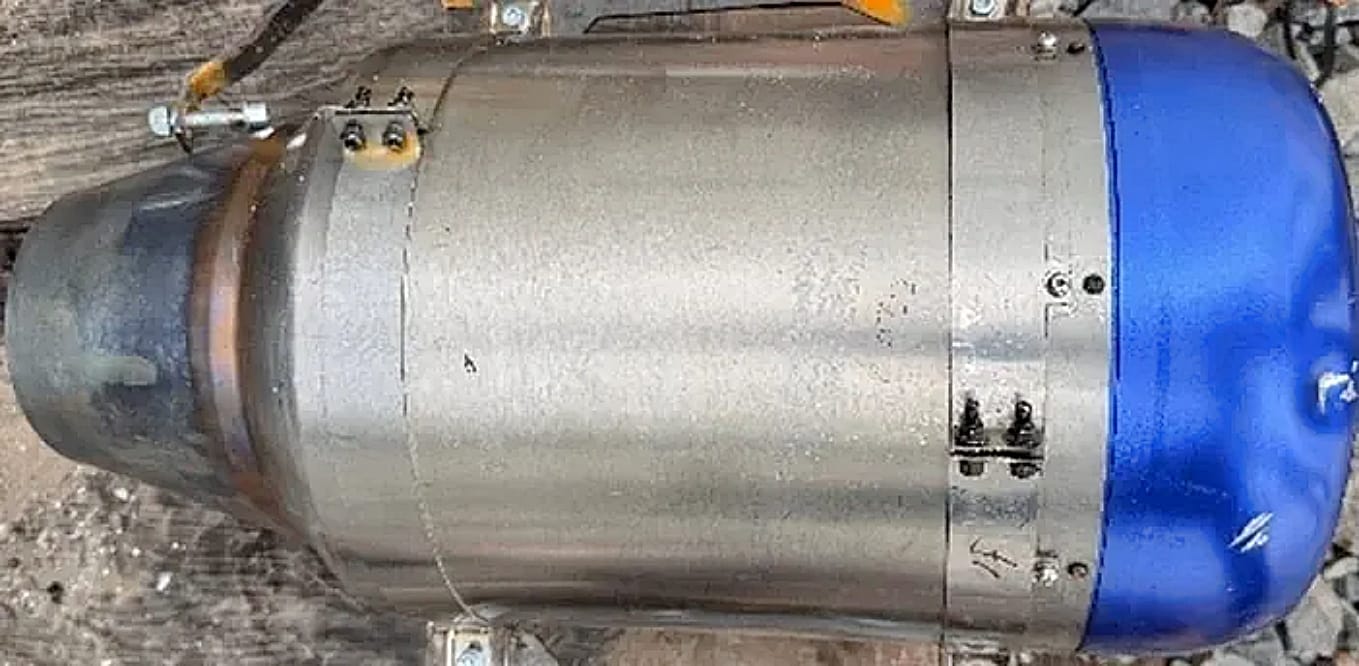
LX-WP-160 turbojet engine, manufactured in China by Telefly Telecommunications Equipment Co., Limited. (Source: war-sanctions.gur.gov.ua)
Before this, Ukrainian intelligence had documented the use of Telefly power plants in several Russian jet-powered drones. The company’s engines are used in both the jet-powered Geran-4 and its modified successor, the Geran-5.
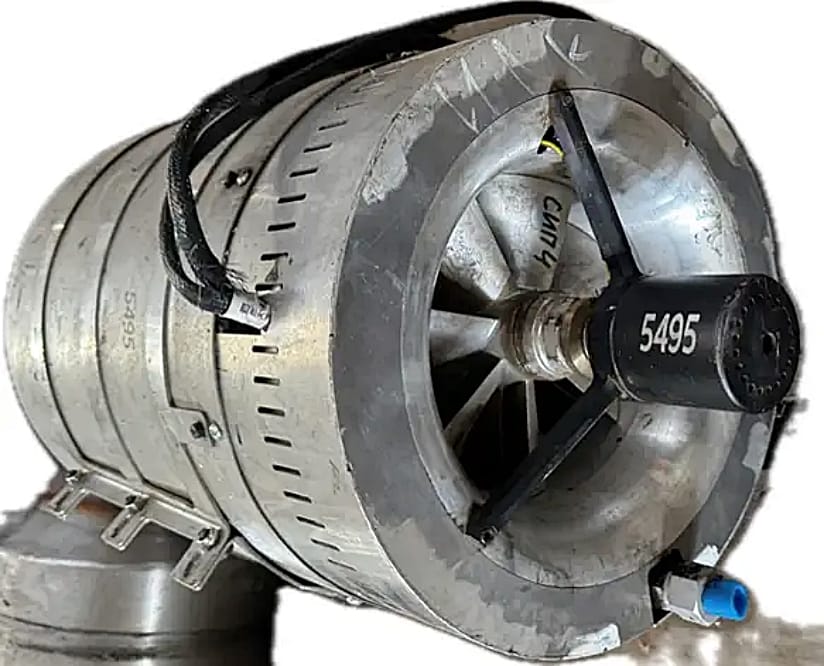
Russian-made equivalent of Telefly turbojet engine produced in Alabuga
These drone variants bear little resemblance to the original prototypes of Iran’s Shahed, whose technology Russia once obtained from Iran. Jet-powered drones shorten the time between an air-raid warning and an explosion, while newer modifications are being adapted to destroy infrastructure. Their appeal lies in their effectiveness and low cost.
In effect, Russia has obtained the equivalent of a cruise missile at a cost of only around $120,000.
At the same time, even with a localized engine, Russia still relies on Chinese technology and components.
What Telefly’s Different Catalogues Reveal
Before Russia localized production, technology supplied by the Chinese company Telefly represented a breakthrough in its ability to terrorize civilians.
On Telefly’s English-language homepage, the company appears primarily to be a supplier of computer and telecommunications equipment. Its product menu includes graphics cards, network cards, servers, memory, and transceivers. There is no jet-engine category. References to engines can no longer be found on the Russian-language homepage either.
Changing the language, however, reveals a different product range. The German-language version, for example, still has a page for the TF-TJ2000 advertising its use in cruise missiles.
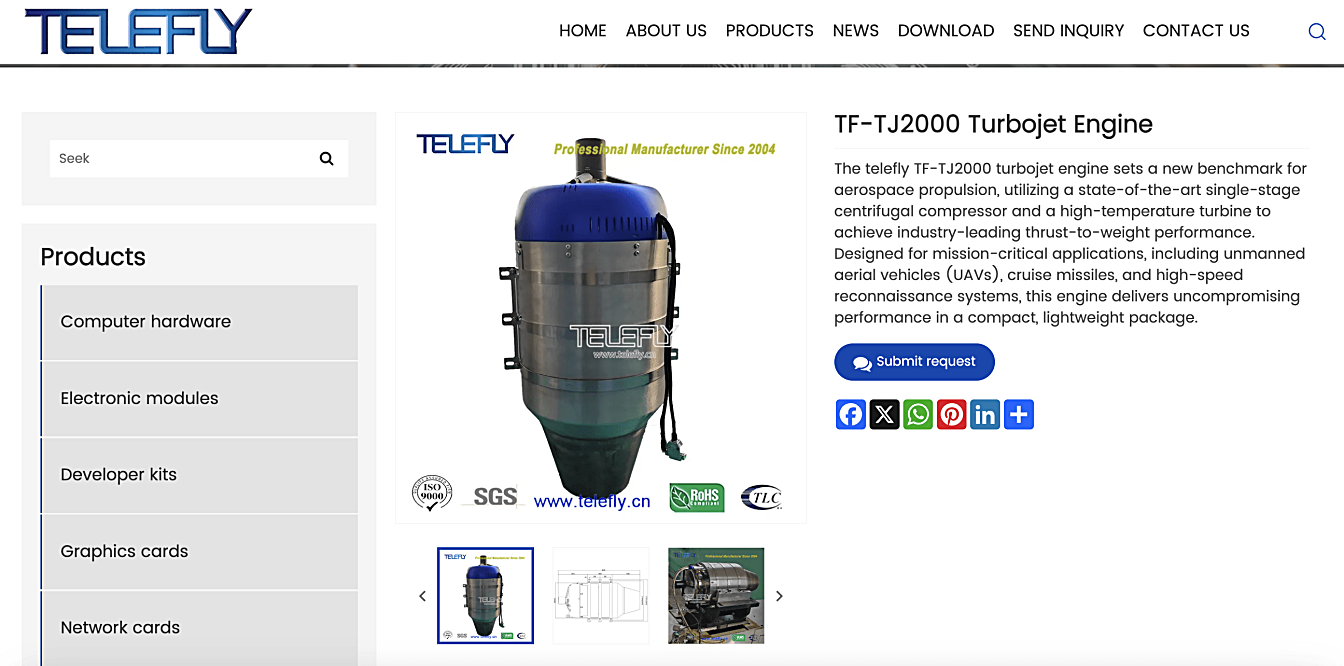
The brand is linked to Shenzhen Xianghao Communication Equipment Co., Ltd., according to corporate registration records. The company was registered in Shenzhen on June 20, 2010, and was previously known as Shenzhen Huasen Communication Technology Co., Ltd.
Its legal representative, Dai Xingwang, owns 60% of the company. The remaining 40% belongs to Jia Jiangyan, who is also listed as a member of the company’s supervisory body.
Separately, Telefly Telecommunications Equipment Co., Limited is registered in Hong Kong and was incorporated on March 29, 2010. This name is used on the brand’s website and in some documents concerning products registered by Russian companies.
Doing business with Russian companies has not prevented Telefly from claiming on its website that it partners with Nvidia and offering Nvidia equipment for sale. In February 2026, the Russian company Kompaniya Sovremennye Tekhnologii registered four declarations of conformity for Nvidia Jetson equipment that also listed Telefly, according to materials obtained by our newsroom. Jetson devices are compact computing modules capable of processing video and running artificial intelligence algorithms, including aboard drones.
How Chinese Jet Engines Boost Russia’s Geran Drones
Jet-powered Gerans have created a new challenge for Ukrainian air defenses. While Ukraine developed interceptor drones to counter conventional strike UAVs, the new engine has enabled Russia to offset these new Ukrainian air-defense capabilities.
The Geran-5 has a cruising speed of 450–600 kilometers per hour, a range of approximately 950 kilometers, and a 90-kilogram warhead, HUR reports. In terms of its characteristics and method of employment, the drone approaches the capabilities of a cruise missile.
A ready-made Chinese engine gave the Russian manufacturer a key component for this weapon. Manufacturing such an engine requires precision machining, appropriate materials, balancing of rotating components, and testing. The ability to purchase a complete power plant allowed Russia to develop jet-powered drones without waiting to establish its own engine production.
The military applications of the product were not concealed in its technical description. On Telefly’s German-language website, the listed applications for the TF-TJ2000 explicitly include unmanned aerial vehicles, cruise missiles, and high-speed reconnaissance systems.
In other words, the company itself advertised the engine for missile applications. This makes scrutiny of buyers and the end use of its products a central issue in light of Chinese leaders’ pledges to enforce export controls on dual-use technologies.
Read the full story on UAS NEWS | PRO
Source: UNITED24MEDIA