
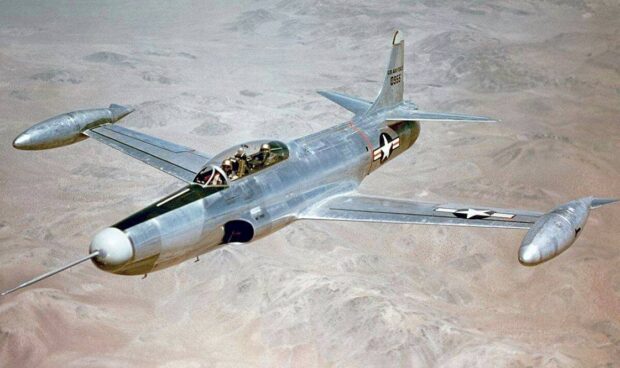
The Lockheed F-94 Starfire was built to solve a terrifying Cold War problem: enemy aircraft were attacking at night, when American pilots could barely see what they were hunting. Equipped with radar, an afterburner, and a dedicated radar operator, the F-94 became one of America’s most advanced interceptors.
Yet when it arrived in Korea, crews were initially forbidden from chasing enemy aircraft across the front because Washington feared its secret radar technology could fall into Soviet hands.
When those restrictions finally loosened, the Starfire proved what radar-guided night fighting could do. In January 1953, Captain Ben Fithian and Lieutenant Sam Lyons intercepted a La-9 in total darkness and are believed to have become the first crew to shoot down an aircraft without ever seeing their target before it was hit.
But the F-94 soon encountered an enemy it was almost too advanced to fight: the primitive Po-2 biplane. The tiny wood-and-fabric aircraft flew so slowly that Starfires repeatedly overshot it, with one F-94 stalling into the sea while trying to stay behind a target at just 110 mph and another colliding directly with a Po-2 during an attack.
Lockheed responded with the rocket-armed F-94C, only to discover that firing its own rockets could blind the crew with smoke and even choke out the engine. Back in America, Starfires were even scrambled during the mysterious 1952 Washington, D.C. UFO incidents, chasing radar contacts and strange lights that were ultimately logged as unknowns.
This is the strange story of an interceptor that pioneered the technologies that would define future American air defence, yet spent much of its short career battling enemies, and sometimes its own systems, that its designers had never anticipated.
The Lockheed F-94 Starfire is a first-generation jet-powered all-weather day/night interceptor aircraft designed and produced by Lockheed Corporation. Put into production in 1949, it was the first operational United States Air Force (USAF) fighter equipped with an afterburner as well as being the first jet-powered all-weather fighter to enter combat during the Korean War.
The F-94 was developed to fulfil a specification issued by the USAF in 1948, seeking a new interceptor capable of day and night operations to replace its piston-engined types in light of recent military advances made by the Soviet Union. The F-94 was derived from the successful Lockheed T-33 Shooting Star trainer; being a relatively simple conversion from an established aircraft led to USAF officials viewing it as a low-risk option and opting to procure the type.
Maintaining a high level of parts commonality with the preceding aircraft, the majority of the F-94’s external changes were related to the adoption of a larger nose that accommodated multiple guns, radar, and an automatic fire-control system. Engine thrust was also bolstered by adding an afterburner to the Allison J33 powerplant used.
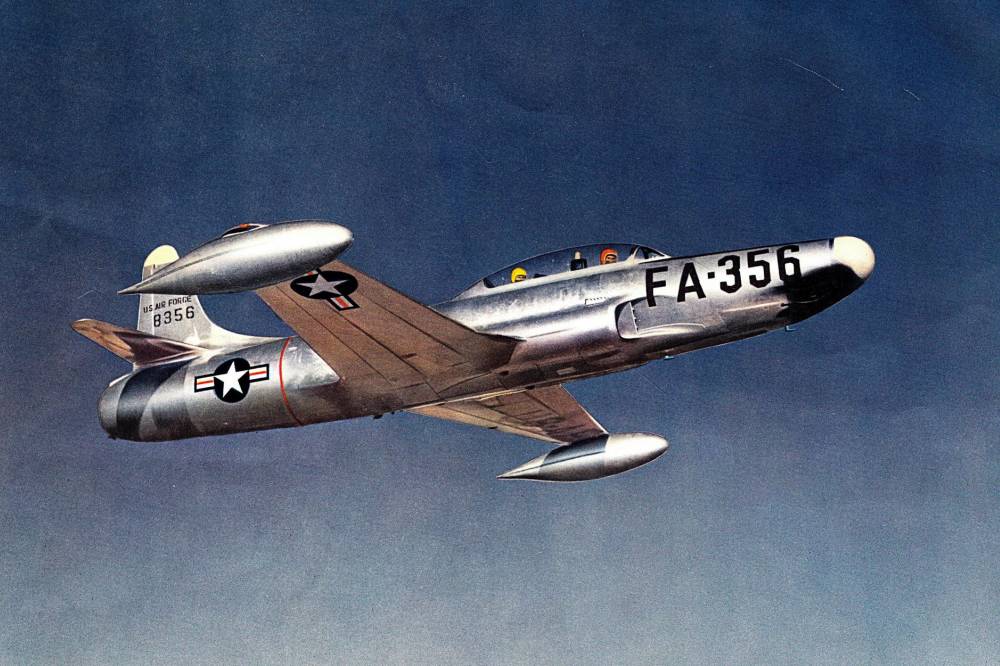
Lockheed YF-94A All Weather Interceptor prototype 48-0356 FA-356 April 1949
On 16 April 1949, the prototype YF-94 conducted its maiden flight. While teething problems were encountered, these were overcome relatively quickly. During May 1950, the F-94A reached operational service with Air Defense Command (ADC), its principal operator, where the type soon replaced the piston-engined North American F-82 Twin Mustang in the all-weather interceptor role.
It was soon followed by the F-94B, a refined model that proved to have greater engine reliability and a more spacious cockpit; the F-94C equipped with a thinner wing, a more powerful Pratt & Whitney J48 engine, and a new Hughes E-5 fire-control system also followed. Further models, including a dedicated aerial reconnaissance variant, were proposed but ultimately not pursued.
In the interceptor role, the F-94 proved to have less endurance and greater reliance upon Ground Control Interception methods than some of its piston-engined predecessors. Beyond its use by ADC, it was also operated by the Far East Air Force, which used the type against various Soviet-supplied aircraft during the Korean War of the early 1950s. The Alaskan Air Command (AAC) and the Air National Guard (ANG) also operated the F-94.
It had a relatively brief operational life, the replacement process commencing in the mid-1950s in favour of more advanced fighters such as the Northrop F-89 Scorpion and North American F-86D Sabre. The last aircraft was withdrawn from USAF service in 1958, while the ANG opted to retire its F-94s only one year later.
Top Photo: Lockheed YF-97 Starfire
Sources: YouTube; Wikipedia