
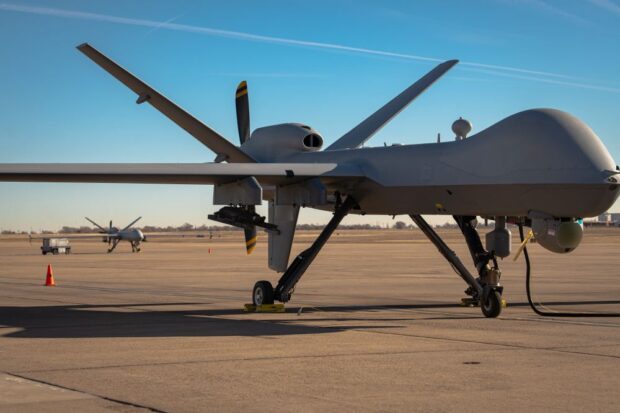
The Pentagon is seeking a new hunter-killer drone similar to the MQ-9A Reaper that can be produced in high numbers at low costs within five years, according to a Defense Innovation Unit notice that comes after the US Reaper fleet suffered dozens of combat losses in the month-and-a-half war against Iran.
Problem Statement
The Joint Force’s reliance on low-density, high-value “exquisite” (>$30 million) manned and unmanned aircraft is unsustainable against adversaries utilizing layered defenses enabled by increasingly low-cost antiaircraft capabilities. This drives the Joint Force into unacceptable compromises: either operate safely outside a threat zone – negatively impacting mission effectiveness, or maneuver inside a threat engagement zone with increased levels of attrition.
To operate effectively, we must accept this inevitable attrition, and deploy larger numbers of less-expensive unmanned platforms, designing them from the start with the expectation that some will be lost in combat.
Desired Solution
The Joint Force seeks a cost-effective, theater-range, massed, and modular Unmanned Aerial System (UAS) to provide a flexible, operationally-responsive, risk-tolerant option in the air domain. The ability to employ many aircraft at once ensures a persistent overwhelming credible threat despite inevitable attrition. Massed modular aircraft (MMA) are envisioned as in-theater reconfigurable platforms capable of long-range payload delivery. Crucially, MMA must retain the ability to be outfitted with a variety of payloads, including Full Motion Video (FMV) sensors, to execute missions that the MQ-9A performs today.
By deploying large groups of risk-tolerant MMA, the Joint Force can overwhelm enemy defences even while experiencing numerous MMA losses.
Keeping a constant airborne MMA presence to launch weapons, gather intelligence, perform electronic warfare missions, or relay communications will force an adversary to stay on the defensive. This relentless pressure will exhaust the adversary, forcing them to burn through expensive anti-aircraft missiles and resources faster than they can be replaced.
The following attributes represent an ideal solution, although many of these attributes exist in the trade space.
Primary Attributes Sought
- Risk Tolerance: Designed for affordable, high-rate manufacture, and minimized total ownership cost
- Sufficient Munition and Sensor Payload Capacity: Payload capacity of at least 2800 lbs
- Meaningful Range: Unrefueled combat radius of at least 2300 nautical miles while carrying payload and ability to self-deploy one-way at least 8,000 nautical miles
- Maximum Interoperability, and Integration: Capable of rapid integration and upgrades via exploitation of the following Modular Open Systems Approach (MOSA) tenets: a) Government Reference Architectures; b) Model Based Systems Engineering; c) formal methods-based software verification
Secondary Attributes Sought
- Autonomy for Control: a one-to-many operator-to-UAS control ratio
- Sufficiently Resilient and Integrated Communications: Hybrid SATCOM/mesh network connecting to Department of the Air Force-Battle Network (DAF-BN); execution of local airfield operations (taxi, takeoff, landing, and divert) under highly degraded or denied primary C2/SATCOM conditions
- Tactically Relevant: At least 200 knots true airspeed; operation from 6,000-foot runway or shorter, semi-improved or prepared
- Sufficient SWaP-C: Sufficient available size, weight, power (25kW), and cooling (5kW) to host a variety of internal and/or external payloads. Enables rapid payload exchange
Capable of full-scale prototype flight testing within 21 months of award, with a targeted Initial Operating Capability (IOC) in FY2031. IOC for MMA is envisioned as 20 mission-ready aircraft delivered to an operational unit, able to be deployed.
Phase 2 Guidance
Companies selected for Phase 2 should expect to deliver a virtual or in-person pitch, and will receive amplifying information with expanded detail to help inform their Phase 2 pitches. As part of a Phase 2 questionnaire, vendors will be expected to provide their Rough Order of Magnitude breakdown to arrive at their proposed design performance and manufacturability tradeoffs. The company’s Phase 2 pitch shall address the Phase 2 evaluation factors contained in CSO HQ0845-20-S-C001 & HQ0034-20-9-DIU, Amendment 0001.
DoW requires companies without a CAGE code to register in SAM (https://sam.gov/SAM/) if selected for agreement award. The Government recommends that prospective companies begin this process as early as possible.
Eligibility Requirements
This solicitation is open to U.S. and international vendors. Vendors are reminded that in order to utilize an Other Transaction agreement, the requirements of 10 USC 4022 must be satisfied. Specifically, reference 10 USC 4022(d), which requires at least one (1) of the following:
1. There is at least one nontraditional defence contractor or nonprofit research institution participating to a significant extent in the prototype project;
2. All significant participants in the transaction other than the Federal Government are small businesses (including small businesses participating in a program described under section 9 of the Small Business Act (15 U.S.C. 638)) or nontraditional defence contractors; or
3. At least one third of the total cost of the prototype project is to be paid out of funds provided by sources other than the Federal Government.
Awarding Instrument
This solicitation will be awarded in accordance with the Commercial Solutions Opening (CSO) process detailed within HQ0845-20-S-C001, posted to SAM.gov on 13 January 2020, updated 13 March 2026.
Source: Defense Innovation Unit