
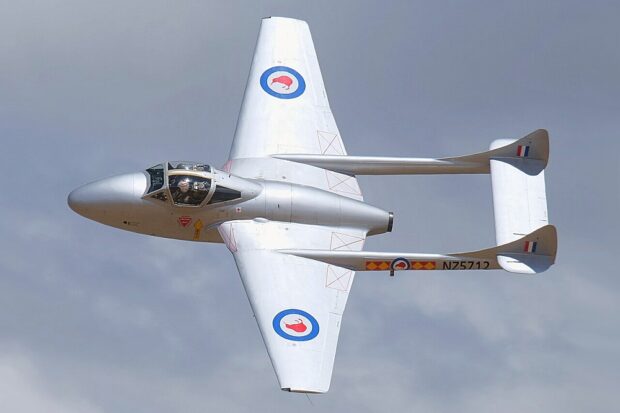
By the time the de Havilland Vampire finally took to the skies in 1945, Nazi Germany was collapsing, and the jet would never fire a shot in the conflict it was designed for. But what came next changed everything.
Unlike earlier jet experiments, the Vampire proved that a single-engine jet fighter could actually work in combat. Compact, fast, and surprisingly agile, it delivered speeds over 500 miles per hour while remaining easier to build and maintain than its rivals. Pilots quickly realized they were flying something different.
The aircraft could turn tightly, climb aggressively, and perform maneuvers that felt closer to future jet fighters than anything from the war it had just missed. Then it went further.
The Vampire became the first jet to successfully operate from an aircraft carrier, opening the door to naval jet aviation. Soon after, it spread across the world, equipping more than 30 air forces and helping an entire generation of pilots transition into the jet age.
It never fought in World War II. But by the time it disappeared, it had quietly shaped the future of air combat.
The de Havilland DH100 Vampire is a British jet fighter developed and manufactured by the de Havilland Aircraft Company. It was the second jet fighter to be operated by the Royal Air Force (RAF), after the Gloster Meteor, and the first to be powered by a single jet engine.
Development of the Vampire as an experimental aircraft began in 1941 during the Second World War, to exploit the revolutionary innovation of jet propulsion. From the company’s design studies, de Havilland decided to use a single-engined, twin-boom aircraft, powered by the Halford H.1 turbojet (later produced as the Goblin). Aside from its propulsion system and twin-boom configuration, it was a relatively conventional aircraft. In May 1944, de Havilland decided to produce the aircraft as an interceptor for the RAF. In 1946, the Vampire entered operational service with the RAF, only months after the war had ended.
The Vampire quickly proved to be effective and was adopted as a replacement of wartime piston-engined fighter aircraft. During its early service, it accomplished several aviation firsts and achieved various records, such as being the first jet aircraft to cross the Atlantic Ocean.
The Vampire remained in front-line RAF service until 1953, when its transfer began to secondary roles such as ground attack and pilot training, for which specialist variants were produced. The RAF retired the Vampire in 1966, when its final role of advanced trainer was filled by the Folland Gnat. The Royal Navy had also adapted the type as the Sea Vampire, a navy-adapted variant suitable for operations from aircraft carriers. It was the service’s first jet fighter.
The Vampire was exported to many nations and was operated worldwide in numerous theatres and climates. Several countries used the type in combat including the Suez Crisis, the Malayan Emergency, and the Rhodesian Bush War.
By the end of production, almost 3,300 Vampires had been manufactured, a quarter of these having been manufactured under licence abroad. De Havilland pursued the further development of the type; major derivatives produced include the DH.115, a specialised, dual-seat trainer and the more advanced DH.112 Venom, a refined variant for ground-attack and night-fighter operations.
Sources: YouTube; Wikipedia
Someone on another forum pointed out that these original engines had long lives. The centrifugal compressor design was aerodynamically bulky, but put far less thermal stress on the turbine components that the slimmer, axial flow designs from Germany.