
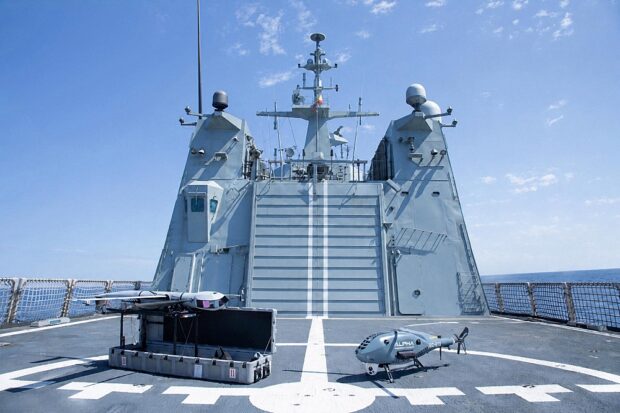
Airbus Helicopters and the Spanish Navy successfully completed a tactical flight trial earlier this month in Rota, Spain. The exercise integrated the offshore patrol vessel Rayo with a Spanish Navy H135 helicopter and two different unmanned aerial systems, the Airbus Flexrotor and Alpha Unmanned Systems´ A900 using the HTeaming solution.
The exercise validated the real-time control of the drone and sharing of imagery between unmanned systems, helicopters, and naval vessels to establish a multi-domain operational link. This capability allows the ship to access critical information from areas far beyond its own sensor range directly at the combat station.
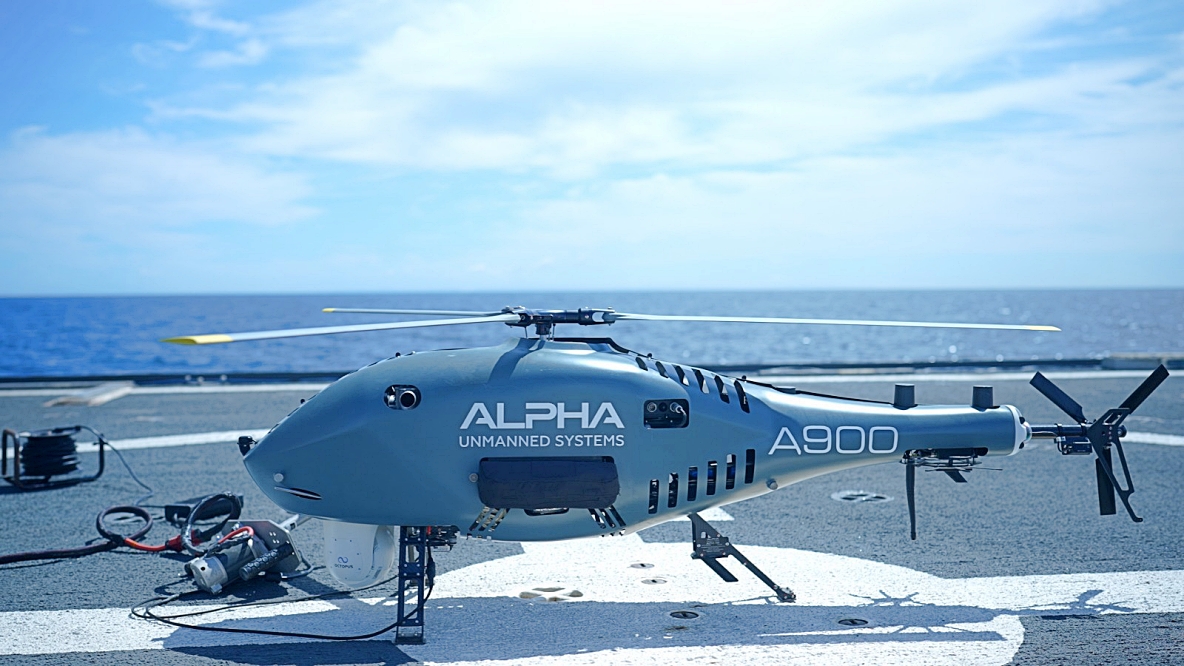
Alpha Unmanned Systems´ A900
During the trials, both unmanned platforms performed take-offs and landings from the moving vessel. A pilot inside the H135 managed the drones during flight using the HTeaming tablet, which proved to be agnostic by successfully integrating the Alpha Unmanned Systems´ A900 . The demonstration consisted of a simulated high-speed boat chase during an ISTAR maritime operation, where the Flexrotor and Alpha 900 tracked the target and transmitted live footage to both the helicopter and the ship.
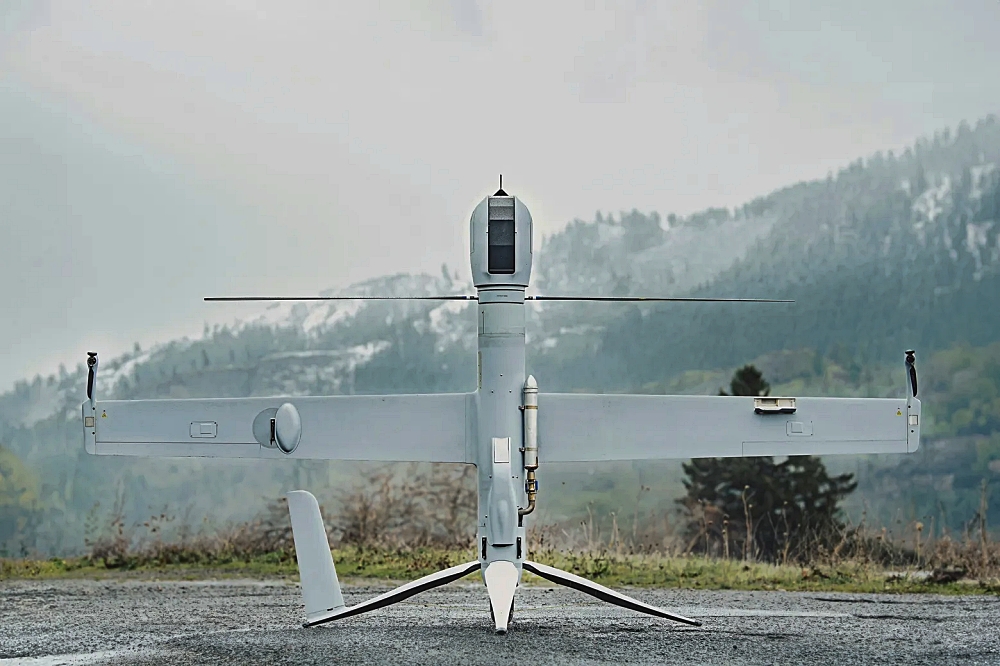
Airbus Flexrotor
The data was integrated into NAIAD (Naval Advanced Integrated Autonomous Vehicles Defence system), Navantia’s tactical integration system for unmanned vehicles, enabling command, control and interoperability of aerial, surface and underwater systems within SCOMBA, the Spanish Navy’s combat management system developed by Navantia.
“Airbus Helicopters is committed to exploring new frontiers in manned-unmanned teaming that brings real added value to customers,”
said Fernando Lombo, Managing Director of Airbus Helicopters in Spain.
“The close collaboration between pioneering companies such as Airbus, Navantia, and Alpha Unmanned Systems, combined with the trust of public entities like the Spanish Navy, shows our shared potential to strengthen Europe’s role as a sovereign leader in defence. By working together, we are proving that we can deliver the innovative technology necessary to secure a leading position on the global stage.”
The H135 crew managed the unmanned platforms using the HTeaming tablet, Airbus Helicopters’ modular manned-unmanned teaming solution. This system empowers crews with full control over UAS in flight, allowing for the integration of unmanned sensors into manned operations to improve mission efficiency. In parallel, data from the UAS was processed through the Helicopter Integrated Tactical System, a tactical console developed by Airbus that acted as a bridge to the vessel. This ensured the information was compatible with the NAIAD/SCOMBA combat system.
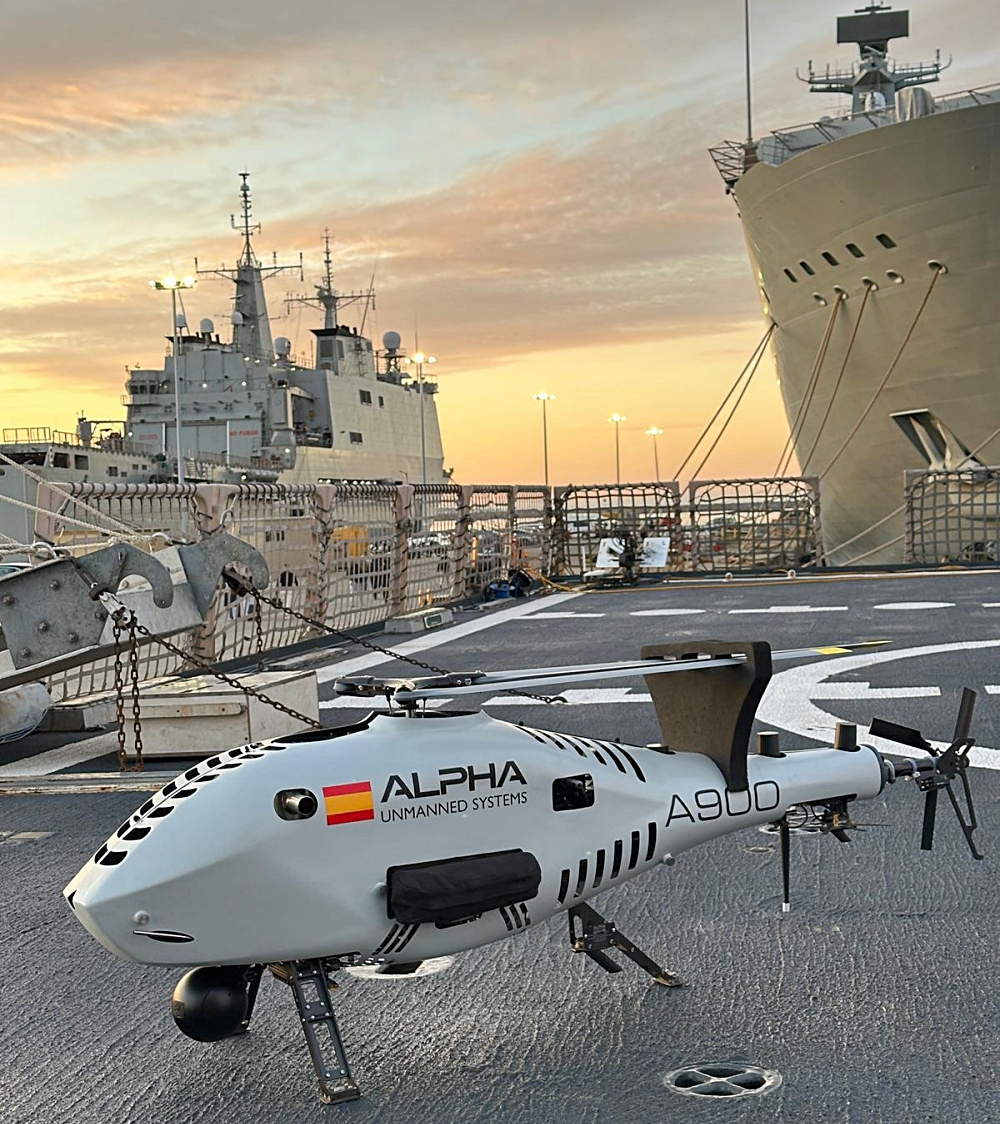
Control of the A900 unmanned helicopter and data transmission were supported by Alpha’s in-house designed Vessel-based Control Station, a fully-mobile UAV control system featuring a gyrostabilised tracking antenna, purpose-built for operations at sea.
This marks the second time Alpha Unmanned Systems has conducted Manned-Unmanned teaming with Airbus Helicopters (Foro de Toledo 2024) and the third time Alpha Unmanned Systems has conducted flight missions aboard Spanish Navy BAM vessels, following previous deployments during the RepMus and Dynamic Messenger NATO exercises.
Eric Freeman, CEO of Alpha Unmanned Systems, commented:
I am very pleased that our A900 UAV helicopter performed flawlessly in a real operational scenario of manned-unmanned teaming at sea. The future of maritime aerial surveillance depends on the interoperability of systems. The effective combination of manned and unmanned assets, where unmanned platforms like the A900 can act as a lower cost, more versatile force multiplier, enhance awareness and reduce aircrew risk.
The flight demonstration was attended by senior officials from the Spanish Navy,
the Guardia Civil’s Servicio Aéreo Unit, and international navy personnel.
Future developments will continue to build on this success by exploring drone swarm technology and further enhancing the integration between air and sea assets, as well as land transport.
Source: Airbus