
In the early Cold War, one strange American jet bomber was sent into places it was never supposed to be.
The North American B-45 Tornado was already outdated by the time it entered service. Its straight wings made it slower than the swept-wing jets arriving around it, and only 142 were built. But behind its odd greenhouse canopy and obsolete design was one of the most secret careers of any Cold War aircraft.
In Korea, the RB-45C reconnaissance variant flew dangerous missions over MiG Alley, where Soviet-built MiG-15s hunted anything that crossed the Yalu River. One Tornado became the first jet bomber ever shot down by a jet fighter. Another later escaped MiGs over Manchuria by pushing past 570 miles per hour in the dark.
Then came its most secret mission.
In 1952, American RB-45Cs were stripped of every US marking, painted with RAF roundels, and flown from Britain deep into Soviet airspace under Operation Jiu Jitsu. Officially, the aircraft belonged to nobody. If one crashed, Washington could deny it was American, while London could deny ever operating the type.
Their mission was to photograph Soviet bomber bases and radar targets for NATO’s nuclear war plans. The same aircraft family would also become the first jet bomber to drop a live nuclear weapon, and modified B-45As would form America’s first permanent nuclear-armed jet bomber force in Europe.
This is the story of the forgotten bomber that flew into Russia under another country’s flag, hunted down cities that never officially existed, and disappeared from history almost as quietly as it served.
The North American B-45 Tornado is an early American jet bomber designed and manufactured by aircraft company North American Aviation. It has the distinction of being the first operational jet bomber to enter service with the United States Air Force (USAF), as well as the first multiengine jet bomber to be refueled in midair.
The B-45 originated from a wartime initiative launched by the U.S. War Department, which sought a company to develop a jet-propelled bomber to equal those being fielded by Nazi Germany, such as the Arado Ar 234. Following a competitive review of the submissions, the War Department issued a contract to North American to develop its NA-130 proposal; on 8 September 1944, work commenced on the assembly of three prototypes.
Progress on the program was stalled by post-war cutbacks in defence expenditure but regained importance due to growing tensions between America and the Soviet Union. On 2 January 1947, North American received a production contract for the bomber, designated B-45A, from the USAF. On 24 February 1947, the prototype performed its maiden flight.
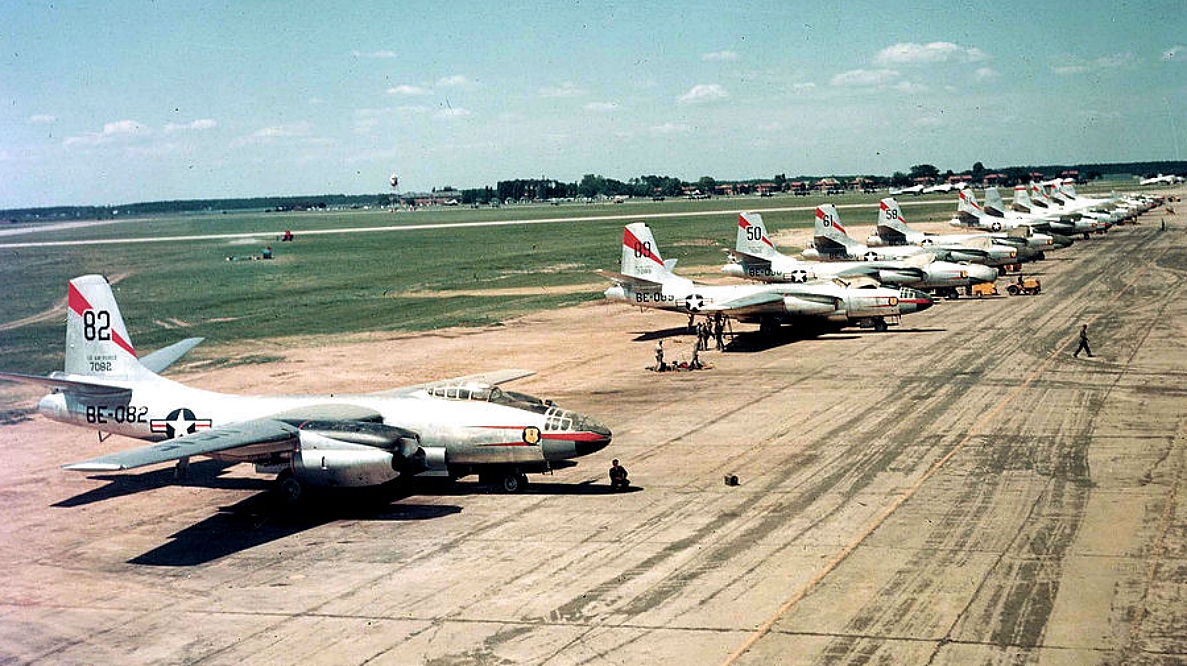
Flightline photo of B-45A-5-NA Tornadoes of the 47th Light Bomb Wing, Langley Air Force Base, Va., before transatlantic flight to Sculthorpe, England, in July 1952
Soon after its entry to service on 22 April 1948, B-45 operations were troubled by technical problems, in particular poor engine reliability. The USAF found the plane to be useful during the Korean War performing both conventional bombing and aerial reconnaissance missions. On 4 December 1950, the first successful interception of a jet bomber by a jet fighter occurred when a B-45 was shot down by a Soviet-built MiG-15 inside Chinese airspace. During the early 1950s, 40 B-45s were extensively modified so that they could be equipped with nuclear weapons. Improvements were made to their defensive systems and the fuel tankage was expanded to increase their survivability and range.
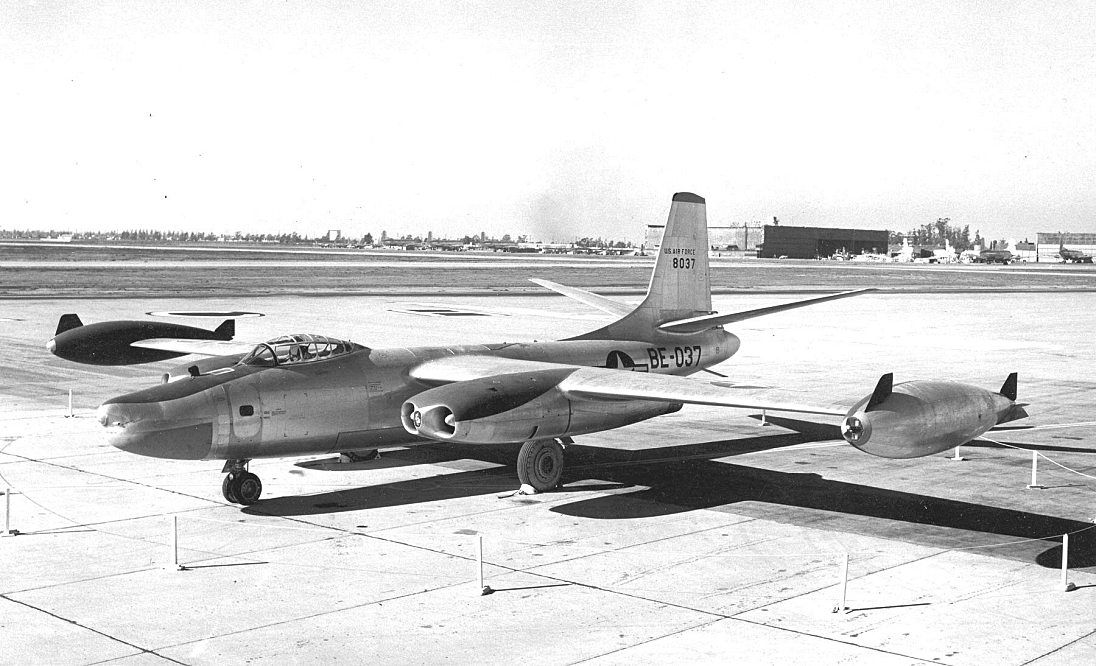
North American RB-45C
In its heyday, the B-45 was important to United States defence strategy, performing the strategically critical deterrence mission for several years during the early 1950s, after which the Tornado was superseded by the larger and more capable Boeing B-47 Stratojet.
Both B-45 bombers and reconnaissance RB-45s served in the USAF’s Strategic Air Command from 1950 until 1959, when the USAF withdrew the last ones in favour of the Convair B-58 Hustler, an early supersonic bomber.
The Tornado was also adopted by the Royal Air Force (RAF) and operated from bases in United Kingdom, where it was used to overfly the Soviet Union on intelligence-related missions. Despite being painted with RAF markings and flown by RAF crew, they did not belong to the RAF; the RAF merely operated them on behalf of the United States.
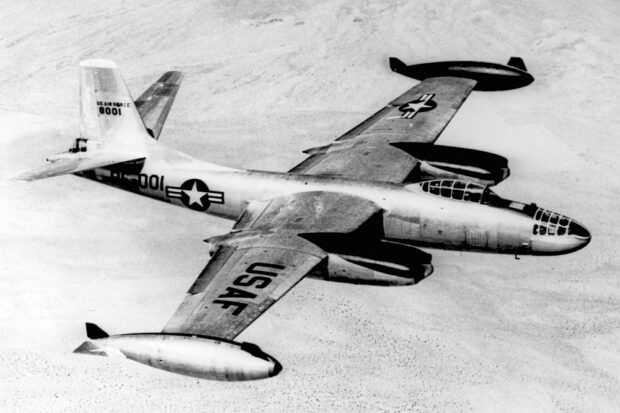
Top Photo: A USAF B-45C Tornado in flight
Sources: YouTube; Wikipedia