
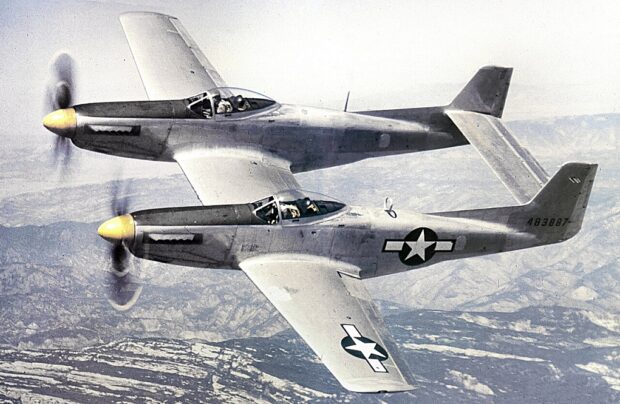
It looked like something that should not have worked: two full-length Mustang fuselages, two cockpits, two Allison piston engines, and one massive wing tying it all together. But when the Korean War erupted in June 1950, the strange-looking F-82 Twin Mustang became exactly the aircraft America needed.
Built too late for World War II and already considered obsolete in the jet age, the F-82 suddenly found itself thrown into the first desperate days of the Korean War. Jets like the F-80 Shooting Star were fast, but they could only stay over Korea for minutes before returning to Japan. The Twin Mustang could stay for hours.This is the story of how America’s last piston-engine fighter covered the evacuation of Seoul, protected C-54 transports at Kimpo Airfield, fought the first American aerial battle since World War II, and helped score the first U.S. aerial victories of the Korean War.
The North American F-82 Twin Mustang is an American long-range escort fighter. Based on the North American P-51 Mustang, the F-82 was designed as an escort for the Boeing B-29 Superfortress in World War II, but the war ended well before the first production units were operational. The F-82 was the last American piston-engined fighter ordered into production by the United States Air Force.
In the postwar era, Strategic Air Command used the aircraft as a long-range escort fighter. Radar-equipped F-82s were used extensively by the Air Defense Command as replacements for the Northrop P-61 Black Widow as all-weather day/night interceptors. During the Korean War, Japan-based F-82s were among the first USAF aircraft to operate over Korea. The first three North Korean aircraft destroyed by U.S. forces were shot down by F-82s, the first being a North Korean Yak-11 downed over Gimpo Airfield by the USAF 68th Fighter Squadron.
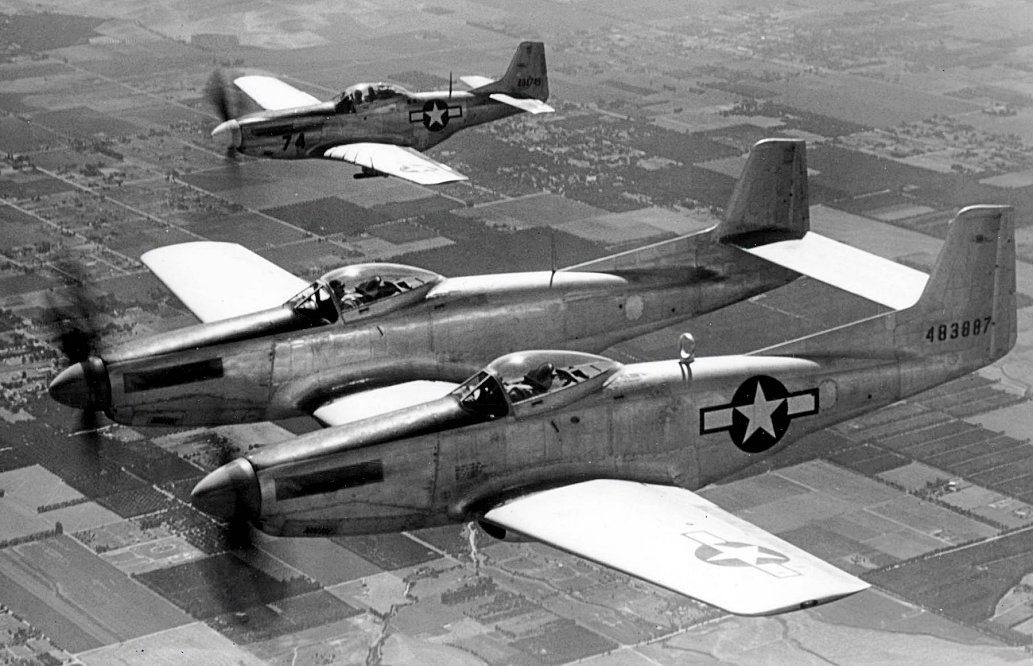
North American F-82 (S/N 44-83887) in flight with North American P-51D (S/N 44-84745)
Initially intended as a very long-range (VLR) escort fighter, the F-82 was designed to escort Boeing B-29 Superfortress bombers on missions exceeding 2,000 mi (3,200 km) from the Solomon Islands or Philippines to Tokyo, missions beyond the range of the Lockheed P-38 Lightning and conventional P-51 Mustangs. Such missions were part of the planned U.S. invasion of the Japanese home islands, which was forestalled by the surrender of Japan after the atomic bombings of Hiroshima and Nagasaki and the opening of Soviet attacks on Japanese-held territory in Manchuria.
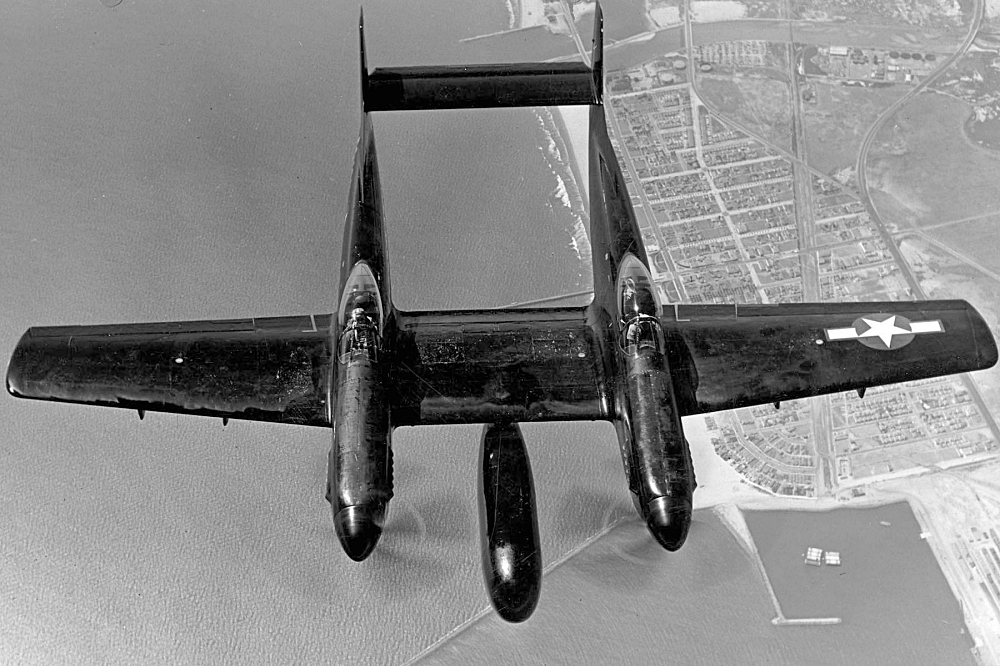
P-82C in black night fighter motif. Note the large pod that carries the radar array under the wing
The Twin Mustang had a very short operational life. About two years after its introduction to SAC, the F-82E was phased out of service in favor of the jet-powered Republic F-84E Thunderjet for bomber escort duties beginning in February 1950; the F-82Es were declared surplus by the end of the summer. Some were modified into F-82Gs and sent to Korea for combat as replacement aircraft, others were converted to F-82Hs and sent to Alaska, but most were sent to storage at Robins AFB, Georgia and ultimately reclamation.
Top Photo: North American XP-82 Twin Mustang 44-83887 on test flight over Sierras, 1945.
Sources: YouTube; Wikipedia