
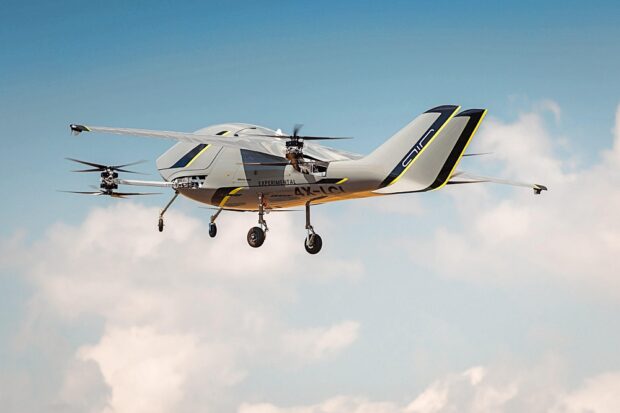
AIR, a manufacturer and developer of smart aircraft, announced the successful first flight of its Production AIR Cargo-Heavy Lift UAS, representing one of the world’s largest VTOL-capable unmanned platforms and a significant step forward in autonomous heavy-lift aviation.
With a payload capacity of approximately 550 lbs., and over 25 units ordered and paid for, the aircraft is purpose-built for demanding logistics missions across a range of environments and sectors, including remote resupply, contested logistics, maritime operations, humanitarian aid, and commercial cargo delivery.
Unlike early-stage proof-of-concept systems, the Production AIR Cargo-Heavy Lift UAS has reached this flight milestone as a mission-ready platform.
It is the product of more than two years of operational development, hundreds of flights, and direct customer feedback from deployments in real-world conditions.
That process shaped an aircraft built to perform consistently across dust, darkness, and sustained mission cycles, not just controlled demonstrations.
“This flight milestone reflects what AIR has been building toward,” said Rani Plaut, CEO and co-founder, AIR. “We’ve spent two years refining this aircraft against real operational demands, not benchmarks or simulations. Delivering that now, at this scale, is what we set out to do.”
Built for high volume mass production, the production platform features next-generation motors, an advanced aircraft battery system, and fully matured avionics.
Its enhanced autonomy and flight logic enable more reliable, repeatable mission execution with reduced reliance on human intervention, a critical capability as operators across sectors look to scale unmanned logistics safely and efficiently.
“This next-generation configuration taking flight is the culmination of years of engineering iteration and direct operational learning,”
said Chen Rosen, CTO and co-founder, AIR.
“Every design decision, from the motors to the flight logic, was stress-tested against what operators actually encounter in the field. The result is an aircraft built not just to fly, but to work.”
The platform’s dual-use architecture makes it equally relevant for defense and commercial operators. In defence contexts, it addresses a growing need for autonomous, flexible logistics in contested and infrastructure-limited environments where traditional supply chains cannot reach.
It is among the only available VTOL aircraft in the high demand “Group 4 UAS” category defined by the U.S. Department of Defense. In commercial and humanitarian contexts, it enables mid-mile delivery, maritime resupply, and rapid aid deployment in remote or infrastructure-limited areas.
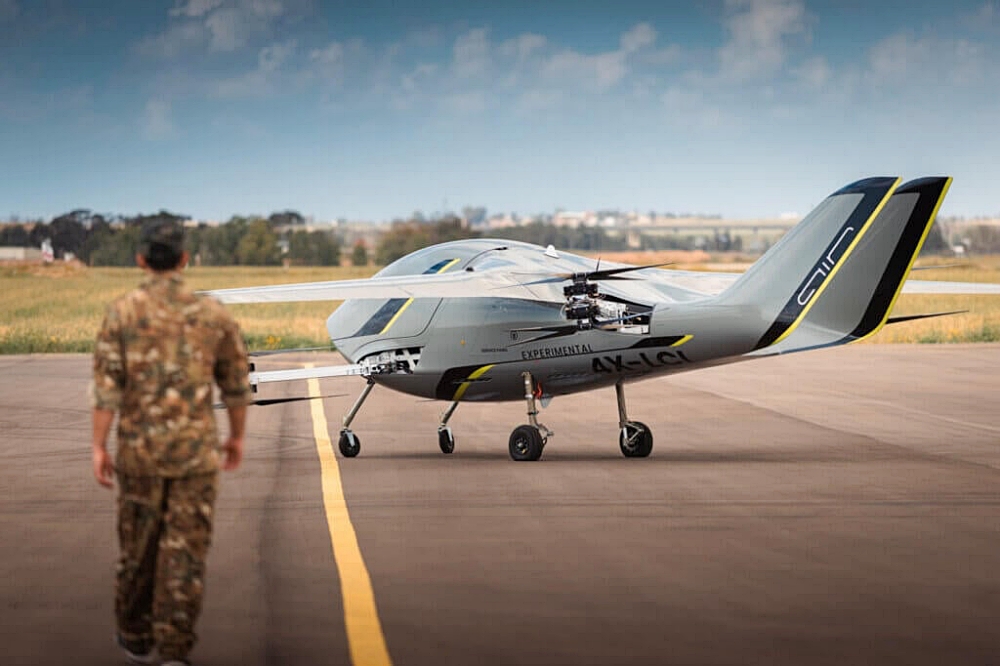
Aircraft Highlights:
- Payload capacity: ~550 lbs.
- Cargo Bay: 70 cu. ft.
- One of the world’s largest VTOL-capable unmanned aircraft
- Group 4 UAS
- Mission-ready: engineered for operational deployment, not demonstration
- Built from the ground up with next-generation motors, advanced battery systems, and fully matured avionics
- Enhanced autonomy and flight logic for consistent, scalable mission execution
- Dual-use platform: defence logistics, commercial cargo, humanitarian aid, maritime resupply
Source: AIR
Why This Matters:
The successful first flight of AIR’s Cargo-Heavy Lift UAS signals a major shift in how logistics—both military and civilian—can be conducted in difficult environments. By combining vertical takeoff and landing (VTOL) capability with a substantial payload capacity, AIR is addressing one of the most persistent challenges in modern operations: delivering supplies reliably where infrastructure is limited or contested.
In defence contexts, this platform directly supports the growing need for distributed, resilient logistics. Traditional supply lines are increasingly vulnerable to disruption, especially in high-intensity conflicts. Autonomous heavy-lift drones enable resupply without exposing personnel to risk, while their ability to operate in austere conditions enhances operational flexibility. Being positioned within the “Group 4 UAS” category also places it in a relatively underserved niche between small drones and large crewed aircraft.
Commercially, the implications are equally significant. The ability to move mid-weight cargo without relying on runways opens new possibilities for remote industry, maritime operations, and humanitarian response. Faster, repeatable delivery cycles could transform supply chains in regions where access is inconsistent.
Ultimately, this milestone reflects a broader trend: unmanned systems are moving beyond surveillance into scalable, mission-critical logistics—reshaping how goods and resources are delivered across both conflict zones and civilian sectors.