
With orders for the twin-rotor helicopter still rolling in, Boeing has provided details on its future plans for the venerable H-47 Chinook, including adding launched effects and creating a path toward a unmanned version of the aircraft.
The latter would offer an unprecedented vertical-lift capability, and one that could be of great interest to the U.S. Army and other operators.
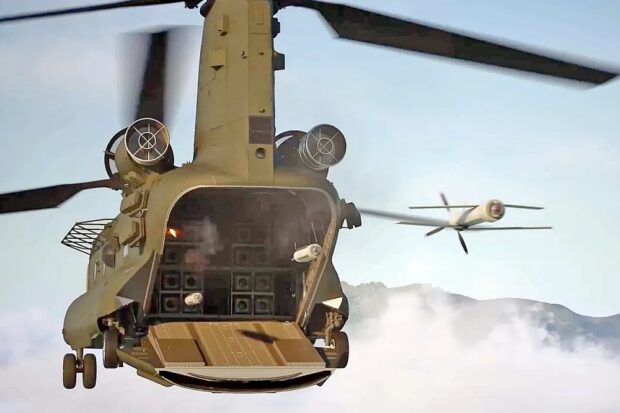
At the recent Army Aviation Association of America’s Army Aviation Warfighting Summit in Nashville, Tennessee, Boeing released a computer-generated promotional video showing launched effects being delivered from the rear ramp of a Chinook.
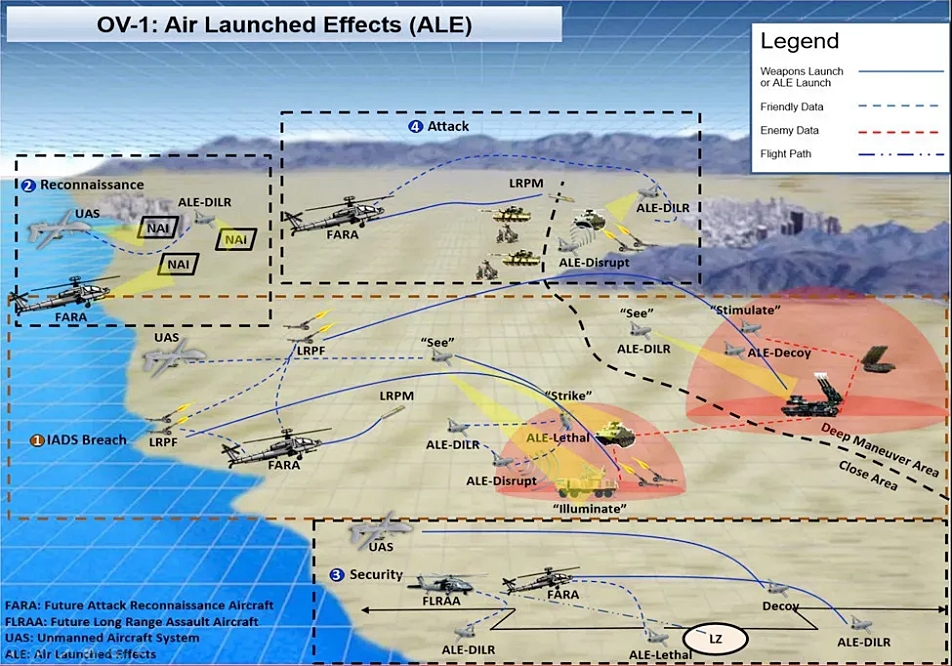
Launched effects, previously referred to as air-launched effects (ALEs), describe a category of various unmanned systems. The new launched effects terminology reflects the fact that they might be launched from land or maritime platforms, as well as manned and unmanned aircraft. Launched effects drones include types that operate as scouts, electronic attackers, decoys, and suicide drones. They are typically highly autonomous, operating independently or in more complex networked swarms.
When it comes to the Chinook, Boeing confirms that launched effects are yet to be tested from the helicopter, but the company is working toward that goal.
Kathleen Jolivette, the Vice President and General Manager for Boeing’s Vertical Lift division, said that the company is investing its own funds in the initiative and is currently looking at how rapidly it might be able to move into the demonstration phase, based on expected U.S. Army and international interest.
It’s worth noting, meanwhile, that Boeing and the Army are already pushing ahead on launched effects demonstrations from the AH-64 Apache attack helicopter, including recently announced trials with Anduril’s ALTIUS-700 Unmanned Aircraft System (UAS) launched from an AH-64E. The Army says that this program progressed from a requirement to a live demonstration in less than six months.
With its capacious hold, the Chinook would be able to accommodate huge numbers of launched effects, allowing multiple missions to be fulfilled over an extended period, especially when compared with other helicopters that typically launch these drones from externally mounted tubes.
Same two rotors. More capability.
We’re pushing Chinook Block II even further.#26Summit pic.twitter.com/FK2zandPmx
— Boeing Defense (@BoeingDefense) April 14, 2026
The Chinook would also be much better able to handle larger launched effects. In the past, the Army has issued descriptions of ‘large’ drones in this category. These are envisaged as having a combat range of up to 350 kilometers (217 miles) and a total flight time of 30 minutes. However, there has also been an aspiration to increase those performance specifications to up to 650 kilometers (404 miles) and an hour of total time in the air. These would weigh up to 225 pounds each, compared to around 25 pounds for an ALTIUS-600, for example.
There is a possibility that Chinooks, specifically special operations MH-47Gs, are already using some kind of launched effects. As we discussed at the time, there is strong evidence that the U.S. military may have used kamikaze drones during the operation to capture Venezuelan dictator Nicolas Maduro earlier this year. Whatever the case, launched effects are increasingly key to the survival of rotary-wing aviation going forward.
As well as launched effects, Boeing is pushing ahead with work on what it calls an optimally manned Chinook, reflecting U.S. Army terminology. As far as we understand it, the terms optimally manned and optionally manned appear to be interchangeable, although the former could also include reduced-crew flying with the help of an AI copilot. Boeing also pushed us toward an Army press release for the H-60Mx Black Hawk helicopter, described as an optimally piloted vehicle and extensively modified to fly with or without a pilot at the controls.
Heather McBryan, the Vice President and H-47 Program Manager at Boeing, said the company is now “working very closely” with the Army in terms of what additional capability it wants to add to future Block II production lots.
According to McBryan, the Army
“publicly stated their desire for what they’re calling an optimally manned aircraft, where they can, in some instances, reduce the workload for pilots, but in other instances, eliminate it completely, and we’ve made a lot of great progress in those efforts.”
McBryan says that this work is also responding to demand from international customers.
As part of this effort, after years of development and post-production modifications, Boeing recently added its Active Parallel Actuator Subsystem (APAS) to the Chinook production line. A hardware and software system, McBryan describes APAS as working “like lane-assist in your vehicle.”
Tested on the special-missions MH-47G for some years now, APAS reduces pilot workload, but also provides additional situational awareness and enables safer maneuvering, especially at the edges of the aircraft’s envelope. For now, APAS is mainly for the MH-47G and for the United Kingdom’s new Chinooks, but McBryan confirms that Boeing is looking at how to bring additional elements of autonomy into the CH-47F as well.
Source: The War Zone