
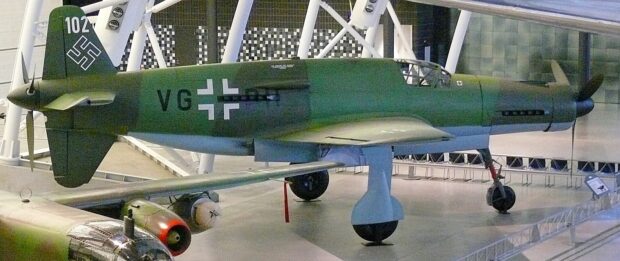
It looked like nothing else in the sky – if you were lucky enough to even catch a glimpse of it. Two engines, nose to tail, one pulling and one pushing – working together to generate enough force to shoot the machine at speeds of 470 miles per hour.
Faster than the world air speed record – even with weapons, fuel, and armour. Any Allied fighter that dared go after it would already be too late.
So fast, in fact, that not even the German Air Ministry could keep up…
The Dornier Do 335 Pfeil (“Arrow”) was a heavy fighter developed by Dornier for Nazi Germany during World War II. Its performance was expected to surpass other twin-engine aircraft due to its unusual push-pull configuration, with one engine at the front and another at the rear. This inline arrangement reduced aerodynamic drag and made it one of the fastest piston-engined aircraft ever built—indeed, the fastest of its type fielded by Germany during the war. Despite its promise, delays—particularly in engine deliveries—meant only a small number were completed, and the aircraft never saw combat.
Originally conceived as a Schnellbomber (fast bomber), the Do 335 could reach speeds of about 800 km/h in level flight, outrunning most contemporary aircraft except early jet fighters.
Design and Development
The concept dated back to World War I, when Claude Dornier experimented with tandem engines in flying boats. This layout reduced drag, kept engine mass near the centerline for improved handling, and avoided asymmetric thrust if one engine failed. The Do 335 also featured a cruciform tail to protect the rear propeller during takeoff.
Because of the rear propeller, the aircraft incorporated advanced safety features, including an ejection seat and explosive bolts to jettison the propeller and tail section before bailout—unusual innovations for the time.
In 1939, Dornier revisited the tandem-engine concept in the high-speed P.59 bomber project. To test it, a small experimental aircraft, the Göppingen Gö 9, was built and flown successfully, demonstrating the feasibility of a rear propeller driven by a long shaft. However, the P.59 was canceled in 1940 under directives to focus on short-term projects.
In 1942, Dornier proposed the P.231, a single-seat high-speed bomber. It won a competition against designs from Arado, Junkers, and Blohm & Voss, receiving official approval as the Do 335. Later that year, the design was reclassified as a multi-role fighter, delaying development.
The first prototype, Do 335 V1, flew on 26 October 1943, powered by two DB 603A engines. While initial tests revealed issues—particularly with the landing gear—the aircraft demonstrated excellent speed and handling. Subsequent prototypes introduced refinements and more powerful engines, including the DB 603G.
By early 1944, the aircraft had accumulated over 60 hours of flight time and earned praise for its performance, reportedly matching the speed and altitude capabilities of the P-38 Lightning while avoiding engine reliability issues.
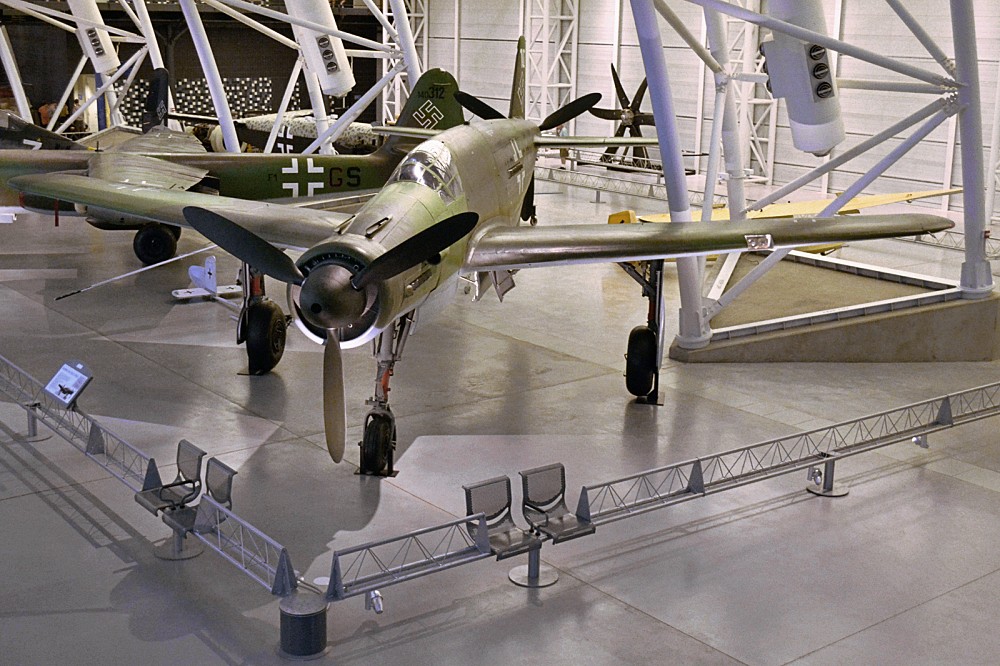
Dornier Do 335 240 102 on display at the Steven F. Udvar-Hazy Center in Chantilly, Virginia
Plans called for large-scale production, with thousands of aircraft scheduled. However, wartime disruptions, including Allied bombing and shifting priorities under the Emergency Fighter Program, slowed progress. Although the Do 335 was given high priority, production facilities were damaged, and competing programs complicated efforts.
At least 16 prototypes flew, along with around 22 pre-production aircraft completed before the war’s end. Some were converted for training, and one example was later tested in the United Kingdom, where it was lost in an accident following an in-flight fire.
Despite its limited production, the Do 335 remains notable for its innovative design and exceptional performance.
Top Photo: Dornier Do 335 Pfeil (Arrow) in the National Air and Space Museum, Steven F. Udvar-Hazy Center, Washington DC.
Sources: YouTube; Wikipedia