
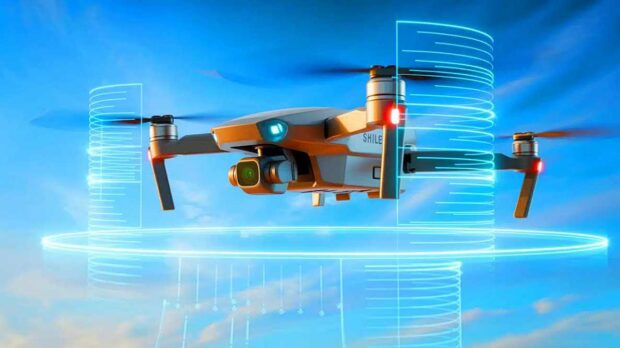
Researchers at the University of Adelaide have begun developing what they describe as a world-first cybersecurity system aimed at protecting drones from increasingly sophisticated cyber threats.
A new study led by the Industrial AI Research Centre and published in the journal Computers and Industrial Engineering outlines an approach to making unmanned aerial systems (UAS) safer and more resilient against hacking, signal disruption and malicious software.
Senior author Professor Javaan Chahl says the research addresses a growing but often overlooked issue: modern drones are essentially flying computers that can be targeted by cyber-attacks.
“Today’s drones are used in warfare, emergency response, infrastructure inspection, agriculture, environmental monitoring, logistics and even medical deliveries,” Chahl says. “They collect large amounts of data, process it onboard, and communicate constantly with operators or cloud-based systems. While this makes drones powerful and versatile, it also creates new vulnerabilities.”
To address this risk, the team developed a new onboard security architecture based on Software-Defined Wide Area Networking (SD-WAN), which acts as an intelligent traffic controller for communications.
Rather than relying on a single connection, the drone can use multiple communication pathways simultaneously—such as mobile networks, Wi-Fi and other radio links—and automatically switch between them if one becomes unreliable or compromised.
First author Tom Scully, a PhD candidate specialising in cybersecurity, says the consequences of a drone cyber-attack can extend beyond digital systems.
“A cyber-attack can interfere with flight controls, disrupt communications, expose sensitive data and potentially cause a physical accident,” he says.
The system also incorporates a next-generation firewall that monitors incoming and outgoing data in real time, blocks suspicious activity and ensures that only authorised communications occur. Unlike conventional approaches, this firewall runs directly on the drone rather than relying on remote infrastructure.
Another key feature is malware sandboxing, which allows suspicious files to be opened and analysed in an isolated environment without risking damage to the system.
The researchers have successfully demonstrated the software on a drone platform using onboard computing hardware connected to cloud-based control systems. Future trials will test the system in real-time conditions, with the goal of supporting secure drone operations across commercial, emergency and government sectors.
Source: Adelaide University