
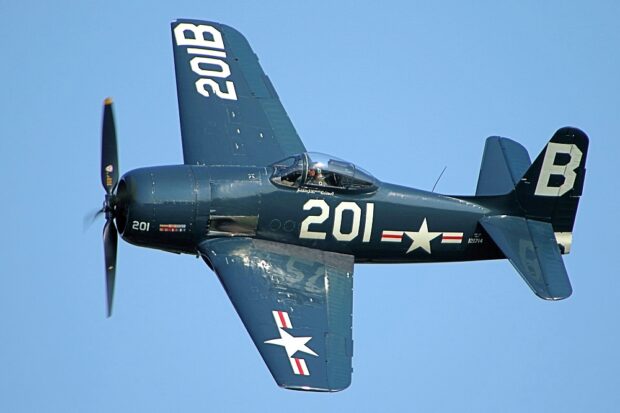
4,000 pounds of airframe. 3,000 pounds of engine. It will reach 424 miles per hour and rocket off a carrier deck at nearly 5,000 feet per minute. By 1943, America is finally smashing its way across the Pacific. But there is still a problem no plane has solved.
From the moment Japanese aircraft appear on radar to the moment they reach an American fleet, there are only minutes. Sometimes less. And the plane that saves a ship isn’t the fastest or the best armed. It’s the one that gets the highest first.
The Grumman F8F Bearcat became America’s answer to a very specific question: how much engine can you actually wrap around a pilot without killing him?
The Grumman F8F Bearcat is an American single-engined, carrier-based, fighter aircraft introduced in late World War II. It served during the mid-20th century in the United States Navy, the United States Marine Corps, and the air forces of other nations. It was Grumman Aircraft’s last piston-engined fighter aircraft. Adapted versions of the Bearcat have broken speed records for piston-engined aircraft. Today, the Bearcat is popular among warbird owners and air racers.
Design and Development
Concept
The Bearcat concept began during a meeting between Battle of Midway veteran F4F Wildcat pilots and Grumman vice president Jake Swirbul at Pearl Harbor on 23 June 1942. At the meeting, Lieutenant Commander Jimmie Thach emphasized one of the most important requirements in a good fighter plane was “climb rate”.
Climb performance is strongly related to the power-to-weight ratio, and is maximized by wrapping the smallest and lightest possible airframe around the most powerful engine. Another goal was that the G-58 (Grumman’s design designation for the aircraft) should be able to operate from escort carriers, which were then limited to the obsolescent F4F Wildcat, as the Grumman F6F Hellcat was too large and heavy. A small, lightweight aircraft would make this possible. After intensively analyzing carrier warfare in the Pacific Theater of Operations for a year and a half, Grumman began development of the G-58 Bearcat in late 1943.
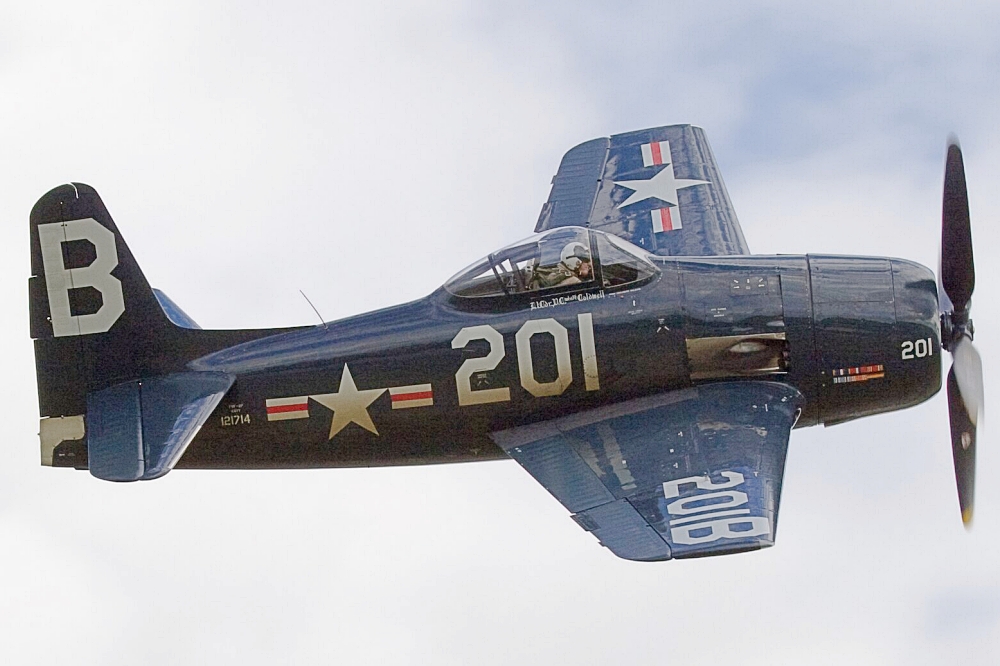
Grumman F8F-2P Bearcat G-RUMM N700HL at Flying Legends, Duxford, UK
Design
The Bearcat was influenced by the larger F6F Hellcat.
In 1943, Grumman was introducing the F6F Hellcat, powered by the Pratt & Whitney R-2800 engine, which provided 2,000 horsepower (1,500 kW). The R-2800 was the most powerful American engine, so it would be retained for the G-58. This meant that improved performance would have to come from a lighter airframe.
To meet this goal, the Bearcat’s fuselage was about 5 ft (1.5 m) shorter than the Hellcat, and was cut down vertically behind the cockpit. This allowed the use of a bubble canopy, the first to be fitted to a US Navy fighter. The vertical stabilizer was the same height as the Hellcat’s, but had an increased aspect ratio, giving it a thinner look. The wingspan was 7 ft (2.1 m) less than the Hellcat’s. Structurally, the fuselage used flush riveting and spot welding, with a heavy-gauge 302W aluminum alloy skin suitable for carrier landings. Armour protection was provided for the pilot, engine, and oil cooler.
Top Photo: Bearcat – Fly Navy Day 2016
Sources: YouTube; Wikipedia