
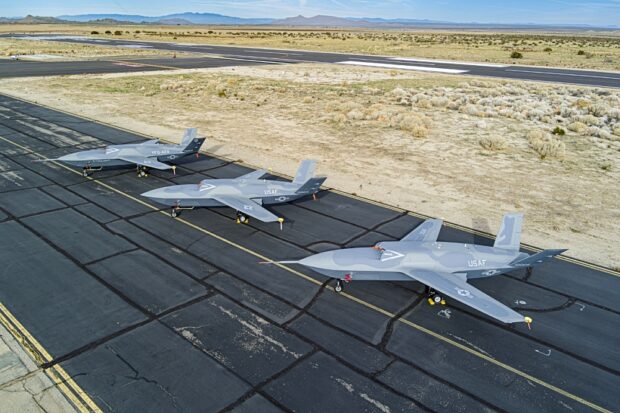
General Atomics Aeronautical Systems, Inc. reached a new milestone this month by integrating third-party mission autonomy into its YFQ-42A Collaborative Combat Aircraft (CCA) and completing the aircraft’s first semi-autonomous airborne mission.
For the test, GA-ASI used mission autonomy software from Collins Aerospace, an RTX business, to operate the YFQ-42A developed for the U.S. Air Force. Collins’ Sidekick Collaborative Mission Autonomy software was integrated with the aircraft’s flight control system using the Autonomy Government Reference Architecture (A-GRA), enabling reliable data exchange between autonomy software and mission systems for precise execution of commands.
During testing, autonomy mode was activated from the Ground Station Console. A human autonomy operator then issued commands directly to the aircraft, which executed them accurately for more than four hours. The test demonstrated Sidekick’s advanced autonomy and the flexibility of the A-GRA framework for complex operational needs.
“We are excited to collaborate with Collins to deliver enhanced autonomous mission solutions,” said David R. Alexander, president of GA-ASI. “The integration of Sidekick with our YFQ-42A demonstrates our commitment to innovation and operational excellence in unmanned aircraft technology.”
Ryan Bunge, vice president and general manager for Strategic Defense Solutions at Collins Aerospace, added that the rapid integration of Sidekick onto the GA-ASI platform highlights the strength of an open systems approach and supports a wide range of combat-relevant behaviors.
This flight continues a fast-paced YFQ-42A development schedule that began in August 2025 with initial flights of Tail One. In under six months, GA-ASI built and flew multiple aircraft, including push-button autonomous takeoffs and landings.
GA-ASI’s long history with unmanned jets includes the MQ-20 Avenger, first flown in 2008, which remains a key platform for autonomy testing. Recent demonstrations have paired multiple autonomy software systems in a single flight and showcased manned-unmanned teaming with fighter aircraft.
Earlier work with the XQ-67A Off-Board Sensing Station, developed with the Air Force Research Laboratory, validated a shared-chassis design approach. This concept underpins GA-ASI’s Gambit Series, enabling rapid development of mission-specific aircraft like the sensing-focused XQ-67A and the air-to-air YFQ-42A.