
Russia is using civilian NVIDIA Jetson Orin computing modules in several types of strike weapons equipped with machine vision and artificial intelligence capabilities, ranging from Molniya and V2U drones to the Shahed-136 and the S-71M Monochrome air-launched missile.
This is evidenced by Ukrainian specialists’ analysis of Russian weapons and information obtained by The New York Times from Ukrainian military personnel and experts.
Ukrainian specialists found NVIDIA Jetson Orin mini-computers in the guidance systems of Russian Molniya drones. According to the analysis, the drones could not only use machine vision during the terminal phase of flight but also independently select a specific target to strike without operator confirmation.
During the July 6 attack, one of these drones was heading towards a petrol station in Zaporizhzhia. According to Ukrainian specialists, the operators designated an area or target for the attack, but once near the target, the drone independently identified a specific object to strike — likely propane tanks.
Three people were killed in the strike. According to experts interviewed by the NYT, this was the first documented case of civilians being killed by a Russian drone equipped with such an autonomous terminal target selection system.
The module examined was not encrypted, allowing Ukrainian specialists to analyze the uploaded terrain images and the software. They established that the system had been trained to recognize specific categories of objects, including petrol station infrastructure.
Unlike “last-mile” systems, in which AI merely helps a drone home in on a target already selected by the operator, in the tested Molniya configuration, a human was not involved in the final selection of the specific object to be struck.
NVIDIA in V2U and Shahed
NVIDIA Jetson Orin has also been found in the Russian V2U strike drone.
As Militarnyi previously reported, its computing system is based on the Chinese Leetop A203 mini-computer, whose key component is the NVIDIA Jetson Orin.
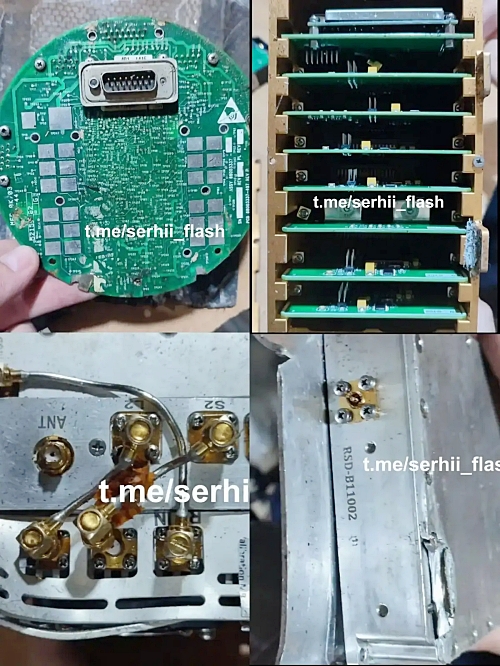
The V2U’s AI system handles object recognition and can automatically guide the munition toward a target. The drone itself has a wingspan of approximately 1.2 meters, can carry a payload of up to 3.5 kg, and uses a two-way LTE communication link.
In June 2025, a similar module was found in a new variant of the Iranian Shahed-136 equipped with a camera and a video guidance system.
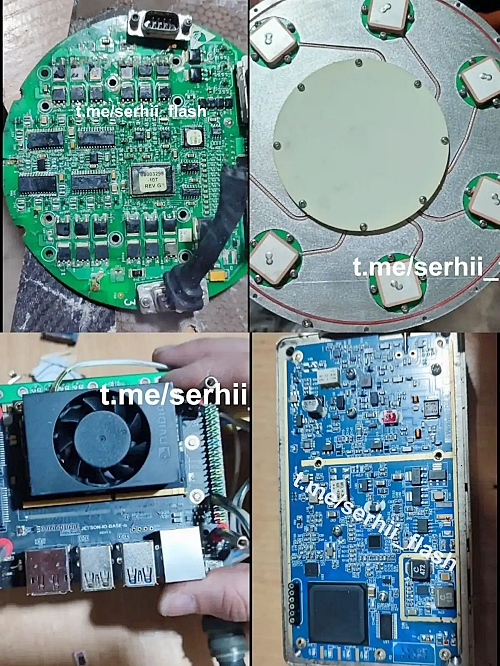
In this case, the NVIDIA Jetson Orin was used for machine vision — processing camera footage and comparing detected objects with preloaded models to enable terminal guidance or automatic target selection.
Thus, the same computing platform can be used in different configurations, ranging from assisting the operator during the terminal phase of flight to much more autonomous target search and selection.
S-71M Monochrome
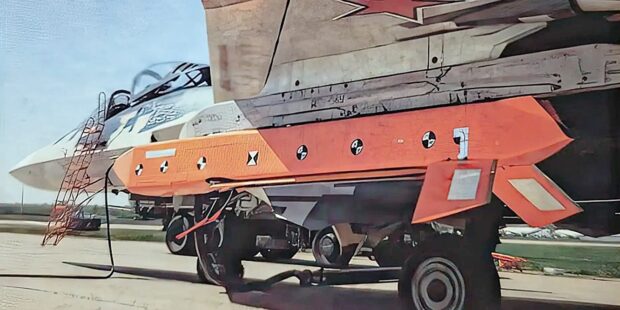
NVIDIA Jetson Orin has also been found not only in Russian drones. Militarnyi previously reported that Ukrainian specialists had found such a module in Russia’s new S-71M Monochrome air-launched cruise missile.
According to the Defence Intelligence of Ukraine, this mini-computer may indicate the use of artificial intelligence technologies in the missile’s control system.
The S-71M is a variant of the S-71K Kover and is designed to be carried in the internal weapons bays of the Su-57 fighter and the S-70 Okhotnik UCAV.
One of the Monochrome’s stated features is its ability to autonomously search for targets. If its other characteristics are the same as those of the S-71K, the missile may have a range of up to 300 km and carry a 250 kg OFAB-250-270 high-explosive fragmentation warhead.
Thus, the cases involving the Molniya, V2U, upgraded Shahed-136, and S-71M demonstrate the use of NVIDIA Jetson Orin in several different Russian strike platforms.
However, the level of autonomy varies between these systems. In some, Jetson Orin provides machine vision and terminal guidance, while in the Molniya drones tested in Zaporizhzhia, Ukrainian specialists say the computer was capable of independently selecting a specific target to strike.
NVIDIA’s Response
NVIDIA confirmed to The New York Times that the components shown in photographs of Russian drones belong to the Jetson Orin family.
The company stressed that these are civilian products designed for students, developers, startups, robotics and machine vision systems, rather than military applications.
NVIDIA says it does not sell Jetson Orin modules in Russia. However, the modules are widely available on the secondary market, making it virtually impossible to track their resale after the initial purchase.
A board from one of the Russian systems examined also bore a marking indicating it was manufactured in China. How exactly the modules reached Russian military developers remains unknown.
Jetson Orin is designed to run artificial intelligence models directly on the device, without a constant connection to cloud computing resources. This capability makes the platform suitable for machine vision, navigation, and autonomous object recognition.
Source: MILITARNYI