
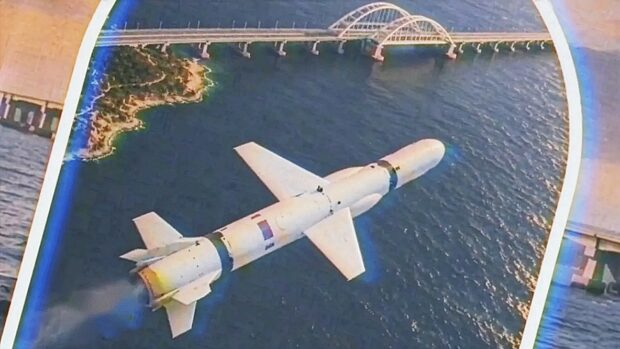
Ukraine has revealed a remarkably diverse collection of domestically developed weapons, and at least two foreign-supplied ones, used in its latest attack on the Kerch Bridge, the critical road and rail link connecting occupied Crimea with mainland Russia.
The operation, coordinated by Ukraine’s Security Service (SBU) and the General Staff, unfolded over several weeks and involved seven stages, according to President Volodymyr Zelensky. The Ukrainian leader made the disclosures, in a post on his official X account, accompanied by a video of the latest strike. As well as the bridge itself, Ukrainian forces systematically targeted Russian air defence systems, radars, electronic warfare equipment, and other installations before moving against the main target.
The final assault, conducted overnight on November 16-17, involved a combination of long-range attack drones, cruise missiles, and shorter-range drones, according to Zelensky. He explained that Palianytsia drones struck the bridge’s road section, while FP-5 Flamingo, Neptune, and Ruta cruise missiles were used against the railway section.
The Ukrainian president named 11 weapons systems involved in the broader operation. Here is a closer look at what we know about them.
Dovbush
Type: Unmanned Aerial Vehicle
Dovbush is a family of Ukrainian-developed unmanned aircraft, with variants intended for reconnaissance and strike missions. Public information on the specific variant employed in the Kerch Bridge operation remains limited.
The Dovbush family includes longer-range platforms, with some versions reportedly designed to operate deep inside enemy territory. Ukrainian forces have used Dovbush aircraft in the broader campaign against Russian military infrastructure. The family also includes heavy ‘drone motherships,’ used to deliver smaller attack drones closer to their targets before launching them.
Since the specific variant or targets assigned to the system during the operation are unclear, the drone may have been used for reconnaissance or strike missions, or both.
Vendetta
Type: FPV Attack Drone
Vendetta is a Ukrainian attack drone associated with the country’s expanding family of domestically produced uncrewed systems. It is described in Ukrainian reporting as an FPV loitering munition, with thermal-imaging capability supporting operations at night. Previous Ukrainian reports describe it as a ‘relatively inexpensive middle-strike drone,’ in a class of drones with a range of between 12 and 43 miles.
Da Vinci
Type: Long-Range One-Way Attack Drone
Da Vinci is another unmanned system identified by Zelensky. The propeller-driven drone is manufactured by Netherlands-based defence technology company Destinus and is reportedly intended to operate in contested electronic warfare environments.
Da Vinci is understood to be closely related to the Lord drone from Destinus, which can reportedly travel more than 621 miles, carry a warhead weighing between 88 and 220 pounds, and be prepared for launch in just 15 minutes.
Although the precise configuration employed in this operation has not been disclosed, unconfirmed reports state Da Vinci was used to suppress Russian air defences.
Sichen
Type: Long-Range One-Way Attack Drone
Sichen is a Ukrainian long-range strike drone designed to attack targets deep behind enemy lines. Based on its appearance, it clearly owes much to the Iranian-designed Shahed-136, also widely employed by Russia.
Publicly reported specifications put its range at up to approximately 870 miles, with a warhead weighing as much as 88 pounds.
Its inclusion in the Kerch Bridge operation points to the breadth of Ukraine’s long-range drone arsenal. However, Zelensky did not specify which installations Sichen targeted.
MICH-2000
Type: Long-Range Attack Drone
Another Shahed-lookalike, MICH-2000 is a Ukrainian long-range one-way attack drone associated with the SBU’s Alpha special operations unit.
The aircraft is reportedly based on a modified commercial Chinese UAV design and adapted for military strike missions. Ukraine’s use of readily available commercial designs as the basis for its own strike drones is by now well established, although more recently it has relied more heavily on fully domestic products.
Some reporting puts its operational range at approximately 1,240 miles, although publicly available performance information remains limited.
Its participation in the operation is noteworthy because it demonstrates the variety of platforms Ukraine is employing for deep-strike missions, including systems developed outside its traditional aerospace industry.
Ruta
Type: Cruise missile
Ruta is a Ukrainian-operated, European-developed, low-cost cruise missile ‘strike system’ manufactured by Destinus.
According to the manufacturer, the baseline Ruta Block 1 is designed to deliver precision strikes against high-value military targets at ranges of up to 186 miles. It carries a payload of up to 331 pounds.
Destinus describes the system as being optimized for high-volume salvo attacks, with an emphasis on cost efficiency. It is designed to fly at low altitude, using terrain masking to help penetrate enemy air defences.
One of its key features is a multi-sensor navigation system combining inertial navigation, satellite navigation, and visual navigation. Destinus says this architecture is intended to allow the weapon to continue operating in environments where electronic warfare systems are attempting to disrupt satellite navigation.
Palianytsia
Type: Long-Range Drone
Palianytsia is one of Ukraine’s more distinctive domestically developed weapons. It is a turbojet-powered drone designed to attack targets at long distances.
Ukraine first publicly acknowledged its successful use in August 2024. The system was developed as part of the country’s effort to expand its ability to conduct deep strikes without relying exclusively on foreign-supplied missiles, which typically come with a restrictive set of employment rules.
Zelensky credited Palianytsia with striking the bridge’s road section during the final phase of the operation. Its use against such a heavily defended and strategically important target represents a significant demonstration of Ukraine’s growing domestic strike capabilities.
An-197
Type: Unmanned Aerial System
An-197 is among the lesser-known weapons included in Zelensky’s list. Ukrainian reporting has linked the designation with a long-range strike drone derived from the country’s existing family of deep-strike unmanned aircraft.
Publicly available technical information remains particularly sparse, and its precise relationship to other Ukrainian drone designs is not fully established.
FP-1
Type: Long-Range One-Way Attack Drone
FP-1 is a well-known long-range Ukrainian attack drone developed by Fire Point, the company also responsible for the FP-5 Flamingo cruise missile.
The system is designed to strike targets deep inside enemy territory and has become part of Ukraine’s expanding domestic deep-strike arsenal.
Its inclusion in the operation underscores how Ukraine employed a combination of different uncrewed platforms, with different levels of performance and payload capabilities, to attack Russian military installations before the final assault on the bridge.
FP-5 Flamingo
Type: Ground-Launched Cruise Missile
The FP-5 Flamingo is one of Ukraine’s most ambitious domestically developed long-range weapons.
Manufactured by Fire Point, the ground-launched cruise missile is designed to attack fixed targets at considerable distances. The manufacturer has advertised a maximum range of approximately 1,864 miles and a warhead weighing up to 2,646 pounds.
Zelensky specifically highlighted the system’s role in the Kerch Bridge operation, saying Ukrainian forces used it to conduct a precision-guided strike. He also noted that the communications link remained operational until the final seconds; this is supported by a purported video from one of the missiles during its final run-in to the target.
The weapon’s reported involvement is especially noteworthy given the bridge’s extensive defensive arrangements, although it also needs to be considered that the Flamingo only made its way through to the target thanks to a wide-ranging effort by a wide variety of other systems.
R-360 Neptune
Type: Anti-Ship and Land-Attack Cruise Missile
The R-360 Neptune is Ukraine’s domestically developed cruise missile, originally designed to attack naval vessels. It is essentially a Ukrainian version of the Soviet-era Kh-35 anti-ship missile, which has been fielded in air-launched, ground-launched, and ship-launched versions.
Neptune gained international attention in April 2022 when Ukrainian forces used the missiles to strike and sink the Russian Black Sea Fleet flagship Moskva.
Its participation highlights how Ukraine has expanded the utility of existing missile designs to address a much wider range of battlefield requirements.
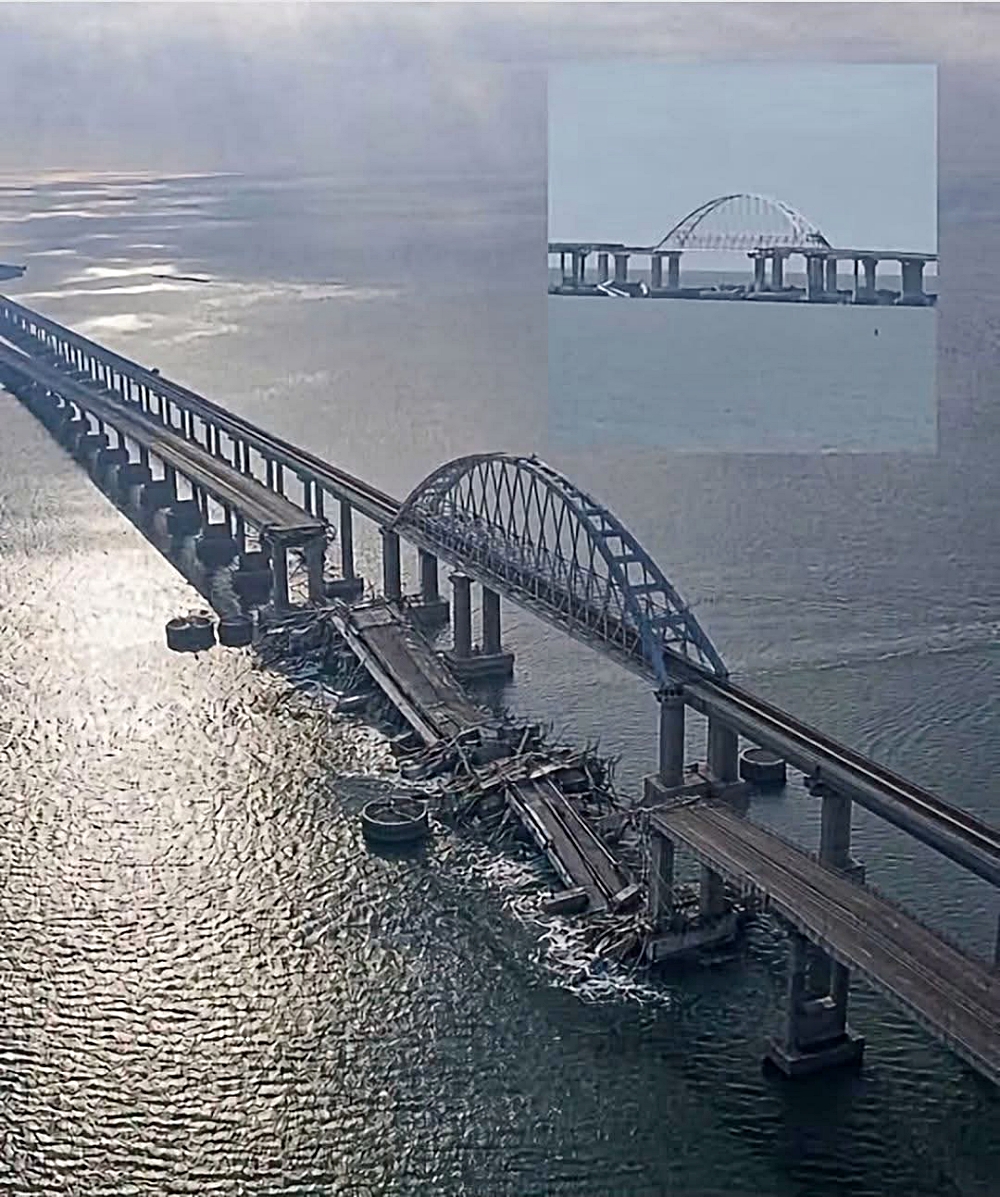
A Multi-Layered Ukrainian Strike
The Kerch Bridge operation illustrates the increasingly diverse nature of Ukraine’s domestic weapons industry — as well as the challenges of prosecuting well-defended targets at extended ranges.
To get around this conundrum, Ukrainian forces appear to have combined reconnaissance and strike platforms, long-range one-way attack drones, jet-powered missile-drones, and conventional cruise missiles. Each of these is suited to a particular target set.
As expected, the operation involved a deliberate effort to degrade the defensive systems protecting the bridge before the final attack. Exactly how this was coordinated once the attack was underway is unclear. Undoubtedly, it was a complex operation that would have required months (at least) or careful planning.
Source: The War Zone