
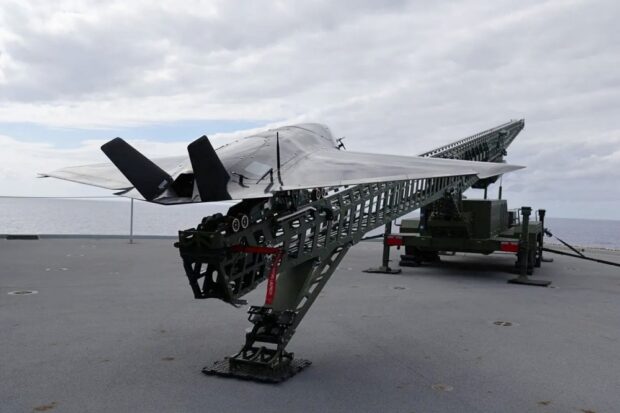
In landmark North Atlantic trials, which took place in mid-October, British made Nyan Maritime one-way strike drones, manufactured in Wiltshire by Callen-Lenz, took off from HMS Queen Elizabeth’s flight deck, demonstrating how autonomous strike systems could operate alongside F-35B stealth jets.
A collaboration between the Royal Navy, British Army and the Royal Air Force, the exercise falls under Project Vantage – an initiative focused on accelerating the test and fielding of maritime strike drones.
The Nyan system is a small unmanned aircraft with a 2.9-metre wingspan, designed to offer a precision strike capability.
The successful operation of Nyan from HMS Queen Elizabeth provides another proof-point of how this capability can support future force development and the evolution of the Royal Navy’s vision for a hybrid navy. As operational requirements evolve, we continue to invest in uncrewed systems that can provide affordable, scalable combat mass and increase the impact of existing capabilities.
Matt Foster, CEO of BAE Systems‘ Callen-Lenz
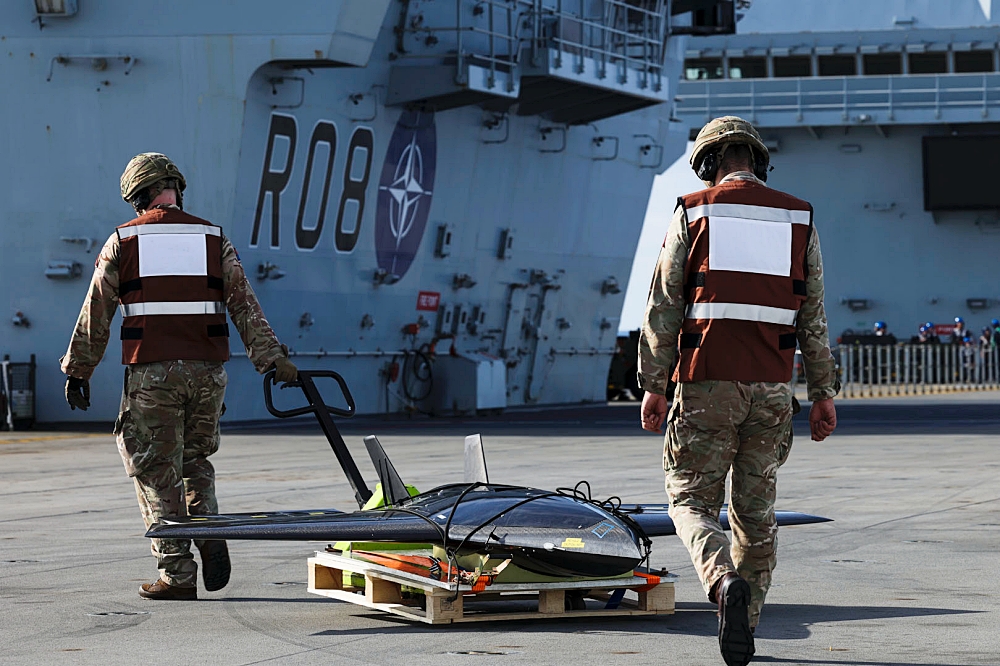
Palletable A Nyan drone is hauled across the flight deck by handlers using a pallet as a sled
The trials mark another step towards the Navy’s high-tech approach to fighting in the air, from an aircraft carrier, known as the ‘hybrid carrier air wing’. It brings together manned aircraft and drones to increase the carrier’s reach, lethality and flexibility, while keeping personnel further away from danger.
The trials developed understanding how unmanned strike systems could contribute to future Carrier Strike operations and wider Defence activity.
Working with experts from across the Armed Forces and industry, the Royal Navy conducted a number of flights from HMS Queen Elizabeth, following the drone’s first launch at sea from experimentation ship XV Patrick Blackett earlier this year.
Defence Secretary Wes Streeting said:
“The threat environment we are facing is fundamentally different from that of recent decades. A major determinant of military power now is who can innovate fastest.
This first for the Royal Navy shows how we’re using the biggest sustained increase in defence spending since the Cold War to invest in equipment and technology that gives our forces greater reach to strike the enemy, with increased lethality.
The more ready we are to fight and win, the less likely we are to have to. This investment strengthens our warfighting readiness and therefore our deterrence.”
At the same time, the carrier hosted Heavy Lift Challenge 3, which saw a Tekever AR5 fixed-wing unmanned aircraft operate from a carrier for the first time.
With a 7m wingspan and capacity to carry 80kg, the AR5 can support both logistics and operational missions. The trials demonstrated how drones used for intelligence, surveillance, target acquisition and reconnaissance could operate alongside strike systems as part of a more integrated fighting force.
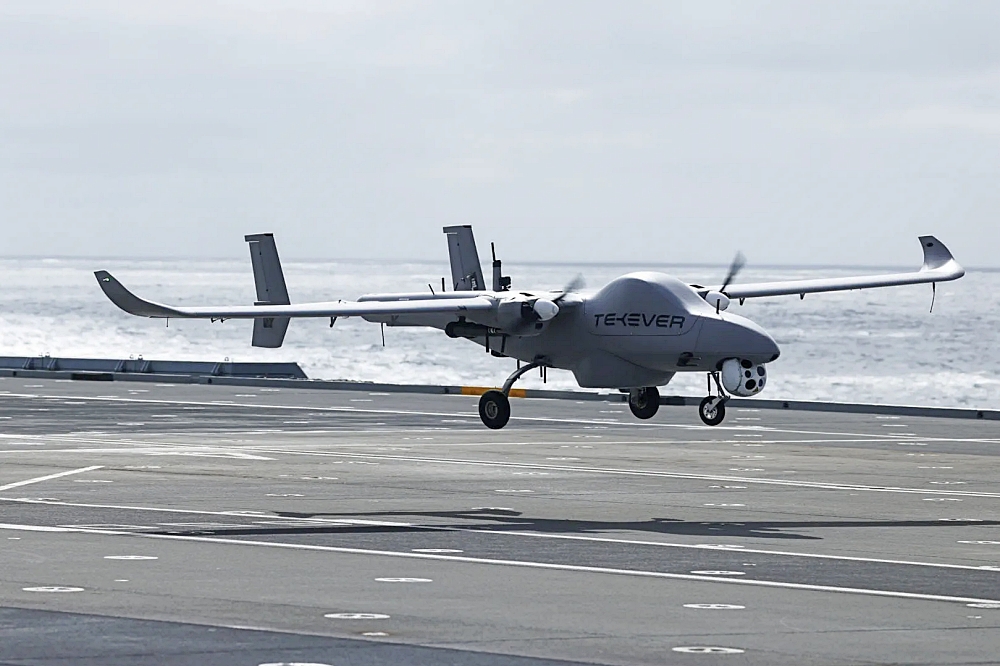
The Tekever AR5 drone prepares to touch down on HMS Queen Elizabeth’s deck
Together, the trials demonstrate how unmanned aircraft can increase the flexibility and capability of the UK’s aircraft carriers as the Royal Navy develops its future hybrid air wing.
Lieutenant Commander David Burton, trials sponsor for Navy Capability, said:
“These trials give us the evidence and confidence to decide how uncrewed systems can work alongside manned aircraft. The lessons will help us build a hybrid Navy that gives commanders greater choice and ensures our carriers remain at the cutting edge of naval warfare.”
The trials are part of the government’s plan to modernise the Armed Forces for the way wars are fought today. The Defence Investment Plan provides over £5bn for autonomous systems by 2030, the largest ever drone investment in Defence.
The plan includes:
- almost £250m for Project Pantheon, developing autonomous systems to build a hybrid carrier air wing, and for trials of jet-powered drones to work alongside the F-35B force
- at least £1.3bn for a hybrid fleet of crewed and uncrewed ships, with the first large autonomous vessels due in service by 2030
- at least £210m for low-cost, long-range one-way attack drones for the Navy, Army, and RAF
Top Photo: A Nyan drone awaits launch on HMS Queen Elizabeth’s flight deck
Sources: UK Royal Navy; BAE Systems