
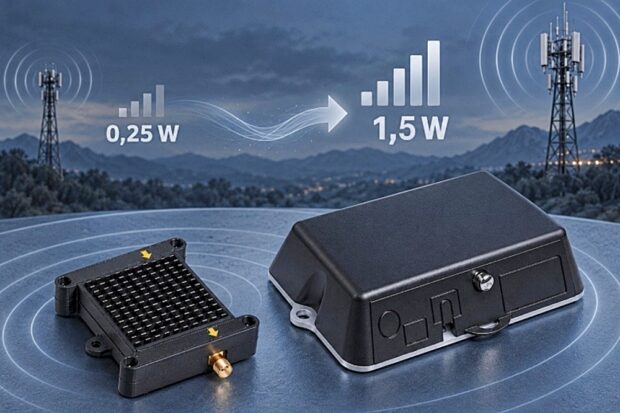
Ukrainian company Militech Group has developed the “Grim” LTE modem, which will help control drones in conditions of Starlink restrictions.
The device amplifies the LTE signal up to 1.5 W — six times more than a regular LTE modem — and provides stable communication even with a very weak mobile network signal.
In October, most units on the front line began to record significant delays in data transmission via Starlink, a channel necessary for controlling FPV drones and ground robotic complexes (GRCs).
Under such conditions, limiting Starlink’s operation actually creates the risk of partial disarmament of units along the entire front line. After all, it is UAVs and ground robotic complexes that currently perform from 50% to 90% of combat missions — from reconnaissance and destruction of equipment to logistics and mining.

Illustration of SpaceX’s Starshield
In modern combat conditions, communication with unmanned systems is provided by fiber optic coils, Starshield military terminals, the Starlink network, as well as LTE modems connected to local cellular networks.
“Given the limitations of fiber optic coils in terms of range and cost, as well as the instability of external partners in providing access to Starlink, today LTE looks like the only reliable solution for military helicopters and ground robotic complexes,”
comments Vasyl Polishchuk, CCO of Militech Group.
Stable Communication for Drones
In difficult terrain where the mobile network signal is weak or patchy, the operator risks losing contact with the drone and failing to complete the mission.
“That is why, back in 2024, our R&D team, anticipating these challenges, developed a technology for amplifying LTE signals up to 1.5 W. It provides seamless switching between base stations and a working radius of up to 45 km,”
adds Vasyl Polishchuk.
Currently, this solution is presented on the Brave1 platform in the form of the “Grim” LTE modem manufactured by Militech Group.
Controlling UAVs and NRCs via LTE requires a stable mobile network signal of sufficient strength, as its weakening can lead to loss of control over the unmanned system. The transmitter output power of a typical LTE modem is typically around 0.25 W.
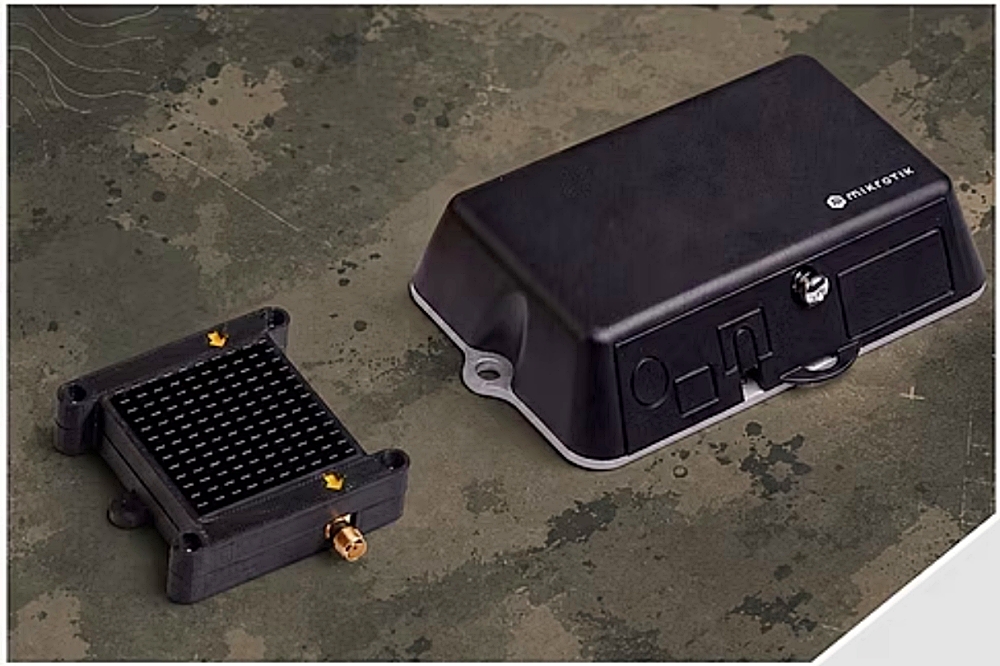
Ukrainian LTE modem “Thunder”. Photo: Militech Group
The GRIM modem provides LTE signal amplification, particularly in areas with weak mobile network coverage. The HRIM modem has passed field testing and is ready for combat deployment. It is built on the basis of a standard MikroTik LTE modem, supplemented by a signal amplifier.
The device also has two SIM card slots. The basic equipment does not include antennas. They are selected individually depending on the type of unmanned system.
“During 2026, batches of GRIM modems in the amount of 500 units are being formed for Ukrainian manufacturers of unmanned systems. From January 2027, the product is expected to become available to foreign customers,”
the company said.
Source: MILITARNYI