
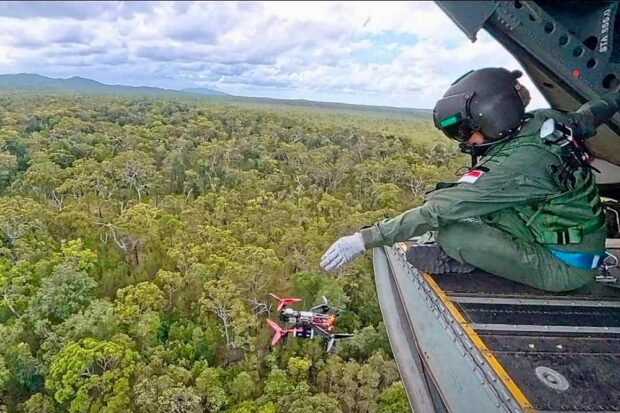
Singapore has been launching FPV drones from the back of its CH-47F Chinooks to extend aircrew visual coverage and provide last-mile surveillance, while employing AH-64D Apache attack helicopters in an air-defence role against larger unmanned aircraft during Exercise Wallaby 2026 (XWB26) in Australia as part of a concerted effort to advance manned-unmanned teaming (MUM-T) and Counter-UAS (C-UAS) capabilities.
Disclosed by Singapore’s Ministry of Defence on October 23, the Chinook trials form part of the exercise’s final training phase, which runs through November 2. Imagery from the exercise points to small, Class 1 FPV quadcopters being released from the helicopter, although MINDEF has not disclosed their range/endurance, payload or control arrangements.
Their stated purpose is to extend the crew’s visual coverage and provide last-mile surveillance during complex operations, with the possibility of future search-and-rescue (SAR) applications by allowing crews to assess areas beyond their immediate field of view.
The Apache counter-UAS engagements took place during the preceding phase of XWB26, which ended on October 17. cUAS is fast becoming a staple mission for attack helicopters, owing to their potential to detect, track and engage low-flying slow-moving unmanned aircraft as their use proliferates.
RSAF XWB Frame 3 Air Director and Commander SOATG Lieutenant Colonel Ng Kehang said the proliferation of UAS has congested lower airspace and created new challenges for helicopter operations, adding that their spread had
“really hit us quite hard.” “In the past, we never really thought that the UAS could be used in such a way,”
he added. He said capabilities that mature through the trials could eventually be incorporated into RSAF operating concepts and integrated with the Army and Navy, with Australia’s expansive airspace allowing Singapore to test applications that may be difficult to evaluate at home.
Source: MINDEF Singapore; FaceBook