
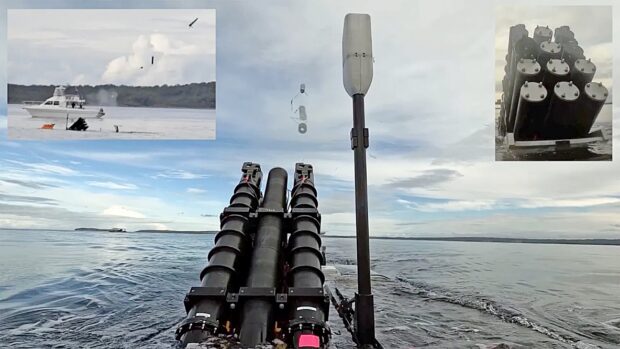
New footage of Australia’s Ghost Shark extra-large autonomous underwater vehicle (XL-AUV) provides the first look at how the vehicle launches aerial drones, while also revealing a pair of deployable masts not previously seen on the platform.
The video comes soon after we got a glimpse of some of the payloads that the Royal Australian Navy plans to integrate on the new unmanned submarine.
Published by manufacturer Anduril, the footage shows a Ghost Shark surfacing before doors on the top of its hull slide open. A launcher consisting of 12 angled tubes then emerges from a drone sub. Another launcher is seen in the other upper payload bay, but is not raised in the video. While it appears to be of the same type, the second launcher could also have a different arrangement of tubes.
“Ghost Shark has teeth now.” – @PatConroy1, Australia’s Minister for Defence Industry.
The @ausgov and @Australian_Navy confirmed the payloads that our Ghost Shark extra-large autonomous submarine carries: sea mines, logistics caches, and air-launched effects for ISR and strike.
Ghost Sharks are rolling off the production line. Payload testing is active.
— Anduril Industries (@anduriltech) October 21, 2026
The footage subsequently cuts to an ALTIUS-type drone being launched from one of the tubes, with Ghost Shark itself remaining surfaced.
The sequence provides a much more concrete look at the aerial-drone deployment concept — or one of them — than the photographs released previously, which offered the first public view inside Ghost Shark’s side payload bay.
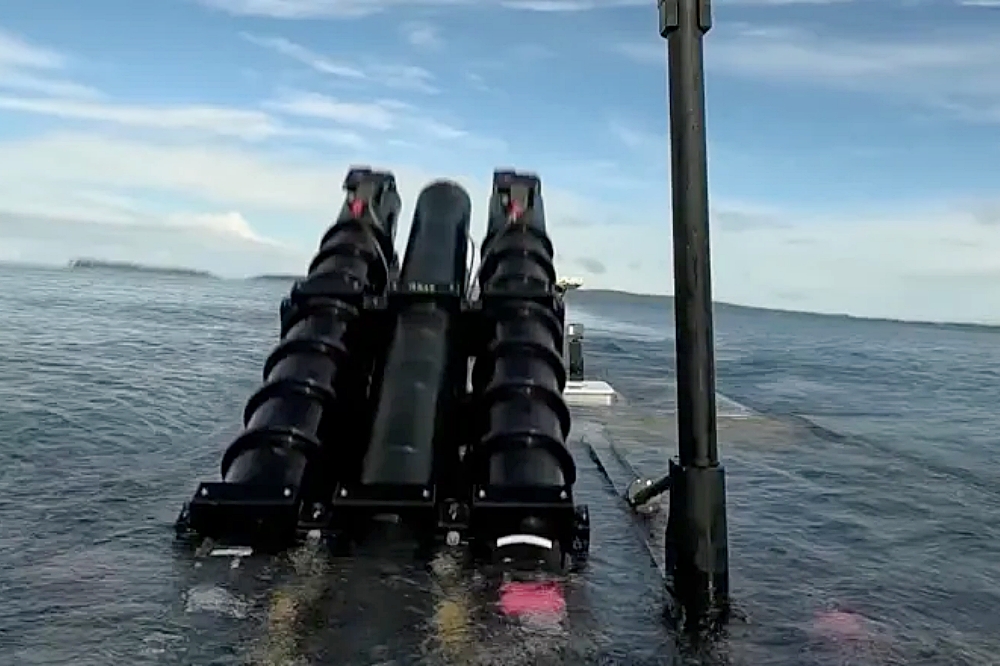
While the 12-tube ALTIUS aerial drone launcher on the left is seen elevating, the launcher on the right remains lowered. Anduril
The Australian government has said the vehicle is being developed for missions including persistent intelligence, surveillance, reconnaissance (ISR) and strike, but the precise configuration and operational capabilities of its weapons and how they are launched had not previously been disclosed.
The video does not identify which ALTIUS variant is being launched. However, Ghost Shark has previously been displayed at the Altus factory in Australia alongside derivatives of the ALTIUS-600 family. This includes the ALTIUS-600 for ISR, as well as the ALTIUS-600M, which is designed for strike missions.
Ghost Shark can clearly deploy a substantial number of aerial drones — two dozen in this case – in a single sortie, enabling swarms to be launched far from an adversary’s coastline. Depending on the drones carried and how they are employed, such a swarm could provide broad-area surveillance, wreak havoc on enemy air defenses via electronic warfare, or attack targets.
At the same time, while the 12-tube launchers fit neatly into Ghost Shark’s hull architecture, the modular nature of the design means that the same space can accommodate many other payloads, which might include alternative types of aerial drones. This could be fewer larger, more capable types, or far more plentiful smaller, less capable ones.
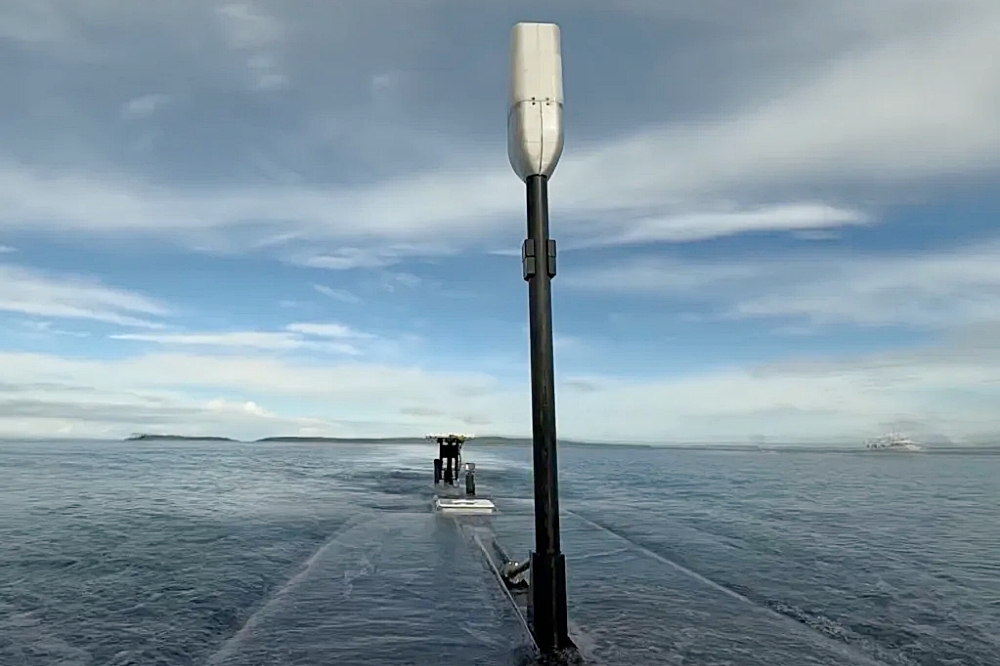
Looking aft, with the two masts raised. Anduril
The other notable development in the video is the appearance of two deployable masts. Their presence is particularly interesting given Anduril’s emphasis on designing uncrewed underwater vehicles without the kinds of protruding mast arrangements associated with traditional submarine designs. On UUVs, masts like these are generally used to support sensors, communications, and propulsion systems.
“We don’t have big masts running down the backbone of our vehicle that a lot of other designs do that then preclude the ability for the payloads to come out in different directions… of the payload module itself,”
Dr. Shane Arnott, Senior Vice President for Engineering at Anduril and the company’s maritime lead, told TWZ back in 2024.
“So we have… in effect, unlimited flexibility in this design, just the way that we’ve configured the vehicle and the payload bay itself could be almost anything within a size configuration that you can dream up,” Arnott added. “We haven’t encountered a crazy idea yet from a customer that … we can’t fit.”
The larger mast that lies flat is actually a fairly traditional one for large UUVs. It lies along the centerline of the hull when stowed, between the upper payload bays. It then deploys upward in an arm-like motion and carries an antenna. The smaller mast is located farther aft and rises vertically from its own housing. Potentially, the tall mast supports a line-of-sight datalink to the drones, while the other being a satcom array, such as one connected to Starlink/Starshield, sends drone feed to controllers anywhere in the world.
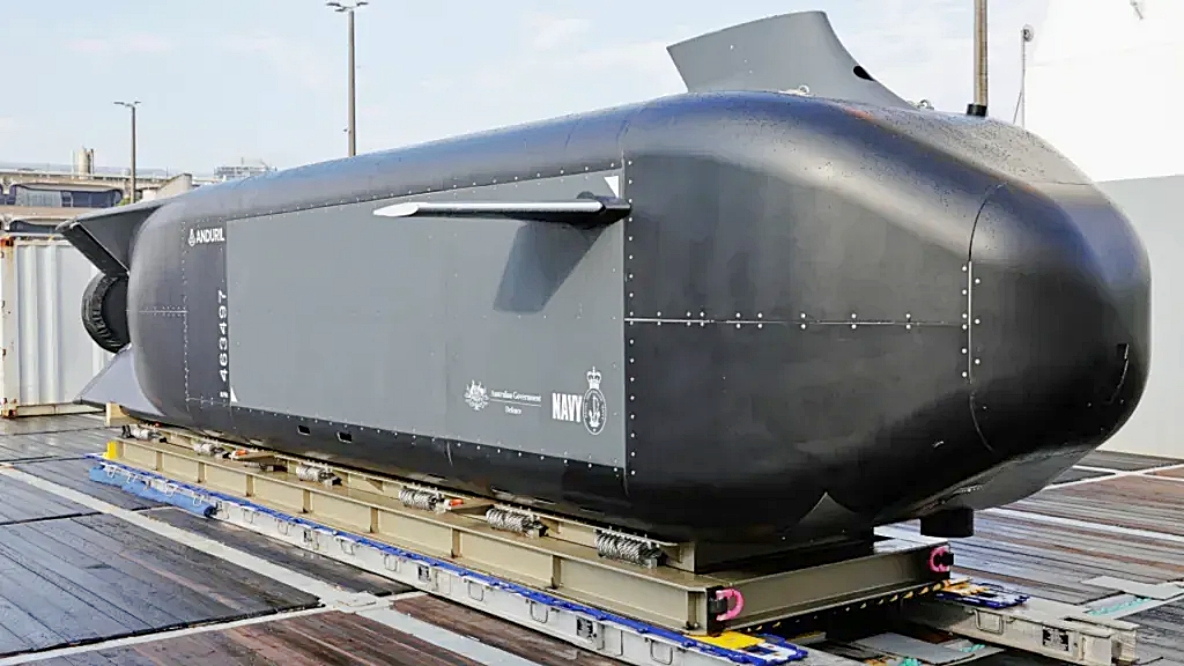
The first Ghost Shark for the Royal Australian Navy. In this earlier view, the retractable masts are not visible. Australian Department of Defence
It’s also worth noting that Ghost Shark could just launch the drones and send them on their missions autonomously, without needing to stay surfaced at all. Other arrangements could exist, as well, such as Ghost Shark launching a dozen drones and one larger one capable of carrying its own satcom terminal. This would allow direct control of the drones by operators anywhere in the world without Ghost Shark remaining present near the surface.
Ghost Shark also has a lower-profile swept-back sail on top of its nose section, not visible in the video. Overall, the vessel would retain a very small signature above the waterline while connected to the drones, making it hard to detect by radar and electro-optical imaging systems.
See the full length article on UAS NEWS | PRO
Source: The War Zone