

North Wales manufacturer KnitMesh Technologies is taking its specialist wire knitting technology into the rapidly developing counter-drone market with a stainless steel mesh designed to provide a physical barrier against hostile unmanned aircraft systems (UAS).
The company showcased its DroneStop Counter-UAS Shield at the recent Counter-UAS Homeland Security Europe conference in London, positioning the technology as a passive addition to the electronic detection and jamming systems increasingly being deployed to protect sensitive sites.
Established in 1957 and headquartered in Greenfield, Flintshire, KnitMesh Technologies has spent almost 70 years developing knitted wire mesh for applications ranging from automotive components and filtration to hydrogen production, thermal management and industrial safety. It also operates a manufacturing facility near New Delhi, India.
Developed, manufactured and tested in the UK, DroneStop employs high-strength stainless steel knitted wire mesh to create a lightweight physical barrier above or around vulnerable assets. Unlike electronic counter-drone systems, it requires no power supply and does not rely on radio-frequency interference or signal jamming.
Instead, the mesh is intended to form the final physical layer of a broader counter-UAS strategy, protecting locations including military bases, ammunition and fuel storage areas, aircraft facilities, communications infrastructure, prisons and other critical national infrastructure.
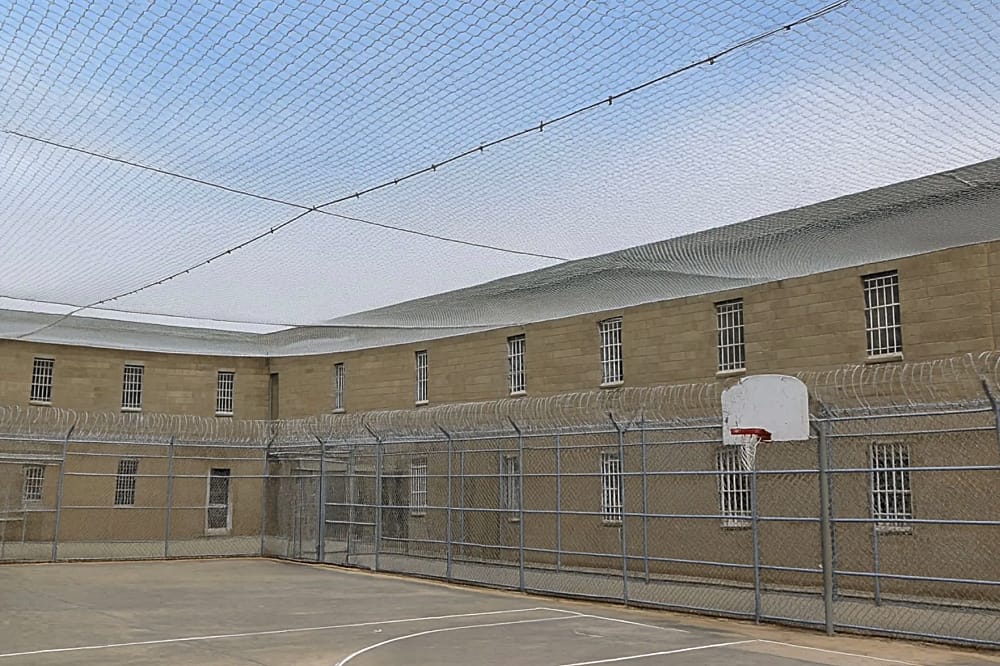
The approach reflects the increasing complexity of protecting sites against relatively small and inexpensive unmanned aircraft. Electronic countermeasures can detect, track or disrupt drones, while a physical barrier can provide protection around particularly vulnerable assets if other measures are bypassed.
KnitMesh says DroneStop can be incorporated into existing security infrastructure and installed either permanently or as a temporary rapid-response system. The standard mesh weighs around 1,500 gsm and is produced from 304L stainless steel, with 316L and Duplex stainless steels also available. UHMWPE (ultra high molecular weight polyethylene) fibre reinforcement can additionally be incorporated where required.
Potential installations range from overhead protection for vehicle parks, trenches and accommodation areas to barriers around radar and communications equipment, aircraft hangars and secure compounds.
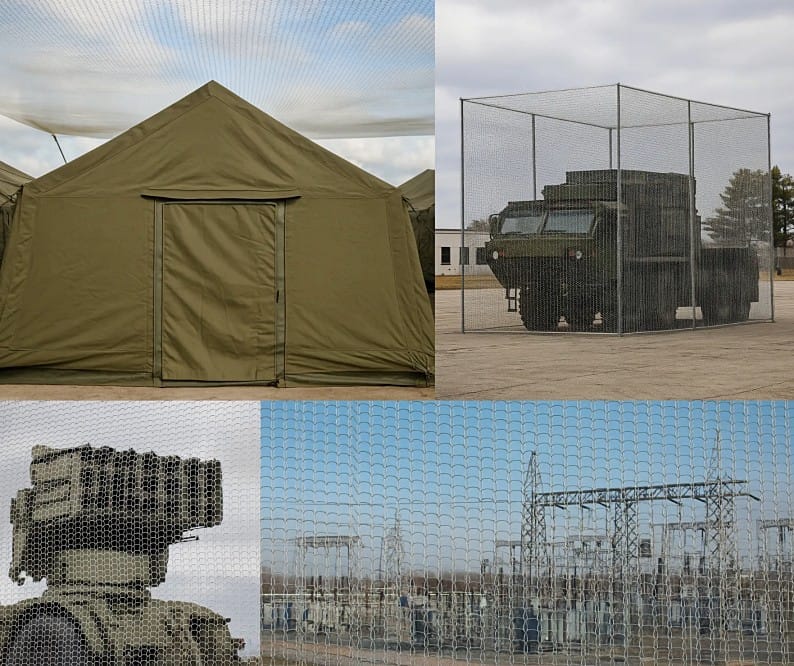
The company says its manufacturing capabilities allow the technology to be produced for anything from individual bespoke installations and pilot projects to larger defence and critical-infrastructure programmes. Its Greenfield operation includes what it describes as the world’s largest wire knitting machine.
KnitMesh executive chairman Lew Bingham and security and defence business development manager Andrew De-Gol presented the system during the two-day London Counter-UAS event.
De-Gol said discussions had centred on current and future requirements and on where a passive physical barrier could fit alongside other counter-drone technologies.
“We had some very productive meetings, discussing current requirements, future projects and where our technology can add real value by providing that important passive layer of defence for critical infrastructure and other assets,” he said.
DroneStop is one of a surprisingly diverse range of applications to emerge from KnitMesh core expertise in knitting metallic and other filaments. The company also supplies mesh for electrolysis and hydrogen production, filtration, sealing and vibration control, as well as automotive and specialist safety applications.
Source: Innovation in Textiles