
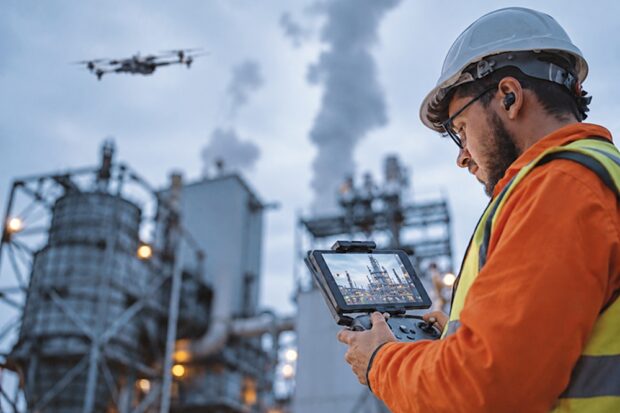
Autonomous drones are becoming powerful tools for industrial inspection. They can fly the same patterns, take pictures, and create logs of asset conditions. However, the data collection is only a small part of the process. The more pressing question is what to do with the information the drone accumulates about the inspected sites.
For the UAV to be genuinely useful in maintenance, the data about the detected issues must reach beyond the machine’s processing capability and enter the software that maintains the inventory of the industrial facility.
From Detection to Maintenance Action
Successful UAV inspection should also provide additional contextual information. Maintenance teams require details on the asset the observation relates to, its location and when the observation was recorded, and a comparison with its condition at an earlier inspection. This emphasises the importance of data structure and asset identification.
A practical workflow could therefore follow:
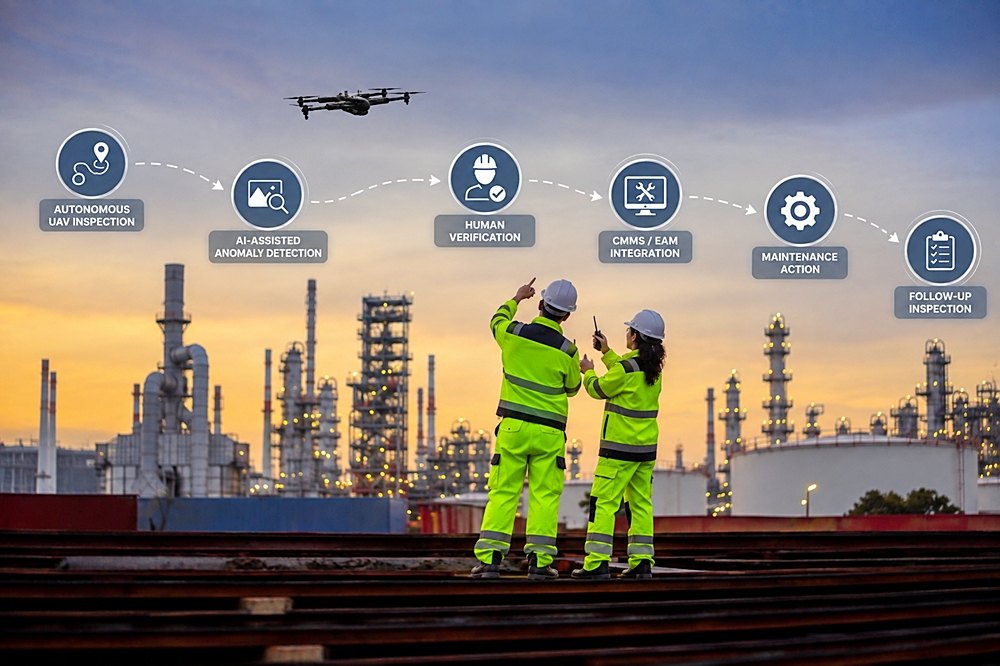
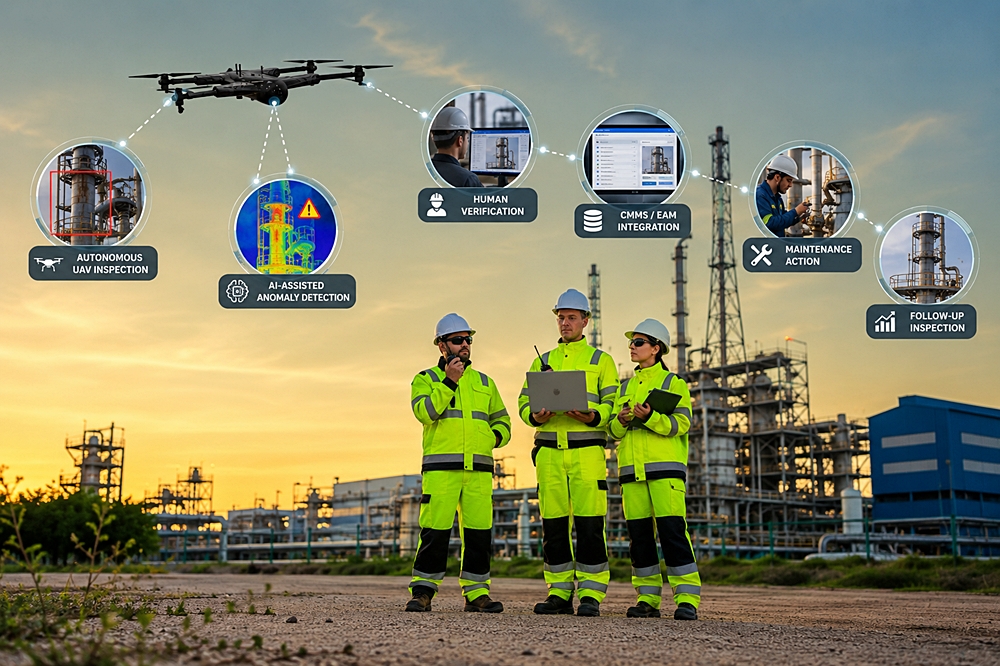
UAV Inspection Anomaly Detection Human Verification Maintenance Action Repair Follow-up Inspection The moment stems from linking these phases instead of running drone examination as a specific activity.
Connecting UAV Data With Maintenance Systems
A lot of industrial companies currently have Computerised Maintenance Management Systems (CMMS) or Enterprise Asset Management (EAM) software tools that contain asset registers, asset inspections, and work orders.
UAV data becomes more useful when connected with these existing records. As industrial maintenance becomes increasingly data-driven, UAV drone technology can provide repeatable aerial data that supports asset monitoring and condition assessment while leaving operational decisions with qualified personnel.
In this regard, for instance, the autonomous inspection could take an image of the particular asset and detect a potential defect. Once validated by a human, the information about the asset number, location, time, imagery, and condition classification would be incorporated into the appropriate maintenance work order.
AI Should Prioritise, Not Authorise
Autonomous systems can generate thousands of images, making full manual review impractical. Computer-vision systems can help identify potential anomalies for closer inspection. UAS Vision has reported similar approaches in aircraft inspection, where drone-captured imagery is analysed and reviewed by human inspectors.
However, detecting an anomaly is different from deciding what maintenance action is required.
AI should therefore act as a screening and prioritisation tool, highlighting relevant findings while qualified personnel make the final maintenance decisions.
Closing the Maintenance Loop
Another distinct advantage offered by autonomous UAV inspection is its repeatability. In case of maintenance or repairs, the drone can repeat the same inspection and gather a similar set of data.
This creates a closed loop:
- Detect – Identify a potential issue.
- Validate – Confirm the finding.
- Maintenance Action – Create the required action.
- Repair – Complete corrective work.
- Reinspect – Verify the repair.
- Update Asset Record – Record the latest condition.
Repeated inspections can also create a time series showing whether an observed condition is stable, deteriorating, or recurring.
From Inspection Tool to Maintenance System
Ultimately, it may be that the next leap in industrial UAV adoption is not about the quality of the flight but rather about taking the information back to, and incorporating it into, the maintenance work.
An aircraft locating an indication of a potential defect can only be the beginning. When that indication is correctly associated with the right asset and verified by appropriately trained technicians, integrated into the maintenance lifecycle and reassessed following corrective actions, autonomous UAVs are integrated into the wider maintenance information ecosystem.
Author: Andrew Mabry
Andrew is a technology researcher and analyst specialising in UAV and drone technology, artificial intelligence, machine learning, automation and emerging digital technologies. His work focuses on real-world applications of autonomous systems and translating complex technological developments into practical insights for professional audiences.
The full length article can be accessed at UAS NEWS | PRO :