

A year ago, Ryan Tseng, then CEO of U.S. defence-tech startup Shield AI, said the company had addressed safety concerns surrounding its V-BAT drone after a U.S. Navy official suffered partially severed fingers during a test.
Shield AI introduced new landing gear and warning stickers near the propeller, and Tseng described the aircraft as “a radically better airplane.”
Now a similar incident has occurred again. On May 12, during a Shield AI training exercise off the Texas coast, a Romanian Navy official’s hand was caught in a V-BAT propeller, severing two fingers and fracturing a third, according to Romania’s Ministry of National Defence. The incident has not previously been reported.
The accident comes as Shield AI faces ongoing questions about the V-BAT’s reliability and safety. Reuters interviewed 21 former employees, investors and industry executives, and reviewed a whistleblower complaint, a lawsuit and company documents. Reuters reported that the V-BAT has crashed more than 50 times in the past 18 months, that employees who raised safety concerns were dismissed, and that a Shield AI employee piloting a Cessna with his child aboard had to take evasive action to avoid a collision with a V-BAT during testing.
Shield AI acquired the V-BAT, a vertical takeoff and landing military drone, when it purchased Martin UAV in 2021. The company declined to make Tseng or current CEO Gary Steele available for interviews.
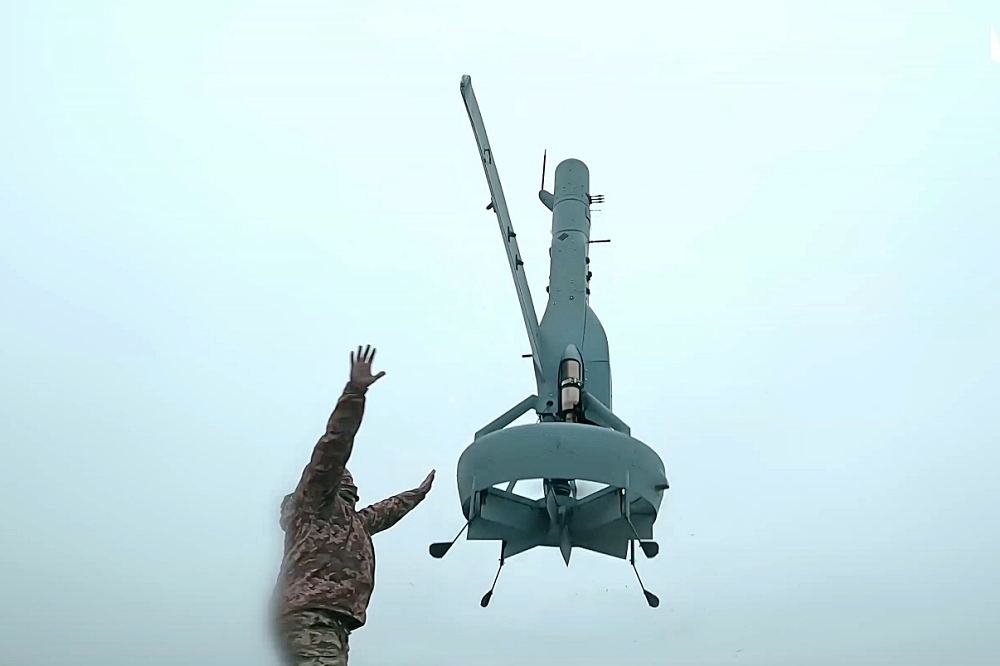
Ukrainian V-Bat drone. February 2025. Ukraine. Source: Unmanned Systems Forces
In a statement, Shield AI defended its record, saying “operational mishaps are common” for drones of this type and describing the V-BAT as “one of the most operationally proven VTOL aircraft in service today.” The company said the drone has accumulated 18,000 flight hours since 2019.
Shield AI said the Romanian official’s injury resulted from “a violation of established safety procedures, not from a product defect,” though it did not specify the violation. Romania’s defence ministry said its investigation remains ongoing. The injured official underwent surgeries in New Orleans before being transferred to Walter Reed National Military Medical Center in Maryland. Romania’s Naval Forces, which signed a $30 million V-BAT agreement with Shield AI last year, said the contract remains in force.
Valued at $12.7 billion after a March funding round, Shield AI has become one of Silicon Valley’s most prominent defence-tech companies, supplying drones and autonomous software to the Pentagon and allied militaries.
Founded in 2015 by brothers Ryan and Brandon Tseng, a former Navy SEAL, the company was among a new generation of venture-backed firms seeking to challenge traditional defence contractors. Despite rapid growth and sales to multiple foreign militaries, Reuters reported persistent problems with the V-BAT.
According to two people familiar with the matter, more than 50 of roughly 200 upgraded V-BATs in Shield AI’s internal fleet have been destroyed during testing or training over the last 18 months. At a NATO event in Portugal last September, a V-BAT reportedly crash-landed on a runway. In February, the company paused flights for several weeks after a series of crashes, including one that sparked a Texas grass fire that burned more than 40 acres.

Former product manager Jacob Miller, who filed a whistleblower complaint and lawsuit against the company, alleged Shield AI concealed technical shortcomings from customers. He claimed the company told the Greek military a V-BAT was operating autonomously during a demonstration when it was actually being flown manually. He also alleged the company altered internal mishap reports to present a more favourable picture of V-BAT performance and support contract bids. Reuters could not independently verify those allegations.
Safety concerns extended beyond customer demonstrations. During testing of an aircraft-detection capability last July, a V-BAT reportedly failed to detect a nearby Cessna, forcing its pilots to take evasive action. Reuters also reported that at least three employees who raised safety concerns either left the company or were fired.
Meanwhile, Shield AI is promoting a larger drone, the X-BAT, designed to fly alongside fighter jets as a “loyal wingman.” The company recently secured a Pentagon contract for the programme, which is expected to use the same flight-control architecture as the V-BAT.
Source: Reuters