
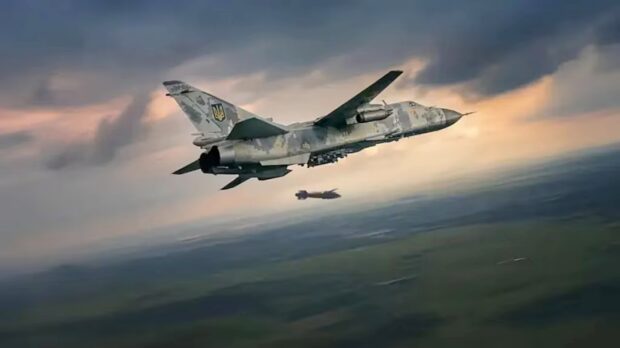
A Ukrainian company has produced the country’s first guided aerial bombs capable of striking targets “dozens of kilometers” behind enemy lines with 250-kilogram warheads, giving Kyiv a homegrown equivalent to Russia’s cheap, devastating glide bombs, the Ministry of Defense announced.
The aerial bomb is a winged but engineless weapon that drops from an aircraft at altitude, gliding to its target on the speed and altitude of release, steered by satellite guidance. It costs much less than cruise missiles per shot, carries much larger warheads than most drones and lets aircraft stay outside the densest air defences.
“The first Ukrainian guided aerial bomb is ready for combat use,”
Minister of Defence Mykhailo Fedorov wrote in a Telegram post announcing the milestone, noting the Ministry has already purchased an experimental batch and is gearing up to deploy the bombs on the front.
“Ukraine is moving from importing individual solutions to creating its own high-tech weapons, which systematically strengthen the Defence Forces and provide a technological advantage on the battlefield,”
Fedorov said.
Until now, Ukraine had no domestic precision glide bomb. The country has relied on scarce Western donations for strikes beyond the reach of conventional artillery, like American-made JDAM-ERs and ATACMS missiles, British Storm Shadows and French SCALP-EG cruise missiles.
Cheap to produce and free of donor restrictions, the new bombs let Kyiv press the fight at mid-range and conserve scarce longer-range Western missiles for deeper targets — part of a broader Ukrainian push to use tech to change the mathematics of war in its favor after over four years of defending itself against a much larger and richer enemy.
“We are scaling up solutions that increase the range and accuracy of strikes and change the rules of modern warfare,”
Fedorov said.
With the Ukrainian Ministry of Defence having placed a first order, pilots are now said to be training with the weapon, meaning that combat deployment is “imminent.”
DG Industry, a little-known Ukrainian firm sponsored by the state-backed defence innovation cluster Brave1, started work on the munition 17 months ago, MoD said.
The team faced a challenging environment, requiring guidance that could survive Russia’s electronic jamming, an airframe that stays stable across release speeds and altitudes and an interface that integrates with whichever aircraft will carry it, according to Brave1.
The result is a system officials say is different from others in its class.
Russia’s UMPK-equipped FAB bombs, for example, are glide kits bolted onto Soviet-era bomb bodies that were never meant to glide. The Ukrainian weapon is purpose-built from the airframe up, not a glide kit.
“This is not a copy of Western or Soviet solutions, but a development of Ukrainian engineers for effective destruction of fortifications, command posts, and other enemy targets tens of kilometers deep after launch,”
Fedorov said.
Glide bombs also offer another edge.
Released from standoff distance, they appear over the target only in the last seconds of flight, leaving traditional air defences little time to react.
They can be harder to detect, too, flying at different speeds, arcs and altitudes than the threats most air defence systems are optimized to track, according to NATO’s Joint Air Power Competence Centre.
Russian Su-34s release the bombs from well beyond Ukrainian air-defense coverage, and once airborne, the bombs themselves are small, unpowered and hard to track.
Ukraine knows from experience how hard they are to stop.
Source: Defense News