
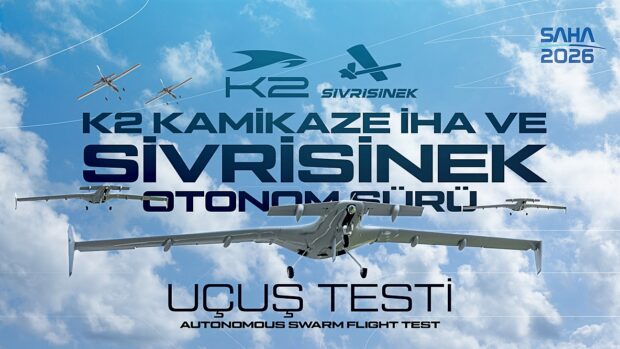
Turky’s Baykar unveiled two new unmanned combat platforms, the K2 kamikaze drone and the “Sivrisinek” (“Mosquito” in Turkish) loitering munition, during a live demonstration highlighting next-generation swarm warfare capabilities.
The systems demonstrated AI-supported swarm autonomy, GNSS-independent navigation, automatic target detection and strike capabilities.
A test at Baykar’s flight training and test centre in northwestern Edirne came ahead of platforms’ public debut at the SAHA 2026 defense expo, scheduled for May 5-9 in Istanbul.
FLYING IN AUTONOMOUS SWARM FORMATION
The demonstration, held on 17 April, opened with the sequential takeoffs of 5 K2 Kamikaze UAVs within 5 minutes. Once airborne, the platforms conducted patrol flights in “right echelon,” “line,” “V,” and “Turan” formations.
Ten Sivrisinek loitering munitions — a new platform developed by Baykar — then joined the operation, forming a swarm beneath the K2 Kamikaze UAVs.
The Bayraktar TB2, TB3, and AKINCI UCAVs accompanied the swarm flight, recording the operation from the air.
AI-SUPPORTED VISUAL NAVIGATION
Among the key technical highlights of the demonstration were the solutions developed to counter electronic warfare environments. Using AI-supported visual navigation software, the platforms demonstrated the capability to perform positioning and navigation independently of GNSS (Global Navigation Satellite Systems).
Having successfully showcased autonomous navigation in a GNSS-denied environment, the K2 and Sivrisinek Kamikaze UAVs also demonstrated AI-supported automatic target detection and automatic strike capabilities.
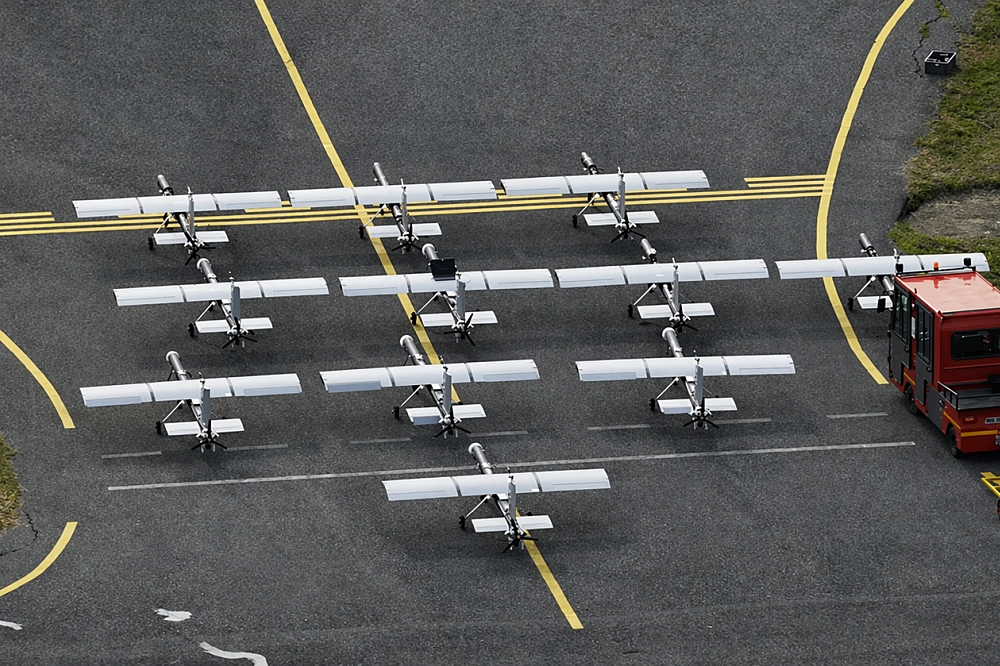
AUTONOMOUS TARGET DETECTION AND STRIKE
As part of the demonstration, a fleet of Sivrisinek loitering munitions executed a dive on the designated coordinates. A K2 Kamikaze UAV then broke off from the swarm and performed a high-speed dive on the designated coordinates, conducting a pass. In the final phase of the demonstration, a swarm group composed of 18 unmanned aerial vehicles across different classes — 5 K2s, 10 Sivrisinek, 1 Bayraktar TB2, 1 TB3, and 1 AKINCI — came together in a “V” formation to salute the delegation observing the flight.
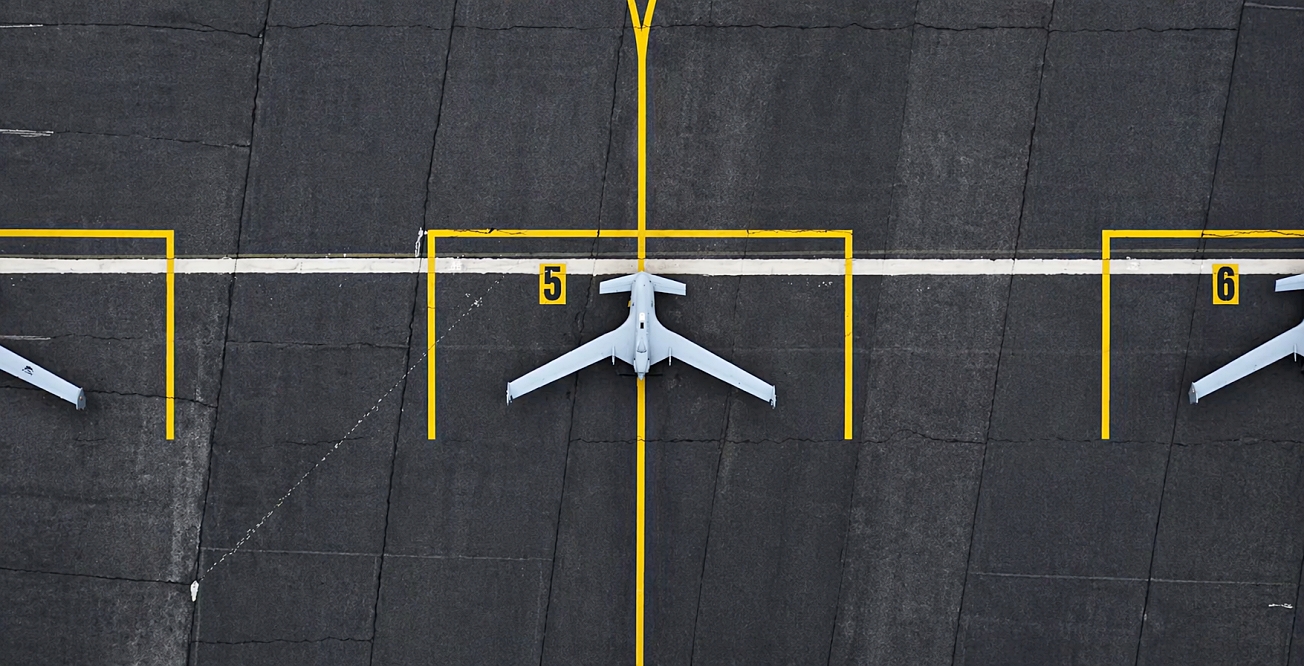
NEXT-GENERATION LOITERING MUNITION: SİVRİSİNEK
Developed by Baykar, the next-generation Sivrisinek loitering munition raises operational depth to the highest level with a range exceeding 1,000 kilometers. Capable of uninterrupted communication within the swarm through AI support, Sivrisinek platforms can instantly share detected targets with one another.
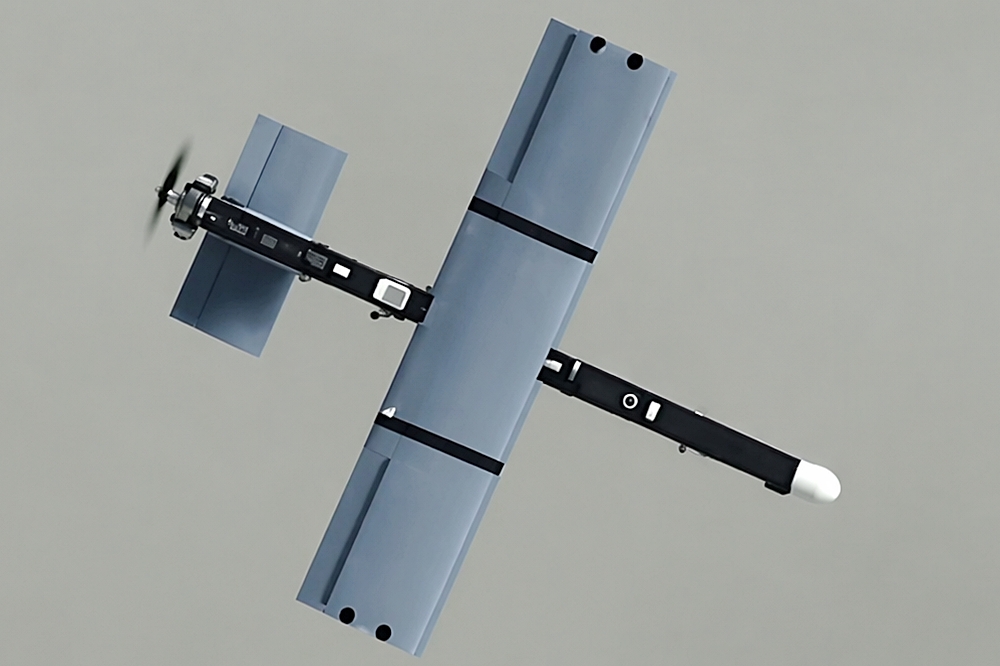
Performing its missions through AI-based visual positioning even in the most challenging environments — including areas where GNSS signals are unavailable or subject to intensive jamming — Sivrisinek stands out in strategic missions to be conducted on the battlefield thanks to its high autonomy capability.
Sources: Byakar; Daily Sabah
Why This Matters
The demonstration by Baykar of its K2 kamikaze drone and “Sivrisinek” loitering munition highlights a major shift in how future conflicts may be fought. Rather than relying on single, highly sophisticated platforms, the emphasis is moving toward coordinated swarms of relatively low-cost autonomous systems. This matters because swarm warfare can overwhelm traditional air defenses through sheer scale, redundancy, and adaptability, forcing militaries to rethink defensive strategies.
Equally significant is the integration of AI-supported autonomy and GNSS-independent navigation. By operating effectively in electronically contested environments—where GPS signals are jammed or denied—these systems address a critical vulnerability in modern military technology. This capability suggests that future battlefields will be less dependent on satellite infrastructure, increasing resilience and operational reach.
The ability of drones like the Bayraktar TB2 and newer platforms to share targeting data in real time further enhances their lethality and coordination. Networked intelligence enables faster decision-making and more precise strikes, compressing the time between detection and engagement.
Ultimately, this development underscores a broader trend: the democratization of advanced warfare capabilities. As such systems become more accessible, they could alter regional power balances and increase the risk of rapid escalation, making them strategically and politically consequential beyond their technical innovation.