
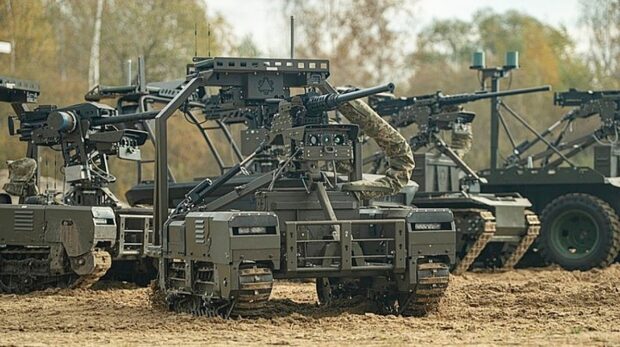
Ukraine said it forced Russian soldiers to surrender and captured their position using only aerial drones and ground robots, no infantry, in a first for the war.
President Volodymyr Zelenskyy said that
“for the first time in the history of this war, an enemy position was taken exclusively by unmanned platforms — ground systems and drones. “
The operation, which saw the Russians surrender, was executed “without losses on our side,” he said.
Ukrainian ground robots have carried out more than 22,000 missions on the front lines over the last three months. He said that means
“lives were saved more than 22,000 times when a robot went into the most dangerous areas instead of a warrior.”
“This is about high technology protecting the highest value — human life,”
he said, identifying some of the robotic systems Ukraine uses, such as Ratel, TerMIT, Ardal, Rys, Zmiy, Protector, and Volia.
“The future is already on the front line — and Ukraine is building it. These are our ground robotic systems,”
Zelenskyy said.
Zelenskyy’s comments point to a significant increase in the use of ground robots. Oleksandr Syrskyi, the commander in chief of Ukraine’s armed forces, said in December that in the previous six months, Ukraine’s ground robots had carried out just 2,000 missions.
That’s less than a tenth of the missions Zelenskyy reported over roughly twice as many months.
Ukraine, with a much smaller population than Russia and often struggling with shortages of Western-provided weaponry, has turned to aerial drones and ground robots to offset manpower and equipment gaps with domestically produced systems.
The result is an effective arsenal that has changed the face of the war and sparked interest across NATO and the West.
Drone technology has become vital to Ukraine’s fight against Russia’s invasion, with Zelenskyy last month saying that drones were responsible for 90% of Russia’s front-line losses.
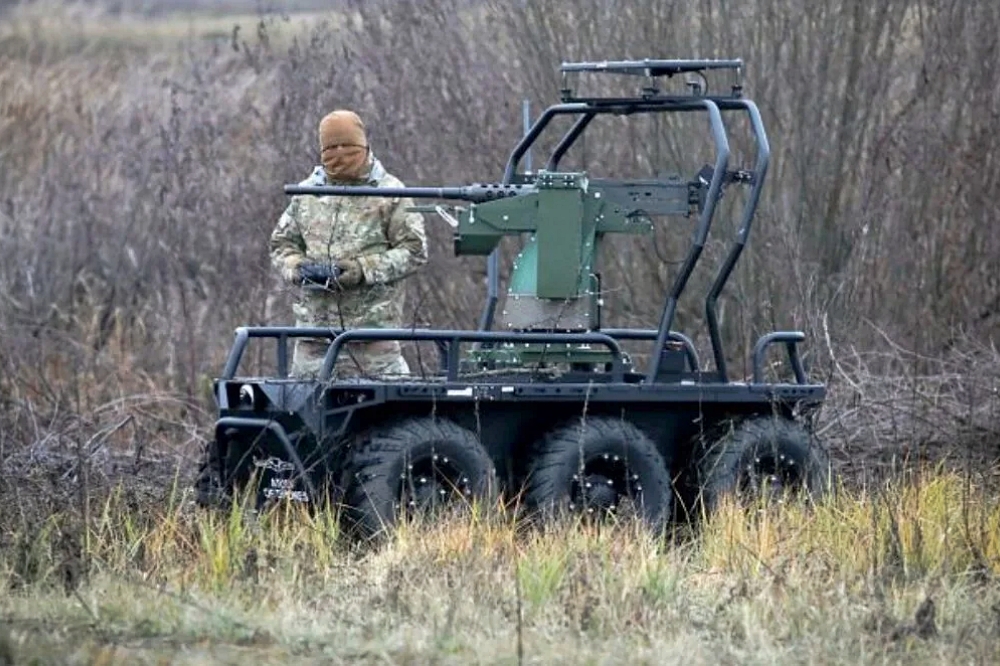
Image: Volodymyr Zelenskyy, President of Ukraine
Just as Ukraine has expanded its drone arsenal, it also has a growing collection of ground robots, also known as unmanned ground vehicles (UGVs), that evacuate the wounded, transport gear, lay mines, fire weaponry, and self-destruct inside Russian positions.
Russian soldiers have been recorded surrendering to both aerial drones and ground robots in this war, including by writing messages of surrender that they presented to the operator via the onboard camera and surrendering after notes telling them to do so were dropped by drones.
Oleg Fedoryshyn, the director of R&D at Ukrainian robotic systems maker DevDroid, told Business Insider that the Russians have surrendered to his company’s drones multiple times. He added that they work best when the Ukrainian soldiers use them alongside aerial drones that can surveil the battlefield and move faster than their ground counterparts.
Ukrainian soldiers have had to rely on drones partly due to equipment shortages, but the success of cheap drones in surveilling the battlefield, replacing artillery, and destroying expensive weapons is not being ignored by other militaries.
Source: Business Insider
Why This Matters
This development matters because it marks a fundamental shift in how wars can be fought. Ukraine’s ability to capture a position using only drones and ground robots—under the leadership of Volodymyr Zelenskyy—demonstrates that combat roles traditionally requiring soldiers can now be performed by unmanned systems. The immediate implication is reduced human cost: missions that once risked lives can be executed remotely, preserving manpower in a prolonged conflict.
It also highlights how technological adaptation can offset structural disadvantages. Facing a larger adversary, Ukraine has leveraged low-cost, domestically produced drones and robotic systems to compensate for shortages in troops and equipment. This suggests a growing democratization of advanced warfare capabilities, where innovation can rival scale.
Strategically, the success of fully unmanned assaults will likely accelerate global military investment in autonomous systems. It raises new doctrinal, ethical, and security questions—particularly around autonomy in lethal operations. Ultimately, this signals a transition toward wars increasingly shaped by machines rather than direct human engagement.
Well done! Keep moving forward please.