
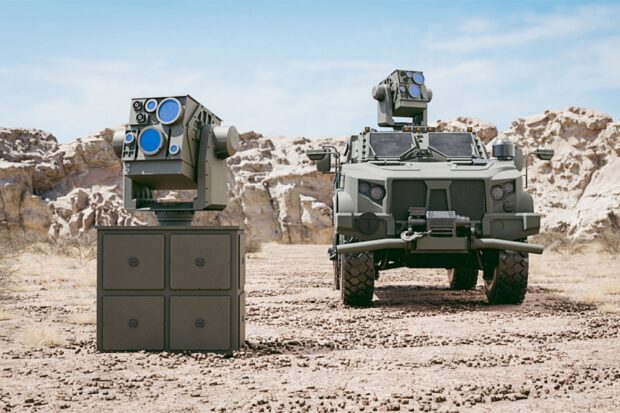
AeroVironment, Inc. has announced the release of LOCUST X3, the third generation of its high-energy laser weapon system designed to deliver precise, speed-of-light engagement against unmanned aerial threats.
Building on lessons from widely deployed systems, LOCUST X3 sets a new benchmark in modular, AI-enabled drone defence. It offers enhanced precision, scalability, and operational flexibility to counter current and emerging threats, including Group 1–3 unmanned aircraft systems and unmanned surface vehicles. Recently featured on CBS News’ *60 Minutes*, the system delivers engagements costing less than $5 per shot and provides sustained defence without the reload constraints of traditional systems.
“In today’s rapidly evolving battlespace, adversaries are deploying mass drone attacks and saturation tactics,” said Wahid Nawabi, Chairman, President, and CEO of AeroVironment. “LOCUST X3 delivers an affordable, scalable solution to counter large-scale aerial threats, protect critical infrastructure, and maintain operational advantage.”
The system features a scalable 20–35+ kilowatt laser, a modular beam director, and AI-enabled detection, tracking, and engagement powered by AV_Halo PINPOINT. This software is part of AeroVironment’s hardware-agnostic platform for layered counter-UAS defence.
Aligned with the Department of Defense’s Modular Open Systems Approach (MOSA), LOCUST X3 enables rapid upgrades and integration across fixed and mobile platforms. It builds on the proven LOCUST platform fielded through the Army’s AMP-HEL and PHEL programs and validated on platforms such as the JLTV and ISV.
“LOCUST X3 transforms how defenders respond to mass drone attacks,” said Mary Clum, President of AeroVironment’s Space, Cyber & Directed Energy segment. “Its modular, AI-driven design enables resilient protection at the tactical edge or fixed sites.”
Designed for persistent counter-UAS operations, LOCUST X3 emphasizes field maintainability, platform agnosticism, scalable lethality, and efficient production for rapid deployment and long-term support.
Source: AeroVironment, Inc.
The beam of the laser should stay on a spot of the drone for a time enough to heat and burn that spot, if that spot is not reflective of course (mirror effect). Drone is moving and changing position swiftly (direction, elevation, aspect, angle, …), there may also be physical objects between the beam and drone, dust, fume and humidity, rain drops, fog, snow flakes in the air, if there is wind the beam wanders, and there is a refraction of the laser beam due to the random air packages ( scintillation). Under all these conditions, I wonder how such a beam could destroy the drones successfully. Please explain.
Celal,
I suggest that you address your question to the manufacturer – link is in the post>
:
AeroVironment, Inc.
https://www.avinc.com/