
The landscape of unmanned aerial systems (UAS) is undergoing a fundamental transformation. As global tensions rise and the demand for long-endurance, tactical intelligence increases, the “hobby-grade” components of the past are being replaced by rigorous, aviation-standard engineering.
At the heart of this shift is Northwest UAV (NWUAV), an Oregon-based manufacturer that has quietly become the backbone of the American UAV propulsion industry.
By integrating three critical pillars—The Single-Fuel Mandate, Supply Chain Sovereignty, and Vertical Integration—NWUAV is not just building engines; it is building a more resilient national security infrastructure.
- THE SINGLE-FUEL MANDATE: Solving the Battlefield’s Greatest Logistical Nightmare
For decades, military logistics have been haunted by the “gasoline problem.” While most ground vehicles and manned aircraft in a theater of operations run on heavy fuels like JP-8, JP-5 or Jet-A, many smaller tactical UAVs traditionally required high-octane gasoline. This creates a dangerous and inefficient “dual-fuel” environment, forcing commanders to transport and store volatile gasoline alongside stable jet fuels.
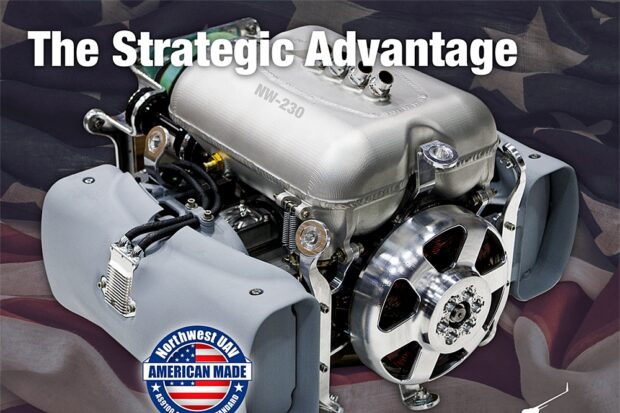
Northwest UAV’s family of engines, including the combat-proven NW-44, NW-88 and the robust NW-230, are engineered and designed specifically to thrive on heavy fuels. These multi-fuel systems allow a single fuel source to power everything from a generator to a Group III aircraft.
This isn’t just about convenience; it’s about survivability. Gasoline is highly flammable and difficult to manage in maritime or forward-operating environments. By delivering engines that achieve peak performance and an astounding 36,000-foot density altitude capability on heavy fuel, NWUAV aligns directly with NATO’s “Single Fuel” initiative. Operators can now launch missions from the deck of a destroyer or a remote desert outpost using the same fuel already in their tanks, streamlining the supply chain and reducing the footprint of every mission.
- RESHORING THE STACK: Why ‘American-Made’ is a National Security Requirement
In the early days of the drone industry, global supply chains were a convenience. Today, they are a vulnerability. Relying on foreign-made engines, ignition systems, ECU’s and Generator Controllers introduces the risk of “kill switches,” data backdoors, and sudden supply cut-offs.
Northwest UAV has been developing and producing its all-American propulsion stack since 2013 (with the company itself founded in 2005 and key “Made in the USA” heavy-fuel engine innovations like the NW-44 PMU introduced that year). Every NWUAV engine is designed, manufactured, and supported at its AS9100D-certified campus in McMinnville, Oregon. This “Reshoring” effort ensures that US defence contractors and government agencies have a trusted source for propulsion that is entirely decoupled from adversarial influence.
Being EAR99 export-approved and US-based means that NWUAV customers don’t just get a motor; they get certainty. They know exactly where their engine was machined and assembled, who assembled the wiring harness, and that every component meets the highest standards of American aerospace quality. In an era where “Trusted Microelectronics” and “Secure Supply Chains” are top-tier Department of Defense priorities (NDAA Compliance), NWUAV provides a blueprint for how American manufacturing can reclaim its dominance in high-tech aerospace.
- THE POWER OF VERTICAL INTEGRATION: From Blueprint to Flight in Record Time
In the traditional aerospace model, building a custom propulsion system is a fragmented process. One vendor handles the machining, another the wiring, and yet another the testing. This siloed approach results in lead-time delays, communication breakdowns, and hidden costs. Northwest UAV has disrupted this model through total vertical integration. Its campus is a “one-stop shop” for UAV development, featuring:
- Advanced CNC Machining: For precision engine components.
- SLS 3D Printing: Allowing for rapid prototyping and complex geometry parts that traditional manufacturing can’t touch.
- Specialized Wiring Harness Shop: Producing protected components that ensure electronic reliability in contested environments.
- On-Site FAA-Certified UAS Range: The “FAST” range allows engineers to take an engine out of the test cell and put it in the air on the same day.
This integration collapses the OODA loop (Observe-Orient-Decide-Act) for aircraft designers. When a project manager needs a modification to an engine mount or a custom harness for a new payload, it happens across the hall, not across the ocean. This speed-to-market is the ultimate competitive advantage, allowing NWUAV partners to iterate faster and deploy more reliable systems than their competitors.
Engineering the Future of Flight
The mission of Northwest UAV extends far beyond internal combustion. With the development of the NWFC-1500 PEM Fuel Cell, they are already bridging the gap to the next generation of silent, zero-emission, long-endurance flight. Whether it’s a heavy-fuel engine powering the demands of a tactical ISR mission or a hydrogen fuel cell enabling silent, covert operations, the common thread is American-made reliability.
Source: Northwest UAV