
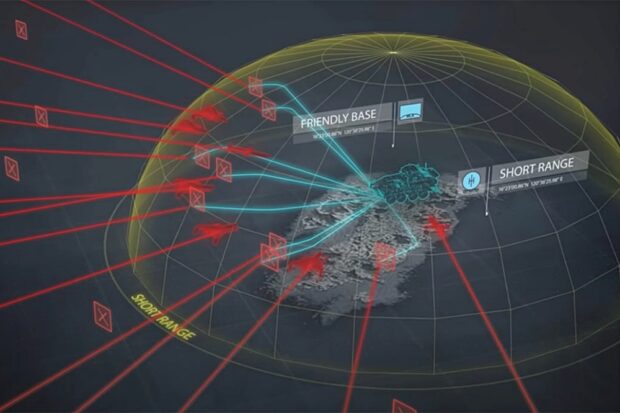
Northrop Grumman is advancing its Cannon-Based Air Defense (CBAD) concept as a scalable response to the growing threat of drone swarms and low-flying cruise missiles targeting U.S. Army formations.
CBAD integrates guided medium-caliber cannon ammunition with layered radar and electro-optical sensors, all connected through battle management command-and-control networks. Rather than functioning as a standalone gun system, it is designed as a fully networked defensive architecture combining battle-proven automatic cannons, advanced ammunition, surveillance radars, electro-optical trackers, and digital fire-control systems. This integration enables coordinated terminal defense against massed aerial attacks.
The concept emphasizes cost-effective engagement. By relying on precision-guided cannon projectiles instead of expensive missile interceptors, CBAD aims to provide sustained short-range air defense against large-volume, low-cost threats. The approach reflects Army concerns that missile-based defenses could face financial and logistical strain during prolonged, high-intensity conflicts.
A key enabler is guided ammunition. Unlike traditional programmable airburst rounds that detonate at a preset time, guided cannon projectiles perform in-flight trajectory corrections toward aerial targets. Fired in controlled salvos, these munitions extend engagement range and significantly improve probability of kill against maneuvering unmanned aircraft systems and low-flying cruise missiles. In effect, the concept transforms the cannon from a purely ballistic area weapon into a maneuver-capable short-range interceptor.
While full performance data has not been publicly released, CBAD builds on existing medium-caliber systems such as the 30 mm XM813 Bushmaster chain gun mounted on Stryker M-SHORAD vehicles, which fires at roughly 200 rounds per minute with typical air defense ranges of 2–3 kilometers. Larger 35 mm systems, common in European service, can exceed 4 kilometers, delivering greater fragment mass and extended terminal coverage.
Sources: Northrop Grumman; Army Recognition