
The thunder of rotor blades announces helicopters from miles away. Radio chatter fills enemy listening posts with target coordinates. Electronic signatures light up radar screens like beacons in the night. Every military aviation unit accepted that flying high-stakes insertions and rescue missions meant being detected by the enemy.
But at Fort Campbell, Kentucky, a different breed of aviator has been systematically destroying every assumption about what helicopters can and cannot do. They flew into Grenada’s humid Caribbean air and vanished between the palm trees. They threaded through Pakistan’s mountain valleys and delivered Navy SEALs to Osama bin Laden’s doorstep without a whisper. They have learned to make 16,000-pound war machines disappear from radar screens and move through hostile airspace like ghosts.
They call themselves Night Stalkers, and they have turned the impossible into just another mission.
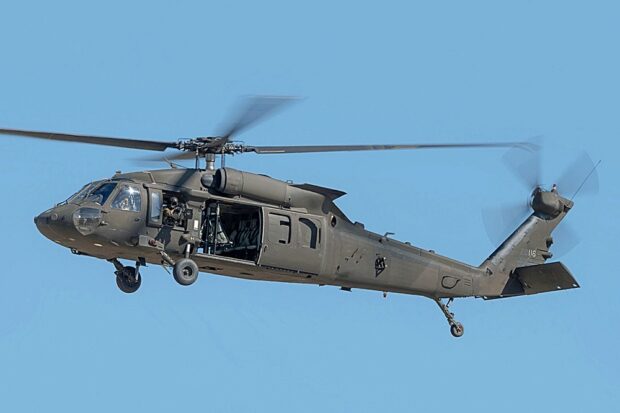
The Sikorsky UH-60 Black Hawk is a four-blade, twin-engine, medium-lift military utility helicopter manufactured by Sikorsky Aircraft. Sikorsky submitted a design for the United States Army’s Utility Tactical Transport Aircraft System (UTTAS) competition in 1972. The Army designated the prototype as the YUH-60A and selected the Black Hawk as the winner of the program in 1976, after a fly-off competition with the Boeing Vertol YUH-61.
Named after the Native American war chief Black Hawk, the UH-60A entered service with the U.S. Army in 1979, to replace the Bell UH-1 Iroquois as the Army’s tactical transport helicopter. This was followed by the fielding of electronic warfare and special operations variants of the Black Hawk. Improved UH-60L and UH-60M utility variants have also been developed.
Major variants include the Navy’s SH-60 Seahawk, the Air Force’s HH-60 Pave Hawk, the Coast Guard’s MH-60 Jayhawk and the civilian S-70. In addition to use by U.S. armed forces, the UH-60 family has been exported to several nations and produced under contract in Japan as the Mitsubishi H-60.
Initial Requirement
In the late 1960s, the United States Army began forming requirements for a helicopter to replace the UH-1 Iroquois, and designated the program as the Utility Tactical Transport Aircraft System (UTTAS). The Army also initiated the development of a new, common turbine engine for its helicopters that would become the General Electric T700. Based on experience in Vietnam, the Army required significant performance, survivability and reliability improvements from both UTTAS and the new powerplant.
The Army released its UTTAS request for proposals (RFP) in January 1972. The RFP also included air transport requirements. Transport within the C-130 limited the UTTAS cabin height and length.
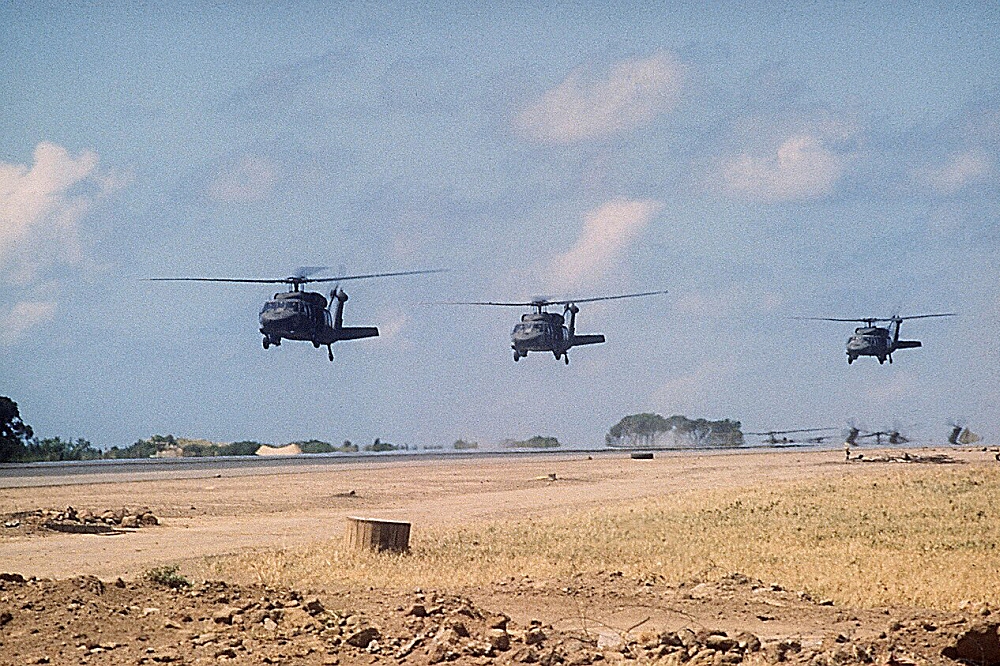
Three U.S. Army Sikorsky UH-60A Black Hawk helicopters prepare to touch down next to the Point Salines airport runway during “Operation Urgent Fury” on 25 October 1983
The UTTAS requirements for improved reliability, survivability and lower life-cycle costs resulted in features such as dual-engines with improved hot and high altitude performance, and a modular design (reduced maintenance footprint); run-dry gearboxes; ballistically tolerant, redundant subsystems (hydraulic, electrical and flight controls); crashworthy crew (armoured) and troop seats; dual-stage oleo main landing gear; ballistically tolerant, crashworthy main structure; quieter, more robust main and tail rotor systems; and a ballistically tolerant, crashworthy fuel system.
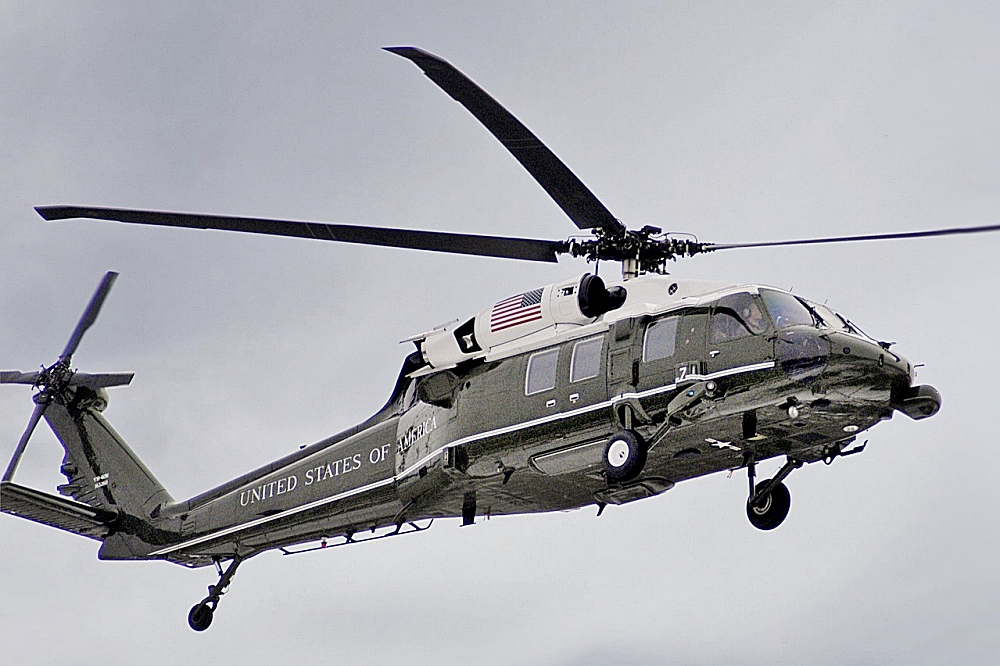
A VH-60N Whitehawk executive transport helicopter, assigned to Marine Helicopter Squadron One (HMX-1), flies over the Potomac River in Washington, D.C., en route to the White House.
Four prototypes were constructed, with the first YUH-60A flying on 17 October 1974. Prior to the delivery of the prototypes to the US Army, a preliminary evaluation was conducted in November 1975 to ensure the aircraft could be operated safely during all testing.
Three of the prototypes were delivered to the Army in March 1976, for evaluation against the rival Boeing-Vertol design, the YUH-61A, and one was kept by Sikorsky for internal research. The Army selected the UH-60 for production in December 1976.
Deliveries of the UH-60A to the Army began in October 1978 and the helicopter entered service in June 1979.
Top Photo: An aircrew with the 1st Battalion, 147th Aviation Regiment of the Wisconsin National Guard at Madison operate a UH-60 Black Hawk helicopter at the headquarters helo pad March 11, 2019, at Fort McCoy, Wis.
Sources: YouTube; Wikipedia