
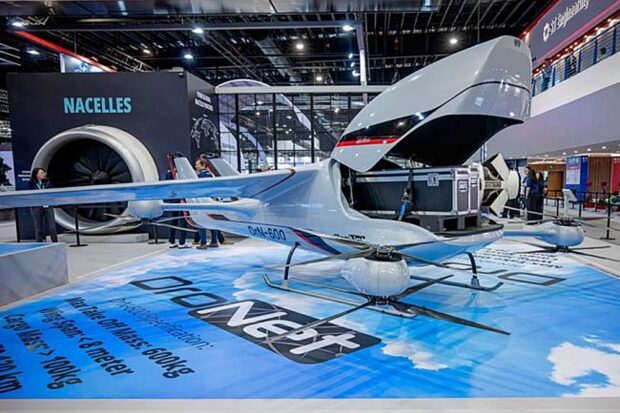
Singapore-based defence and technology firm ST Engineering has unveiled plans for a new unmanned air system aimed at civil cargo operations.
Revealed at the 2026 Singapore Airshow, the DrN-600 is an all-electric vertical take-off and landing (eVTOL) platform marking ST Engineering’s entry into the medium-lift UAS segment.
The multi-rotor aircraft features four nacelles, each housing two coaxial rotor assemblies powered by electric motors for vertical lift. An 8m (26ft) wing is mounted above the central fuselage, complemented by twin vertical tails for stability in forward flight.
The fuselage houses up to 100kg (220lb) of cargo, accessed through an upward-opening nose reminiscent of a Boeing 747. The aircraft has a maximum take-off weight of 600kg and a projected range of 37–64nm (70–120km). Its cargo bay offers around 1.5m³ of usable volume and is sized for standardised front-loading pallets, enabling compatibility with existing logistics processes rather than requiring dedicated handling systems.
ST Engineering says this configuration allows the DrN-600 to support last-mile delivery in areas where conventional aircraft or ground transport are limited, including islands, mountainous terrain and remote communities.
According to the company, the design addresses key barriers to large-scale UAS commercialisation, particularly technology robustness and unit economics.
Chua Jin Kiat, executive vice-president of ST Engineering’s international defence business, says the DrN-600 will integrate into the company’s broader UAS ecosystem, including centralised docking control and smart digital network connectivity for urban operations. He adds that the aircraft is designed to deliver strong performance while aligning with regulatory requirements.
Although developed primarily for commercial cargo, the DrN-600 will also be offered as a dual-use platform for military applications, says Teong Soo Soon, head of unmanned aerial systems.
A baseline aircraft is scheduled to begin flight testing in the second quarter, with certification of the final design expected within two years.
Sources: FlightGlobal ; Aerospace Global News