Residents in a small community in Cowley County, Kansas got the thrill of the year recently when a flatbed trailer came driving down main street with what appeared to be a saucer shaped craft on the trailer. Continue reading

UAS VISION
an independent online news service for the Unmanned Aircraft Systems world
Residents in a small community in Cowley County, Kansas got the thrill of the year recently when a flatbed trailer came driving down main street with what appeared to be a saucer shaped craft on the trailer. Continue reading
The Military Channel just posted this video of a NATO cyber-attack prevention exercise held recently in Belgium. Continue reading
A rash of new clues surrounding the Sykipot computer virus having its way with the US unmanned aircraft fleet suggests the malware originated in China, and explains how it has been used. Continue reading
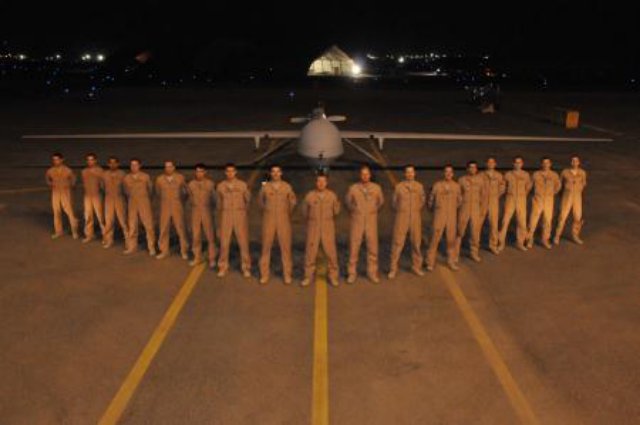
Lt. Col. Erik Drake, 46th Expeditionary Reconnaissance Squadron Commander with assigned airmen in front of a MQ-1B Predator Dec. 15, 2011. Photo by Master Sgt. Paul Mann
As the world watched the last convoy pass through the gates at Khabari Crossing on the Kuwait-Iraq border, they may not have realized those on the ground had some help in the skies from airmen with a historic lineage. Continue reading
Australia’s Defense Department removed three major projects, including the Joint 129 Phase 2 project for tactical unmanned aircraft, from its official list of contracts falling behind schedule or having cost overruns. Continue reading
An internal review of the US Air Force’s intelligence, surveillance and reconnaissance (ISR) capabilities indicates the need for unmanned aircraft systems that can survive in contested airspace, as well as improved data processing and greater capacity for movement and dissemination of that data, according to a senior service official. Continue reading
A former contract worker for Insitu pleaded not guilty in Federal Court last week to stealing a maintenance manual for top-secret UAS technology. Continue reading
A new Pentagon study shows that almost 30 percent of UAS pilots surveyed suffer from what the military calls “burnout.” It’s the first time the military has tried to measure the psychological impact of waging a “remote-controlled war.” Continue reading