
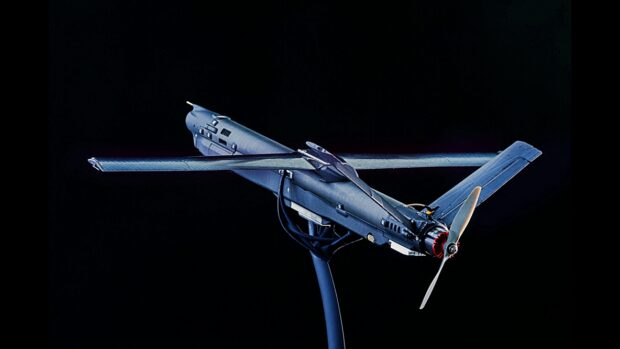
Swedish defence tech company Nordic Air Defence (NAD) has unveiled the K200, its next-generation autonomous drone interceptor. The company announced that the drone could be deployed in Ukraine for testing and evaluation in a real-world combat scenario.
The successor to the company’s Kreuger 100XR, the K200 was developed to counter jet-powered, one-way attack drones—notably the Russian-made Geran-3, which has menaced Ukrainian cities for years. Russia typically escalates its bombing attacks on Ukrainian cities during the winter, making the K200’s development fortuitous for Kyiv’s air defence.
- While the K100 (OG model) was designed for Group 1-2 drones, K200 is designed to hit larger, faster threats like the jet-powered Geran 3a and 4, NAD CEO and co-founder Karl Rosander told Tectonic.
- In tests, the interceptor has hit 9/10 targets, he added, and features totally autonomous guidance. It also circles targets and re-engages them if it misses.
- K200 is about two times the size of the K100 and can carry a 500g warhead (versus the K100’s 250g).
“As those drones become faster and attacks grow larger, Europe needs interceptors that can keep pace and be produced in volume,” Rosander said. “[This] is our next step in meeting that need, [and] testing in Ukraine will help us improve the system against real threats.”
Great white north: Now, Nordic Air Defence is a company very much founded in the “making taking down aerial threats much cheaper” era.
- The company was set up by Rosander (who founded podcast platform Acast in a previous life), alongside Gustav Wiberg and Oskar Heiwe in Stockholm back in 2023.
- The idea was to make shooting drones (primarily) out of the sky way, way cheaper. As we’ve said a million times, and we’ll say again, it’s pretty freaking dumb to shoot a low-cost drone out of the sky with a $3M missile.
- The company has put a pretty huge premium on testing in Ukraine—and building based on what they hear operators need. Rosander said they work “very, very, very closely with [their] partners in Ukraine,” and have been testing their systems in-country “for a while.”
- They’ve also set up operations and production partnerships in Poland, the UK, and Ukraine, per Rosander.
Oh, and they’ve raised a total of $4.98M in funding, according to Pitchbook data, most recently a $3M seed led by Inflection.
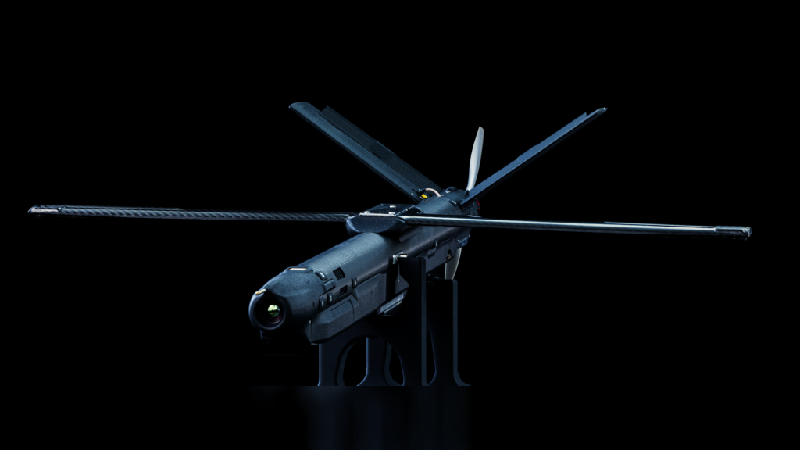
Small but mighty: The company’s first-slash-flagship interceptor, the K100, was focused primarily on those smaller, quadcopter-like drones that terrorize operators on places like the Ukrainian frontline.
- The original model looks like a teeny-tiny missile—about the size of a Subway footlong, for the Americans among us.
- It’s battery-powered and uses a single propeller (keeping things low-cost). Rosander also said none of their drones contain Chinese components.
- The upgraded version of the K100—the K100XR—features folding wings, which aimed to increase range and speed.
- The K100 (OG) can reach speeds of 270 km/hr, and the XR version 354 km/h, both at a range of more than 3 km.
- It’s also got a blast radius—with that 250g payload—of about five meters.
Big ups: The K200 is a pretty substantial upgrade for the jet-powered drone era.
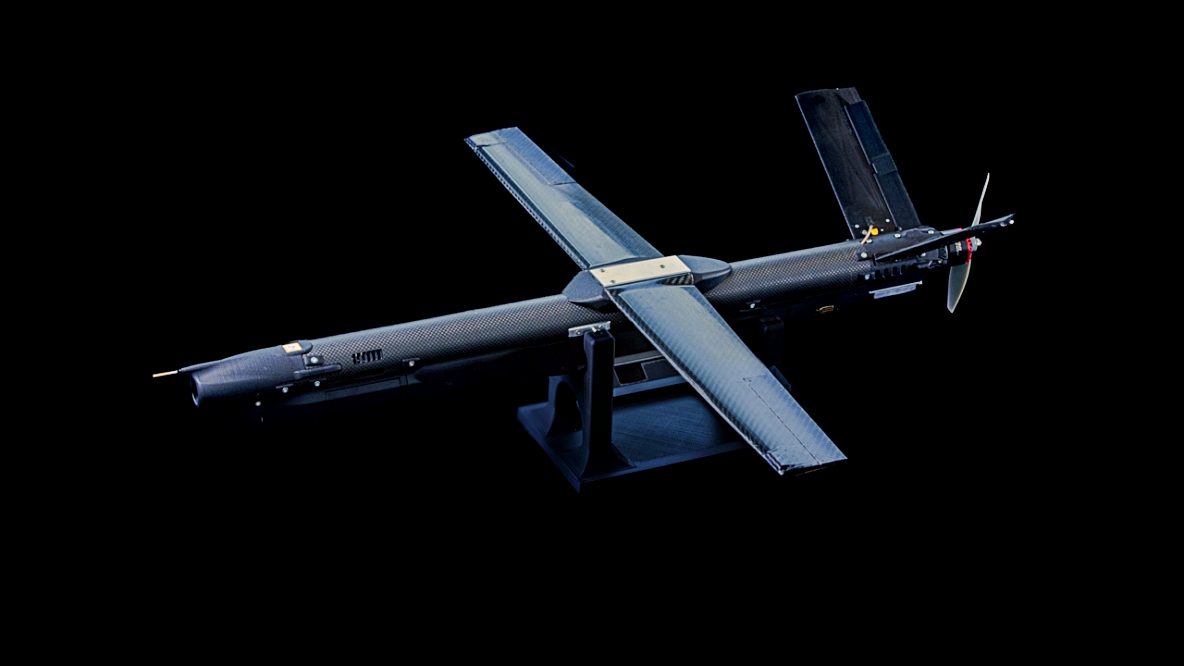
- Rosander said the interceptor was developed in just 70 days based on customer requests to counter those faster Gerans and Shaheds. It’s a slightly larger mini-missile with a fixed-wing setup like the K100XR.
- Like the K100, it’s fully autonomous (built in-house) and uses onboard cameras and sensors to detect and lock-on targets.
- It can also be launched from NAD’s different launch setups—VIPRO (vehicle-mounted pod), Striker (portable tactical rail launcher), or Matchbox (modular vehicle-mounted or standalone launcher).
- And, per Rosander, “you don’t need to have a direct hit. [Users] can choose track and follow, so you can explode when it’s the best place to explode it.” The K200 has a blast radius of more like 10-12 meters thanks to that 500g payload, per Rosander.
- Right now, it’s “not for the Geran 5 yet,” he added, but they’re iterating quickly to get there.
The system is also sensor- and C2-agnostic.
“We need a coordinate from any 3D sensor or any visual sensor; we just need the coordinates, and then we go…and we calculate the best path to hit the target,”
Rosander said.
Hush hush: Rosander wouldn’t tell us exactly how much the K200 costs, but said that
“outside Ukraine, for an autonomous interceptor…you won’t find anyone that can make by far for this low price.”
- Interestingly, he said that the K100 and K200 are about the same cost, production-wise.
- The company “will be able to produce 1,000 a month internally,” he said, but that they will scale that way up with their partners around the world.
The K200 supports tail-chase, head-on and crossing engagements and is designed to integrate with existing layered air defence systems through data links and associated radars. A family of launchers supports deployment from vehicles, fixed sites and vessels, while shared avionics, propulsion and seeker technology allow NAD to reuse components across its interceptor range as it prepares to scale production.
NAD has opened a staffed office in Ukraine, where testing will inform further development of the K200 as the company prepares to introduce the system across multiple markets.
Karl Rosander, CEO and Co-founder of Nordic Air Defence, says:
“Defenders cannot keep using expensive missiles against drones that cost a fraction of the price. As those drones become faster and attacks grow larger, Europe needs interceptors that can keep pace and be produced in volume. The K200 is our next step in meeting that need. Testing in Ukraine will help us improve the system against real threats and bring those lessons to customers across multiple markets.”
Sources: Tectonic Defense; National Interest; Autonomy Global