
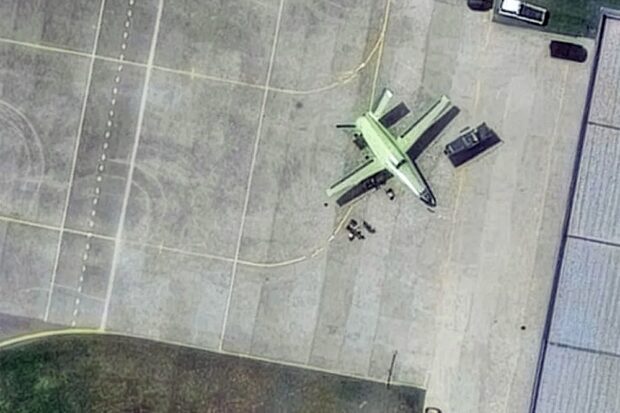
Satellite imagery has revealed an unusual unmanned aircraft at Pucheng, China, with a configuration that bears very strong similarities to Boeing’s carrier-based MQ-25 Stingray. While we still have no idea about the function of the drone, the facility itself also appears to be an increasingly important hub for China’s expanding unmanned aircraft industry.
The drone initially attracted attention after being spotted in a satellite image of Pucheng Neifu Airport in Shaanxi Province, in northwestern China, available through Apple Maps. A separate image of the drone, where it appears on a runway, is also available through Bing Maps. TWZ subsequently obtained imagery of Pucheng from Vantor showing the unmanned aircraft in question.
The most obvious comparison for the unidentified aircraft is Boeing’s MQ-25 Stingray.
The MQ-25 is a carrier-based unmanned aircraft developed primarily to provide aerial refuelling for U.S. Navy aircraft, extending the range and operational flexibility of carrier air wings. It also provides a foundation for future unmanned naval aviation capabilities.
In terms of dimensions, the unidentified Chinese UAV has a wingspan of approximately 66 feet and a length of 49 feet, according to Vantor. In contrast, the MQ-25 measures approximately 75 feet in wingspan and 51 feet in length.
The Chinese drone appears to occupy a similar general design category, but there are several important differences notable at this stage.
One of the most noticeable is the forward fuselage. Unlike the MQ-25, whose forward section has a relatively flattened, shovel-like appearance, the Chinese aircraft appears to have a more conventional, tapered nose. Perhaps this could incorporate a conical radome housing radar equipment. That theory, and it is just a theory, could be supported by the different colour of the nose compared to the yellow primer-painted airframe.
The air intake is also different. Rather than the exotic, flush inlet associated with the MQ-25, the Chinese design has a more conventional dorsal intake that appears serrated to help with radar signature and/or split into two channels. Another possibility is that the aircraft has two engines, although that remains speculative, based on the apparent bifurcated intake.
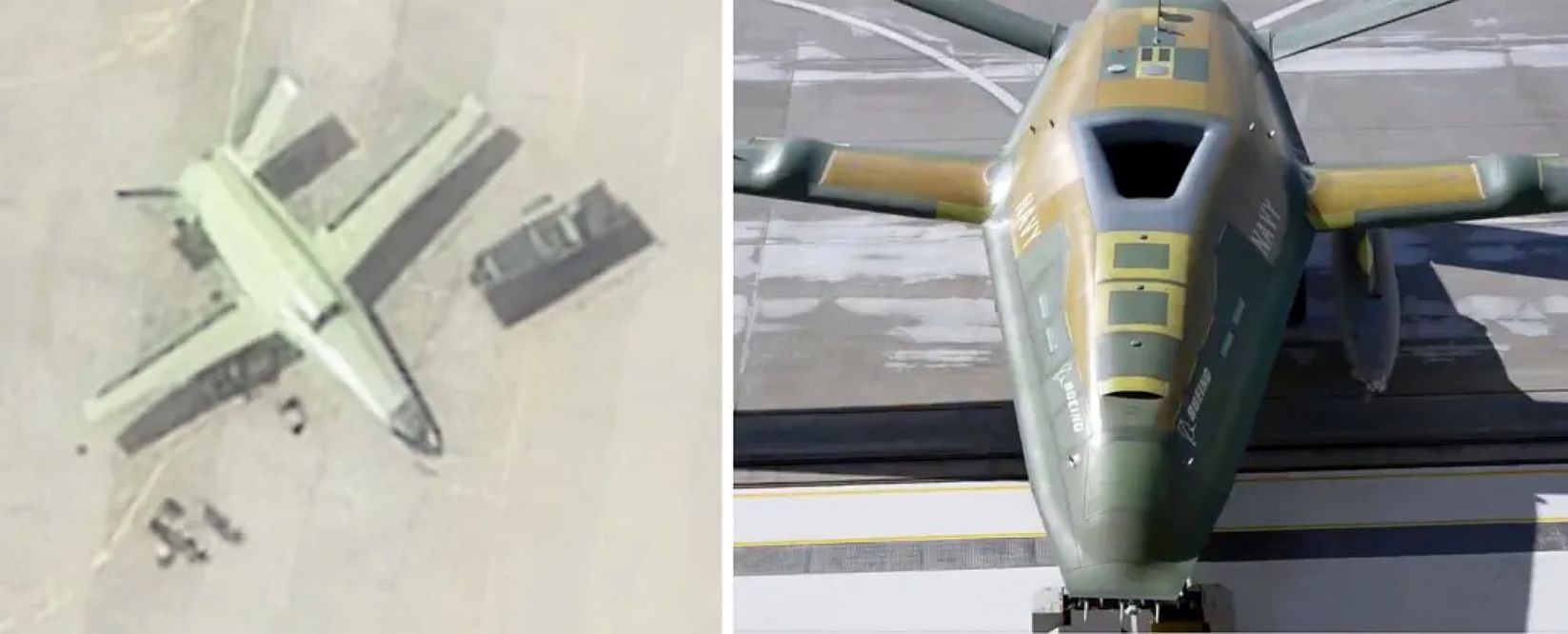
A side-by-side look at the drone seen in the image of Pucheng, at left, and an MQ-25, offering comparative views of their inlets. Satellite image ©2026 Vantor/Boeing
The tail configuration may also be distinctive, with a laterally flared V-tail, like the MQ-25 Stingray , but possibly incorporating visible control surfaces instead of an all-moving tailplane design.
Taken together, these features suggest an aircraft that shares some of the MQ-25’s general design philosophy but is not an attempt at a direct clone.
The aircraft’s appearance is also interesting given the location where it has been spotted.
Pucheng Neifu Airport is located in Shaanxi Province, and its surrounding aviation facilities include an area identified in Apple Maps as the National Aeronautics Industrial Base Pucheng General Aviation Industrial Park Guanliban.
The industrial park has its own smaller runway, separate from the main airport infrastructure.
Source: The War Zone