
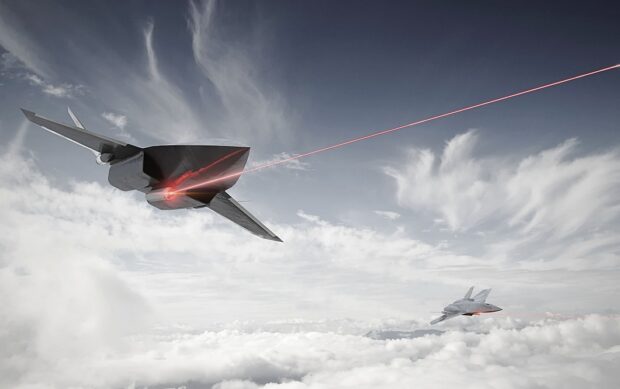
Germany has launched a new effort to develop an airborne laser weapon. The new contract is Germany’s first formal foray into airborne laser weapons, but builds on years of German investment and maritime laser weapon trials.
MBDA announced that it had been contracted by the Federal Office of Bundeswehr Equipment, Information Technology and In-Service Support (BAAINBw) to undertake the development effort. The project centers on a pod-based demonstrator system, with essential components already being designed.
The goal is to establish the technological foundations for future laser weapons on board aircraft. The contract now awarded stipulates that key components of the so-called Laser-Pod are already designed for later flight operations.
This is intended to verify the feasibility of an airborne laser weapon and lay the foundation for future operational capability with the Luftwaffe. In expert circles, the development of an airborne laser is considered a particularly demanding “crown jewel” of laser weapon technology – especially due to the extreme requirements for size, weight, and resilience against flight conditions.
Quick Facts
- Programme: Airborne laser weapon demonstrator for the Bundeswehr
- Contractor: MBDA Deutschland
- Customer: BAAINBw, the Federal Office of Bundeswehr Equipment, Information Technology and In-Service Support
- Announced: 2 November 2026
- Format: Pod-based demonstrator, key components designed for flight from the start
- Main targets: Drones and cruise missiles (MBDA)
- Not disclosed: Contract value, host aircraft, laser power, schedule
What MBDA has been Asked to Build
According to MBDA, the project centres on a laser pod whose essential components are already being designed, and the job is to lay the technological foundations for future airborne laser weapons. The longer-term goal is a capability that could shoot down drones and cruise missiles. MBDA also sees uses in protecting ships, ground vehicles, troops and critical infrastructure.
What the announcement leaves out is almost as interesting as what it says. There is no contract value, no laser power class, no development timeline and no named host aircraft. The accompanying artwork shows two large, stealthy, unmanned fighter-like aircraft with laser pods slung under their fuselages, but that is an illustration of the idea rather than a commitment to a platform.
Why an Airborne Laser is the Hardest Kind
A laser weapon on a frigate can draw on the ship’s generators and dump heat into the sea. An aircraft pod has none of those luxuries. Every kilogram, every litre of coolant and every kilowatt of electrical power has to be found inside a streamlined shape that must survive vibration, temperature swings and manoeuvring loads. MBDA says exactly that: the size, weight and robustness requirements for flight are what make the airborne version so demanding.
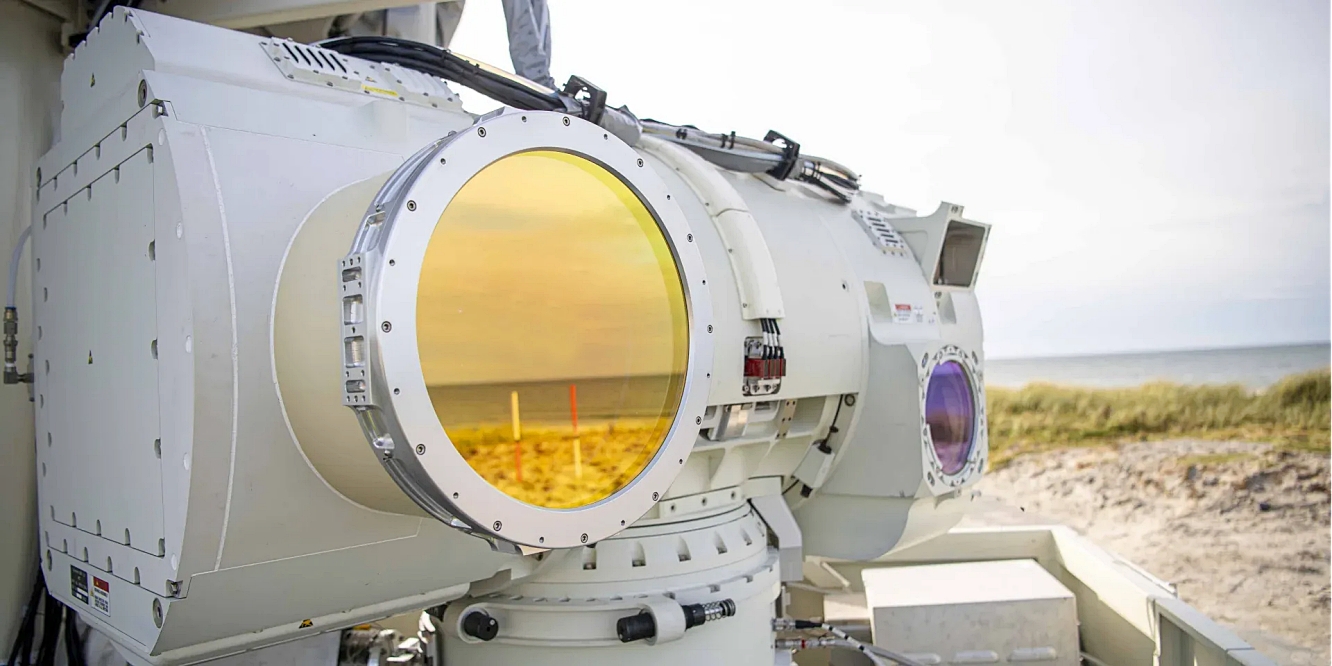
DRAGONFIRE, a Laser Directed Energy Weapon (LDEW) system
The prize is magazine depth. A missile is gone once it is fired. A laser keeps shooting for as long as there is power and cooling. Against waves of cheap one-way attack drones, that arithmetic matters, and it is why air forces from the United States to the United Kingdom are chasing the same goal. The most famous earlier attempt, the U.S. YAL-1, needed an entire Boeing 747 to carry its megawatt-class chemical laser. Germany is aiming for a pod.
What Germany’s Airborne Laser Means for the Luftwaffe
For now this is a demonstrator, not a weapon programme, and nobody has said which aircraft will carry it. The Luftwaffe flies the Eurofighter Typhoon today and is buying the F-35A, while the rendering hints at future unmanned combat aircraft. Each would pose very different power and cooling questions.
What the contract does settle is the direction of travel. Berlin has a working naval laser on the way and now wants to know whether the same physics can fly. If MBDA cracks the pod, a fighter’s answer to a swarm of drones might one day be measured in seconds of beam time rather than in expensive missiles.
Sources: MiGFlug; The War Zone; X