

To advance United States counter-UAS capabilities, the Defense Innovation OnRamp Hub: Kentucky – a Defense Innovation Unit program – partnered with V Corps from Nov. 3-5 to test emerging defence technologies against simulated threats.
“Evaluating intense radio-frequency jamming and drone tracking requires vast space and specialized infrastructure,”
Tobin said.
“Yano Range provided the controlled environment needed to safely blast high-density electronic signatures without disrupting external communications. A test like this could not have provided the much-needed, real world results V Corps needed without it.”
Tobin noted that the ability to confront complex electromagnetic threats before encountering them in the field will give the warfighter a decisive tactical edge.
“The focus was clear,” Tobin said. “Accelerate innovation, turn emerging technology into an operational advantage and ensure we’re ready to fight tonight, not someday.”

An unmanned aircraft awaits testing during Independent Verification and Validation (IV&V) 27-1: SPECTRUM PROOF at Fort Knox, Kentucky, Oct. 29, 2026.
During three days of demonstrations, 15 commercial technology providers deployed systems designed for electromagnetic support and attack, showcasing their abilities to detect and disrupt UAS under contested conditions.
“This kind of event delivers validated, lethal electromagnetic warfare solutions directly to the warfighter, ensuring we dominate the spectrum on the modern battlefield,” Tobin said.
By using tactical expertise from V Corps, subject matter experts tested the emerging warfare technologies against realistic, modern battlefield scenarios.
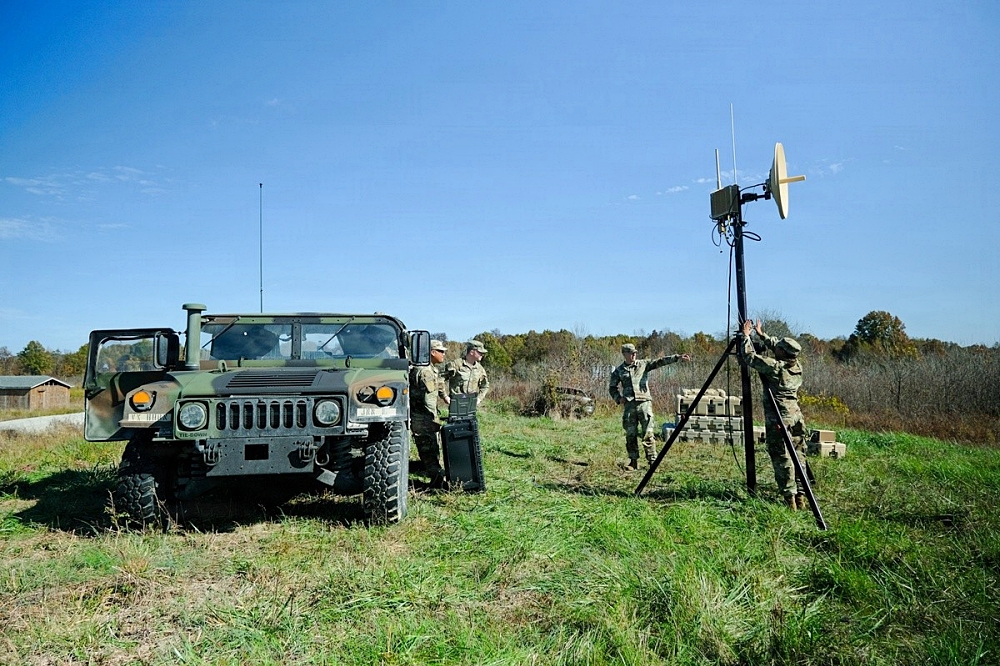
U.S. Army Soldiers assigned to the Joint Network Node Platoon, V Corps, position a Terrestrial Transmission Line of Sight (TRILOS) system toward participating commercial vendors during Spectrum Proof 27-01 at Yano Range, Fort Knox, Kentucky, Nov. 6, 2026. (U.S. Army photo by Sgt. Brandon Vasquez)
Tobin added that the exercise marks a significant step in Fort Knox’s transition from a traditional training installation to a premier location for high-intensity, multidomain warfare instruction.
“As warfare continues to evolve, our installations must evolve with it,”
he said.
“Spectrum Proof is an example of how Fort Knox can help lead that change by providing an environment where Soldiers, industry and military leaders can come together to test, evaluate and advance emerging capabilities. The future fight will be multidomain, and we need to ensure our formations are prepared to operate and win in that environment. This is an important step in positioning Fort Knox as part of that future.”
Tobin said proactively pairing warfighters with new technology in active scenarios also shows a fundamental shift in how the military approaches technological modernization. The goal is no longer just incremental upgrades, but staying ahead of an environment that constantly changes.
“Technology evolves every year, and for too long, we’ve been caught in a cycle of playing catch-up and hoping we’re ready,”
said Tobin. “
This event is about breaking that cycle. It embodies the Department of War’s commitment to readiness and lethality by demonstrating how non-lethal capabilities can enable greater precision and effectiveness in future conflicts.”
Following the operational runs and a distinguished visitor demonstration day, evaluators compiled after-action review packages, the findings of which will provide senior defence leaders with quality data to direct future Cyber Electromagnetic Activities development.
Top Photo: Teams demonstrate unmanned aerial system and counter unmanned aerial system capabilities during a controlled, high-density Electromagnetic Spectrum evaluation at Fort Knox, Kentucky on Nov. 3, 2026. (Photo Credit: Savannah Baird)
Source: U.S. Army