
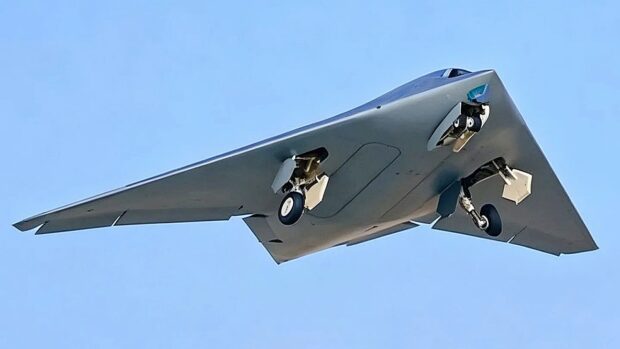
China has provided us with the clearest look yet at its GJ-11 stealth unmanned combat aerial vehicle (UCAV), with new official footage revealing previously unseen details of the flying-wing drone, including its internal weapons bays, landing gear, nose-mounted sensor installation, and distinctive exhaust arrangement.
The release also comes alongside a claim from the People’s Liberation Army Air Force (PLAAF) that the GJ-11 has completed its first live-fire strike mission, scoring a hit. This is somewhat puzzling, since the UCAV has racked up test sorties for years already, including at forward operating locations, and it seems almost inconceivable that a live weapons delivery would not have been conducted before now. Perhaps this is a case of something being lost in translation, such as the use of a new internal sensor or a new type of weapon delivery.
The footage, broadcast by Chinese state television’s CCTV , comes two days ahead of the 77th anniversary of the founding of the PLAAF. Accompanying reporting provides additional details about the aircraft’s intended mission set, including airstrikes and suppression of enemy air defences (SEAD), as well as its integration into manned-unmanned teaming (MUM-T) operations with manned fighters.
The new disclosures offer the most comprehensive public look yet at the GJ-11’s configuration and provide further insight into how China intends to employ the stealthy flying-wing aircraft, which is named Xuanlong — Chinese for Mystery Dragon.
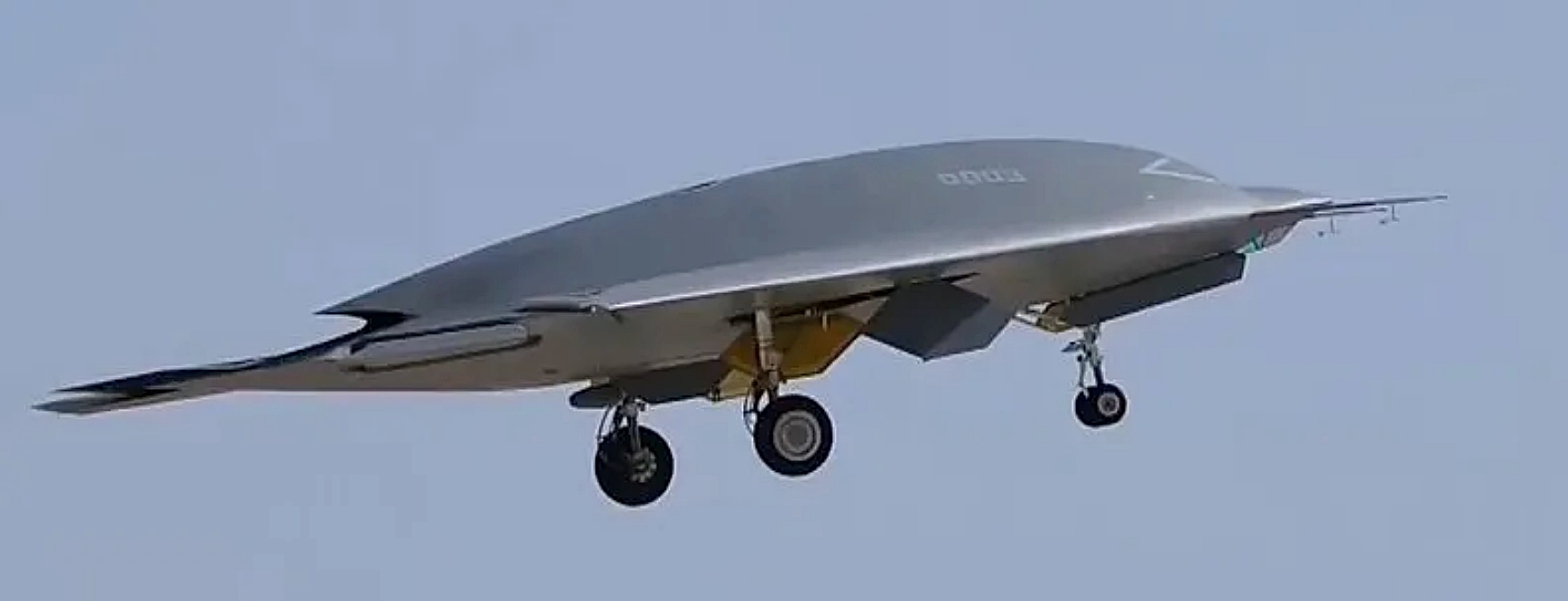
A GJ-11 takes off. PLA screencap
A Closer Look at the GJ-11
One of the most revealing views shows the underside of the GJ-11, clearly exposing its two internal weapons bays. Located within the aircraft’s blended wing-body, the ventral bays have separate sets of doors with distinctive serrated edges — a common feature on low-observable aircraft. The internal arrangement and dimensions of the bays remain unclear, as does the precise range of weapons the aircraft can accommodate. However, it would appear likely that each bay can accommodate at least a 1,000-pound-class and likely a 2,000-pound-class weapon.
#GTMilitaryWatch CCTV News military channel released new footage on Monday offering a close-up, multi-angle look at the Chinese People’s Liberation Army (PLA) Air Force’s GJ-11 stealth drone. It also revealed that two of the Air Force’s first batch of self-trained female drone operators scored a first-round hit during the GJ-11’s first live-fire strike mission.
https://t.co/1Xa4fbXNgI— Global Times (@globaltimesnews) November 9, 2026
According to CCTV, the two bays can carry a variety of air-to-ground/surface munitions. The weapons bay configuration had previously been revealed in a model of the GJ-11 displayed by the Aviation Industry Corporation of China (AVIC) at Airshow China in 2021, but the new footage provides a much better look at the actual aircraft.
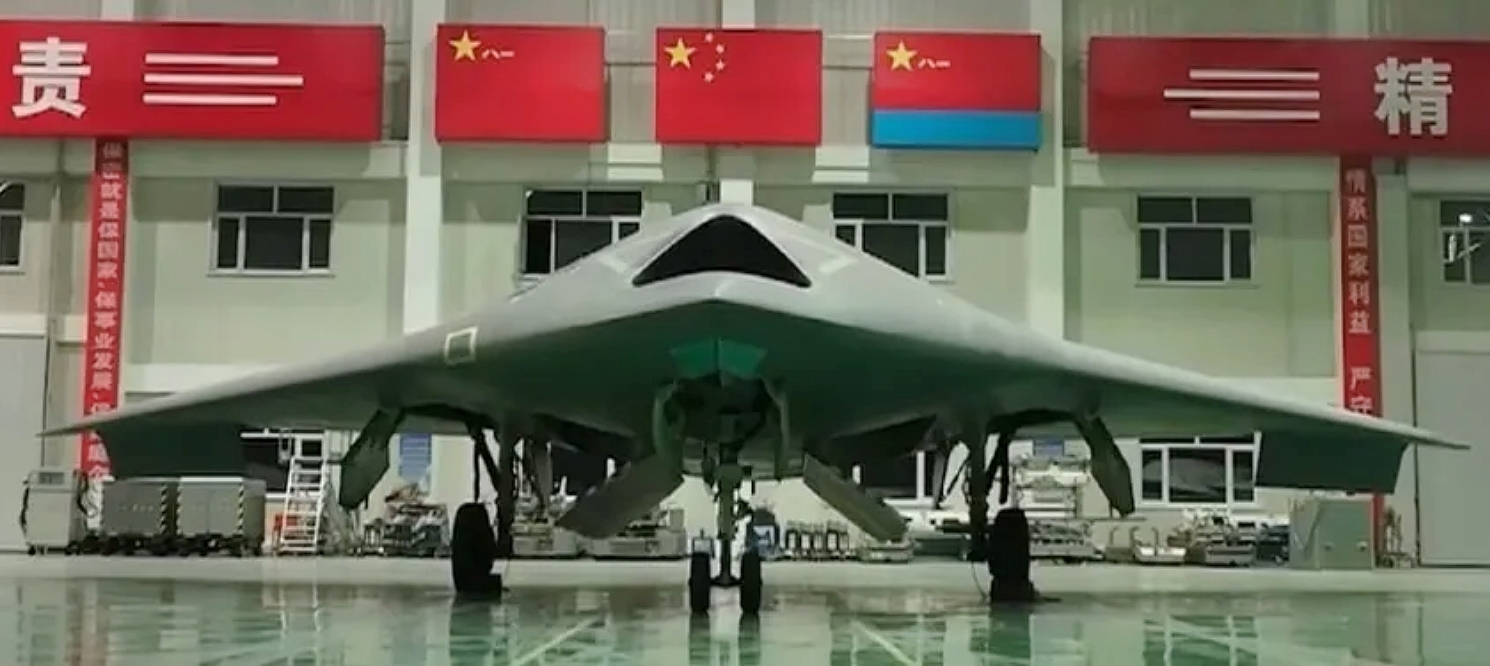
Head-on view of a GJ-11 in the hangar, with the weapons bay doors partially open. PLA screencap
Internal weapons carriage is central to the GJ-11’s low-observable design, allowing it to carry munitions without the radar signature (and aerodynamic) penalties associated with external pylons and stores.
The new imagery also offers a closer look at a trapezoidal glazed fairing beneath the nose. This appears consistent with an electro-optical/infrared (EO/IR) sensor installation. Its precise configuration and capabilities have not been disclosed, but it’s worth noting that similar-looking installations also appear on the crewed J-20 and J-35 fighters, with these systems apparently being analogous to the electro-optical targeting system, or EOTS, found on the F-35.
If the sensor on the GJ-11 works like an EOTS, it would provide the drone with precision targeting and identification, lasing, as well as a secondary infrared search-and-track emulation function.
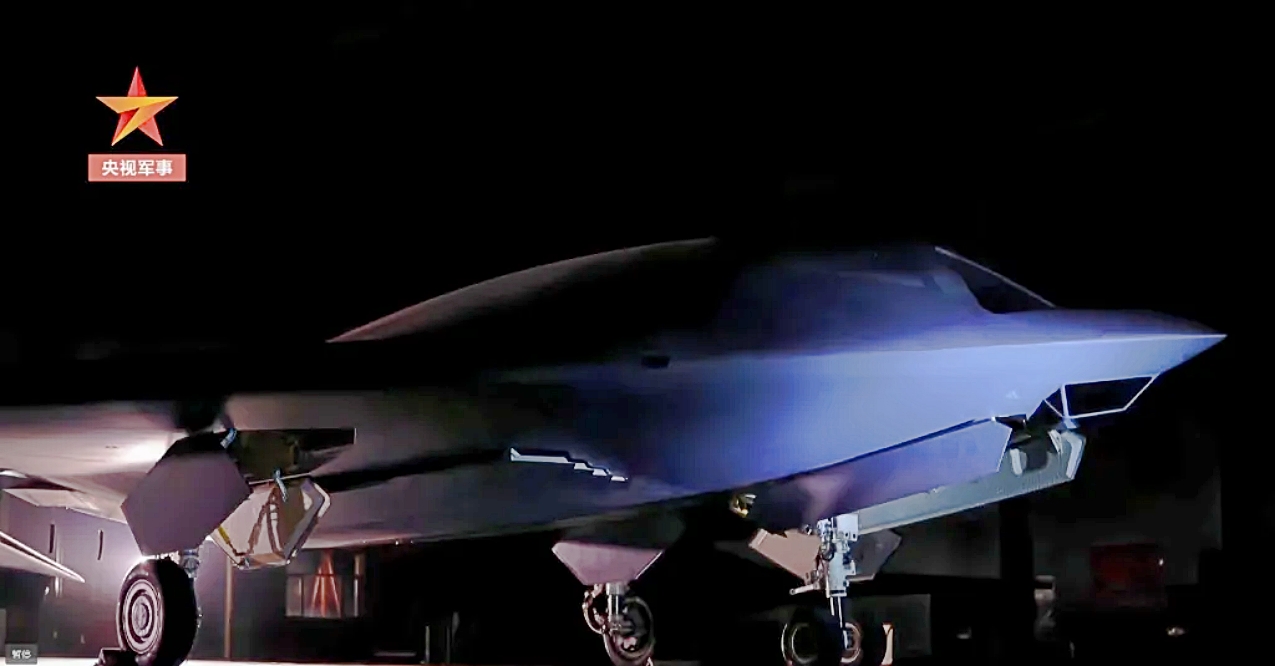
A view of a GJ-11 showing the undernose EO/IR sensor installation. PLA screencap
Perhaps the most distinctive external feature remains the GJ-11’s exhaust arrangement, for what is reported to be a WS-13 turbofan engine. A close-up of the rear of the aircraft shows the flattened exhaust outlet, shielded and integrated into the upper rear portion of the flying-wing airframe.
Combined with the dorsal air intake and the absence of conventional exposed engine nozzles, this configuration is intended to reduce the aircraft’s radar and infrared signatures, especially from the most critical view aspects. The GJ-11’s tailless, blended-wing configuration is by now a defining feature of low-observable UCAV designs.
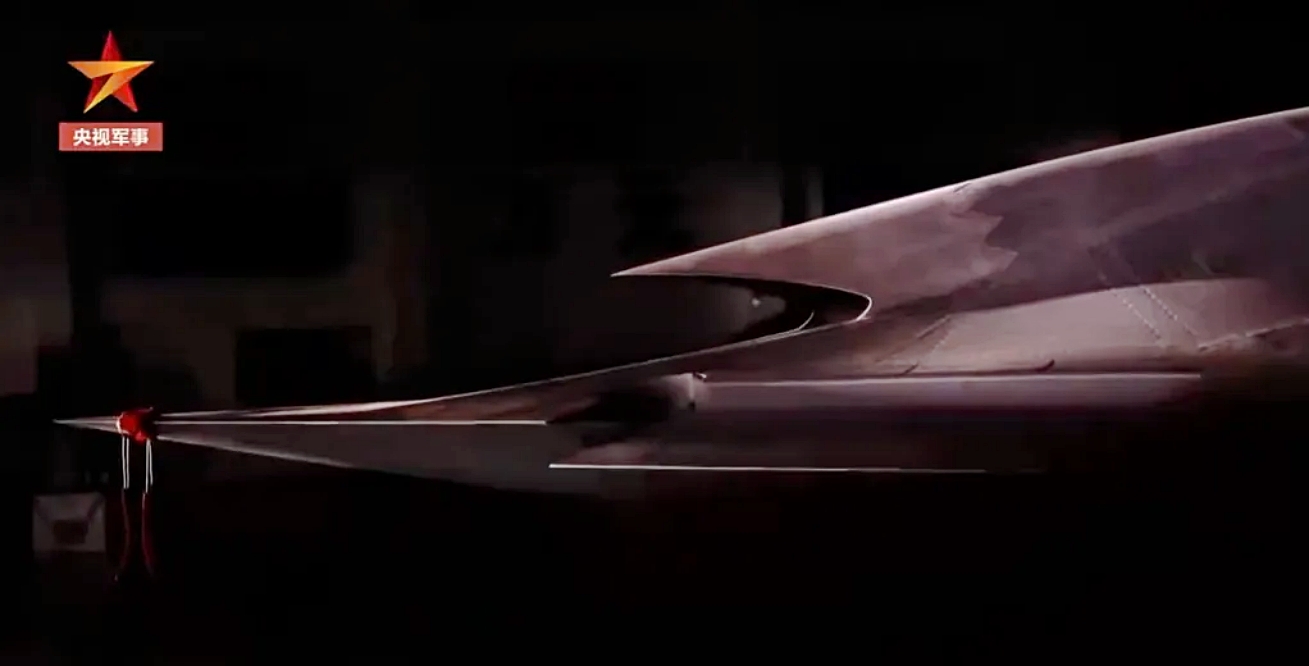
Close-up of the tail section of a GJ-11. PLA screencap
At least some of the GJ-11s shown have an air data boom on the nose. While normally associated with early flight testing, the GJ-11 is now far beyond that. The booms could still be fitted for some envelope expansion and other flight test work, although it may also simply involve earlier footage.
We do know that China expects the UCAV to be controlled by manned aircraft, as part of its basic concept. The PLAAF has at least trialed manned aircraft as drone controllers, and this is one mission set that has frequently been ascribed to the two-seat J-20S.
Source: The War Zone