
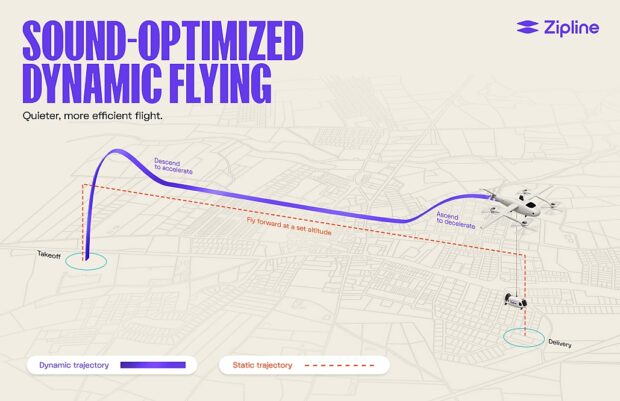
Zipline, the world’s largest drone delivery service, now has a quieter fleet, thanks to a breakthrough from its engineering team: sound-optimized dynamic flying. In an industry first, Zipline’s autonomous drones now use onboard sound modeling to optimize in real time for quiet flying.
“Zipline is building a future with less noise, less traffic, and less pollution,”
said Keenan Wyrobek, Zipline Co-Founder and CTO.
“We want people to love having Zipline available, not just tolerate it, and that starts with making it the quietest way to get a delivery. We’ve spent years pushing the limits of engineering to make that true.”
While most drones must continuously run all their motors in order to stay in the air, Zipline drones have a fundamentally different design, featuring a fixed wing that allows them to fly like birds and planes, turning off all but one motor once they reach cruising speed and altitude. With sound-optimized dynamic flying, Zipline drones now transition to on-wing flight more efficiently while producing less noise, using wind and gravity to accelerate and decelerate, similar to birds taking advantage of air currents.
Instead of static, pre-planned trajectories, Zipline’s dynamic flying optimizes for reduced sound by balancing wind, altitude, and speed. As a Zipline drone takes off, it uses its weather sensors to measure the real-time wind conditions. It then combines that data with a custom sound model to determine the quietest way to transition to on-wing flight, such as dipping its nose to gain speed like a bike going downhill, or popping upwards to quietly slow down at the end of a flight.
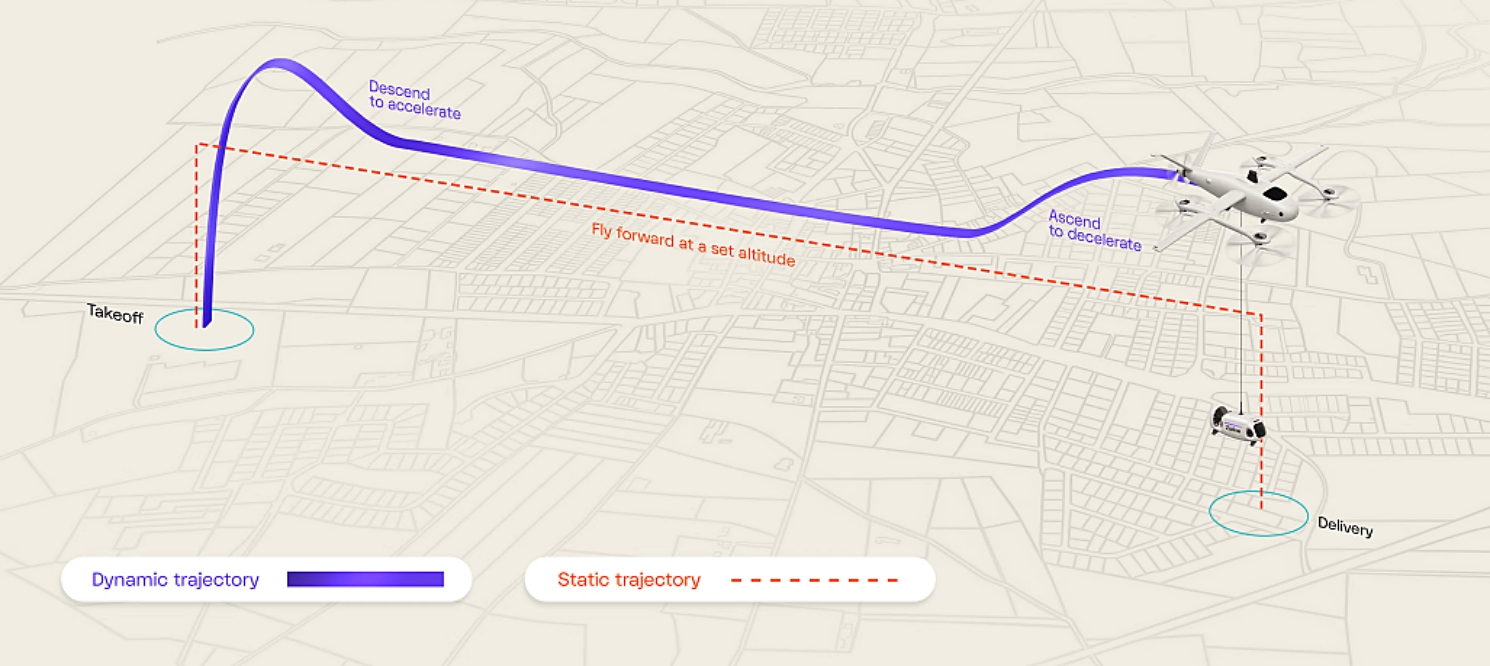
click to enlarge
Now deployed fleetwide, sound-optimized dynamic flying reduces flight times too. Zipline flight times are 53 seconds shorter on average thanks to faster transitions in and out of on-wing flight, spending roughly 50% longer traveling “on-wing”. This improved efficiency reduces the energy Zipline drones use per flight by 21%.
This upgrade builds on years of Zipline aeroacoustic engineering focused on making its drones blend into the background of everyday life, including patented ultra-quiet propellers, and the two-part architecture which keeps the drone roughly 330ft above the ground during delivery, compared to an average of 32ft for other delivery drone services.
Sound-optimized dynamic flying now enables what comes next: even higher-altitude flights and deliveries, and more sophisticated maneuvers that make Zipline even quieter.
Source: Zipline