
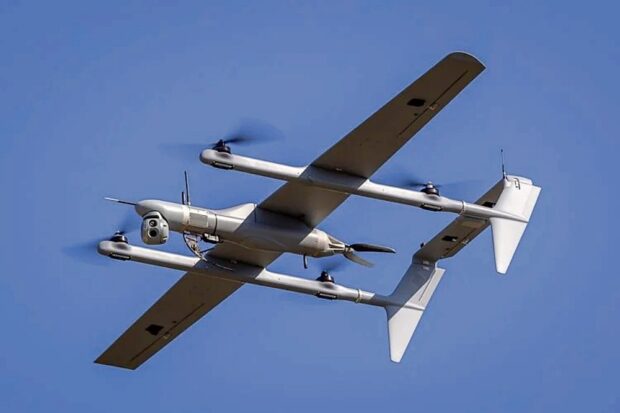
Following a trial period conducted in 2024 and 2025, the DGA (French Defence Procurement Agency) has placed an initial order for the VTOL version of the U010 Aliaca drone.
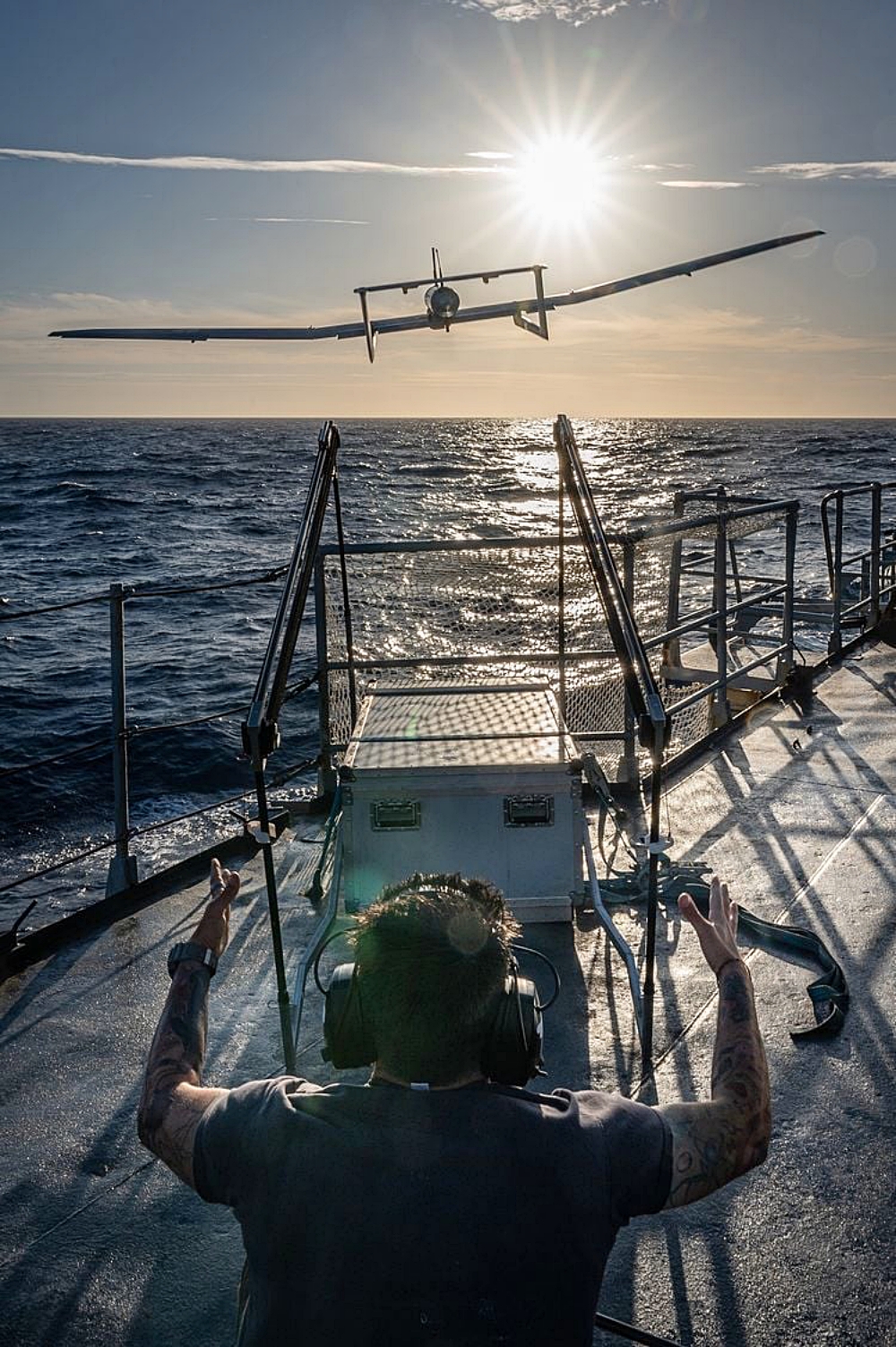
“In its initial version, the Aliaca launched at sea via a catapult and was recovered in a net. The French Navy first operated this system on an offshore patrol vessel back in 2019. The strong results achieved led Navy officials to extend its use to other vessels and order additional systems in 2020,”
explains Maxime Caille, Director of the U010 Aliaca programme at Airbus Helicopters.
Each system consists of two drones and a ground control station operated by two personnel, each equipped with a ruggedised laptop: one for flight control and the other for payload operations. A single operator could actually handle both flight control and payload simultaneously by partitioning the screen or toggling between displays. Take-off and landing are automated, and the entire mission can also be pre-programmed.
An Extra Eye in the Sky for Maritime Surveillance
Deliveries of the additional systems began in 2022 to equip offshore patrol vessels, surveillance frigates, and the new overseas patrol vessels as they entered service. On these compact vessels, the U010 Aliaca has served as a set of remote binoculars, capable of seeing beyond the ship’s radar horizon without needing to deploy a helicopter.
A spokesperson for the French Navy emphasises:
“Both in mainland France and overseas, the U010 Aliaca is an invaluable tool for gathering real-time intelligence during maritime security and surveillance missions, as well as combating trafficking and illegal fishing.”
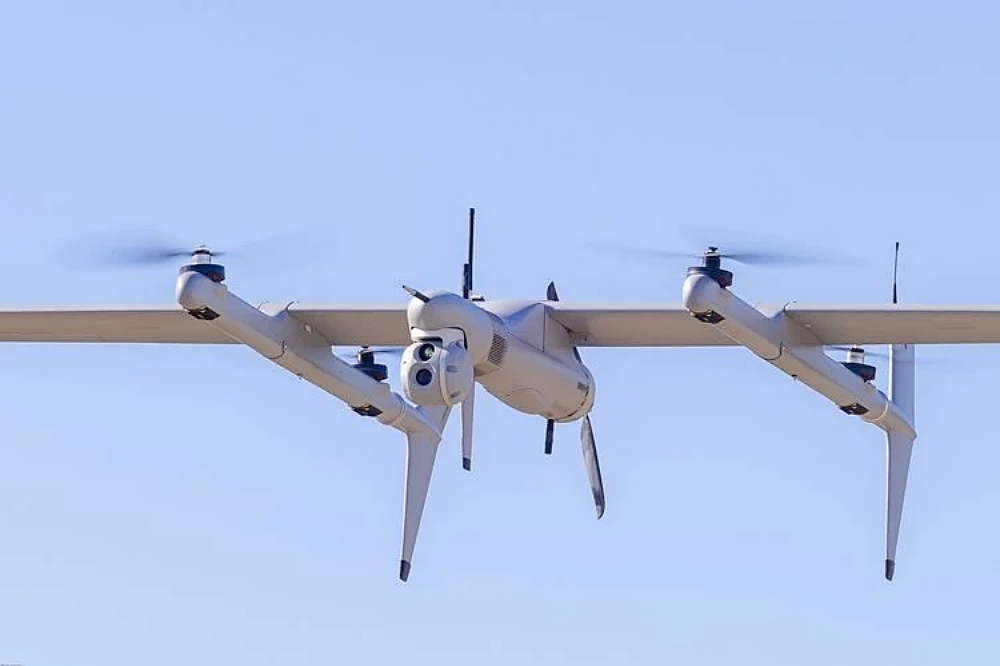
Among the advantages highlighted by operators, the U010 Aliaca stands out for its minimal logistical footprint and extremely low acoustic signature, enabling discrete overflights of suspicious vessels. Its excellent identification capability – powered by an electro-optical/infrared (EO/IR) day/night sensor turret with 30x optical zoom – is also widely praised.
“Real-time video feeds streamed by the U010 Aliaca to the operations room facilitate precise vectoring of interception craft and make it possible to accurately evaluate target threat levels,”
Navy officials add. Notably, several aircraft are also operated from land for coastal surveillance and maritime approach security.
Highly satisfied with the U010 Aliaca as a tactical sensor, the Navy subsequently sought to deploy it on smaller host vessels, which required overcoming the logistical constraints of the catapult-and-net setup. This led to the development study of a vertical take-off and landing version.
“Vertical take-off and landing significantly expand how the drone can be deployed,” Navy spokespeople confirm. “Pre-flight preparation takes just a few minutes, and the drone can also be launched in sea conditions that previously would have prevented a safe net recovery.”
Beyond offshore patrol vessels, surveillance frigates, and overseas patrol vessels, the VTOL version of the U010 Aliaca will also equip even smaller combatants or support ships. It will offer unprecedented flexibility for land-based operations as well.
“Adding vertical take-off and landing capabilities to the existing drone is a genuine technical achievement. The VTOL variant features a new wing design and a modified fuselage, but it relies on the same core components, including the autopilot and data link. Autopilot design, ground station software, and data link and sensor integration are core areas of our expertise. We have complete mastery over our system, enabling us to adapt and evolve it very quickly,”
adds Maxime Caille.
The U010 Aliaca: Lightweight But Tough
Engineered to operate in the most demanding maritime environments, the U010 Aliaca combines robustness, versatility, and advanced technology. Featuring a maximum take-off weight of 25 kg, a wingspan of 3.6 m, and a length of 2.2 m, the U010 Aliaca comes with two propulsion options tailored to mission needs: a 100% electric version offering up to 3 hours of endurance and a 50 km data link range, and a hybrid version pushing these performance metrics to 6 hours of flight time and a 100 km operational radius.
Certified SAIL III under the European Union Aviation Safety Agency (EASA) SORA methodology, it meets strict safety requirements. This qualification allows it to operate over populated areas, opening doors to numerous civil and public safety applications.
Read the full story on UAS NEWS| PRO
Source: Airbus