
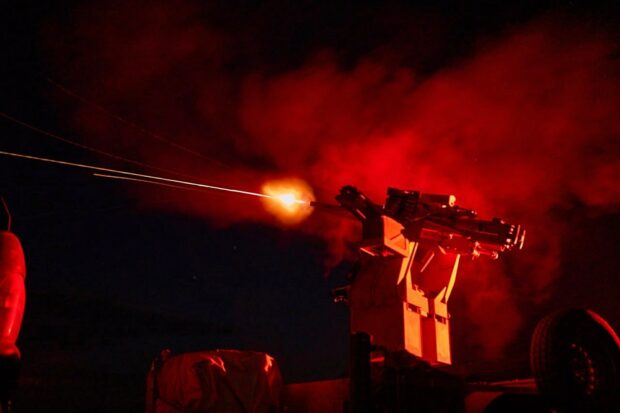
More than 12 automated .50-caliber turrets deployed across Kyiv to counter Russia’s jet-powered attack drones are Ukrainian-made Sky Sentinel systems.
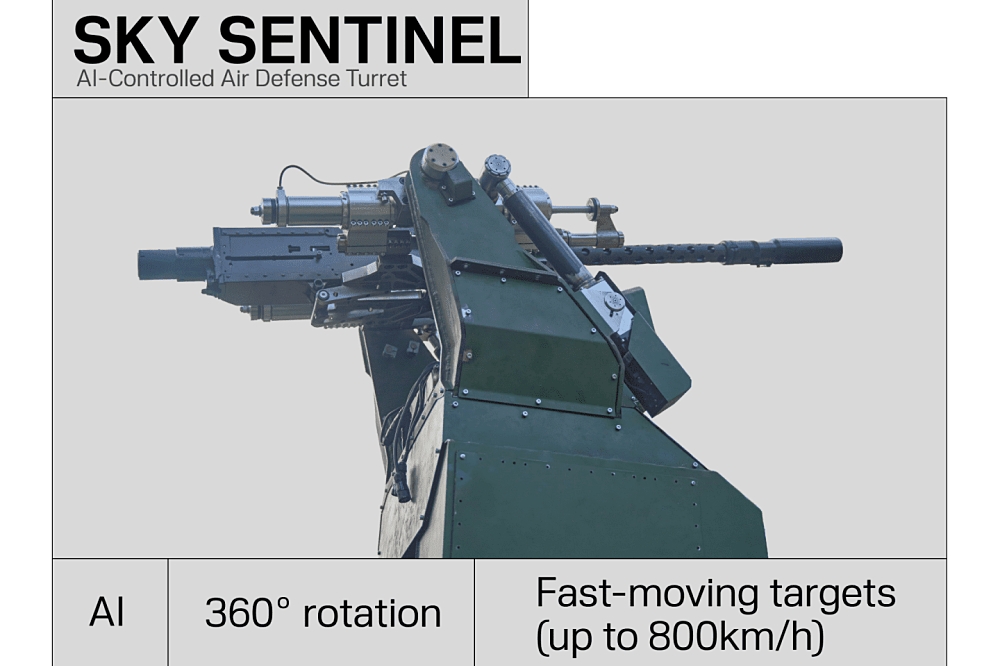
Sky Sentinel is a Ukrainian-developed automated anti-drone turret that uses machine vision and artificial intelligence to detect, track, and engage aerial targets.
The system combines a heavy machine gun with an automated fire-control module. Once a target is acquired, its optics track the drone while onboard software calculates its speed, trajectory, distance, and the lead required for an interception. Unlike an interceptor drone, Sky Sentinel does not need to chase its target. It calculates where the UAV will be and fires toward that point, allowing it to engage fast-moving aircraft within its firing envelope.
Previously published specifications indicate that Sky Sentinel can engage aerial targets traveling at speeds of up to around 800 kilometers per hour, placing Russia’s jet-powered attack drones within its theoretical capability.
The Geran-5, now increasingly used by Russian forces, flies substantially faster than conventional propeller-driven Shahed-type drones. Its vulnerability to Sky Sentinel, however, depends on altitude and range. At higher altitudes, a jet-powered drone may remain beyond the reach of heavy machine-gun fire. But as it descends toward a target or operates at lower altitude, it can enter the turret’s engagement zone.
At that point, the key factor is no longer whether a weapon can catch the drone, but whether it can track it and calculate a firing solution quickly enough. Sky Sentinel’s machine vision continuously follows the target while its software determines the interception point in real time.
At the heart of the system is a turret equipped with a heavy machine gun, including the 12.7mm M2 Browning, capable of rotating 360 degrees.
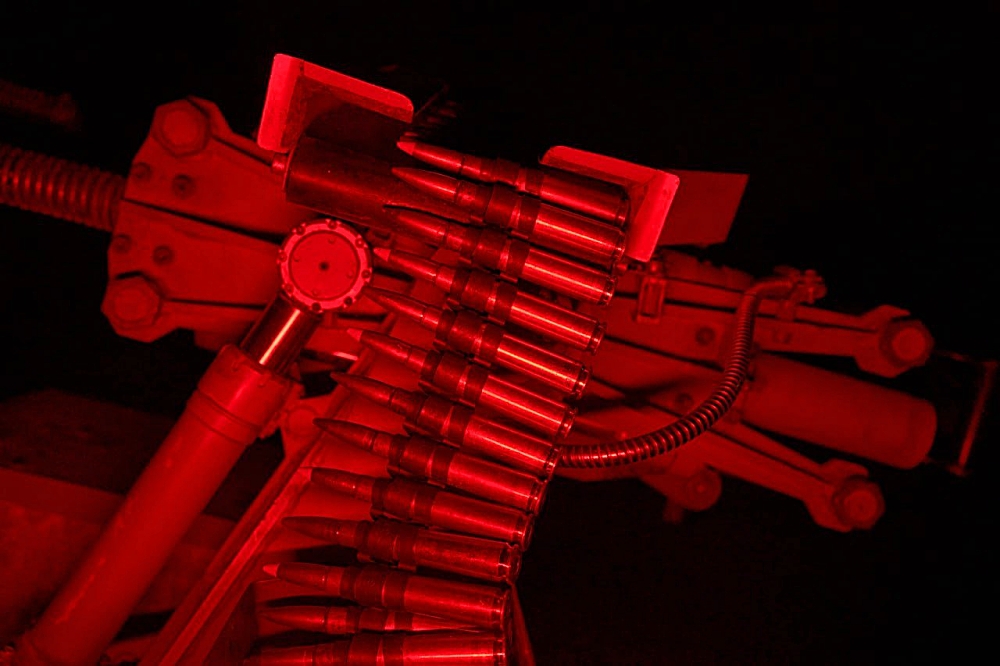
Ammunition belt feeding a Sky Sentinel anti-drone turret during nighttime operations. (Source: UNITED24 Media)
First, Sky Sentinel has to distinguish between a bird and a Shahed. Once a threat is identified, the system must respond without delay.
After receiving radar data, the optical system acquires the target, while the software tracks it, determines its speed and trajectory, accounts for wind resistance, and calculates the necessary lead. A human operator does not need to manually keep the drone in the sights: the operator simply monitors the system, while the turret handles aiming and ballistic calculations.
Ukrainian Sky Sentinel turret downs Russian drones captured in rare video footage. https://t.co/YDfWgqRjvh
— UNITED24 Media (@United24media) April 18, 2026
Precision became one of the project’s biggest engineering challenges. The developers told UNITED24 Media that even a millimeter of mechanical play in a moving assembly could translate into tens of meters of error at a distance. And the turret does more than move: it must also withstand recoil. Other challenges include optical quality, ammunition consistency, adverse weather conditions, and operating in an environment affected by electronic warfare.
Source: UNITED24MEDIA