
ResearchAndMarkets has just published a new report on “Military Drones Market Opportunity, Growth Drivers, Industry Trend Analysis and Forecast 2026-2035″
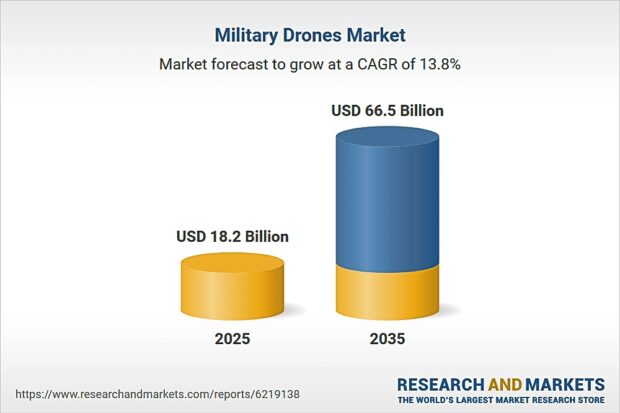
The Global Military Drones Market was valued at USD 18.2 billion in 2025 and is projected to reach USD 66.5 billion by 2035, expanding at a compound annual growth rate of 13.8%. Rising defence modernization expenditure, regional security concerns, counterterrorism operations, and demand for advanced intelligence, surveillance, and reconnaissance capabilities are expected to support sustained market growth.
Military forces are increasingly deploying unmanned aerial systems to improve operational efficiency, reduce personnel exposure, extend intelligence coverage, and strengthen battlefield coordination. Military drones now perform critical roles across combat operations, reconnaissance, precision engagement, communications support, maritime monitoring, electronic warfare, and persistent surveillance.
Artificial intelligence and machine learning integration is accelerating the development of next-generation military drone capabilities. AI-enabled systems support autonomous navigation, real-time threat assessment, adaptive mission execution, sensor fusion, and faster operational decision-making. Defense agencies are also investing in resilient communications and advanced command-and-control architectures to maintain drone performance in contested and electronically disrupted environments.
Growing interest in swarm-based drone operations represents another important Global Military Drones Market trend. Networked unmanned platforms can operate under shared command structures to support coordinated surveillance, combat missions, electronic operations, and force protection. As defense organizations prioritize multi-domain operations, demand is increasing for interoperable drones that can exchange mission data with existing aircraft, ground forces, naval assets, satellites, and intelligence networks.
Fixed-Wing Military Drones Maintain Market Leadership
The fixed-wing military drones segment accounted for 72.1% of the market in 2025. Segment leadership is supported by extended endurance, longer operating ranges, higher cruising speeds, and greater payload capacity. These capabilities make fixed-wing platforms suitable for long-duration intelligence missions, wide-area surveillance, border security, maritime patrol, and expeditionary operations.
Procurement of medium-altitude long-endurance platforms continues to increase as armed forces seek persistent monitoring and reliable mission coverage across geographically dispersed operating areas. Investments in high-endurance designs, advanced payloads, secure data links, and satellite communications are expected to reinforce the segment’s position throughout the forecast period.
Remotely Piloted Systems Account for a Significant Market Share
The remotely piloted segment held 64.5% of the Global Military Drones Market in 2025. Demand remains supported by operational requirements for continuous communication between airborne platforms and ground control units. Remote operators retain real-time control over navigation, sensor deployment, intelligence collection, and engagement decisions, supporting mission precision and accountability.
Defense organizations are prioritizing secure, resilient, and low-latency command-and-control systems capable of operating in complex environments. Continued improvements in encrypted communications, satellite connectivity, anti-jamming technologies, and interoperable control stations are expected to support further adoption of remotely piloted military drones.
United States Military Drones Market Reaches USD 6.5 Billion
The United States Military Drones Market reached USD 6.5 billion in 2025, reflecting continued investment in medium- and high-altitude long-endurance platforms. Market expansion is also supported by deeper integration of unmanned systems into multi-domain operations and manned-unmanned teaming strategies.
Secure satellite communications, long-endurance performance, advanced autonomy, and compatibility with command, control, communications, computers, intelligence, surveillance, and reconnaissance frameworks remain central to U.S. procurement priorities. Ongoing modernization programs and demand for scalable, mission-ready platforms are expected to strengthen the country’s position in the global military drone industry.
Competitive Landscape and Strategic Priorities
Key companies operating in the Global Military Drones Market include Lockheed Martin, Northrop Grumman Corporation, General Atomics Aeronautical Systems, Boeing, Airbus, Israel Aerospace Industries, BAE Systems Inc., Leonardo S.p.A., Thales Group, Dassault Aviation, Baykar Tech, Elbit Systems, Textron Inc., AeroVironment Inc., and Teledyne FLIR LLC.
Leading military drone manufacturers are investing in autonomous flight technologies, AI-enabled mission systems, secure communications, payload integration, sensor fusion, and electronic warfare capabilities. Strategic priorities include developing scalable platforms for long-endurance and multi-role missions, improving interoperability with established defense networks, and strengthening system resilience in contested operating environments.
Collaboration with defence agencies remains essential for aligning platform development with evolving mission requirements. Partnerships, research programs, technology integration, and continuous product innovation are helping companies differentiate their offerings while addressing emerging operational needs.
Comprehensive Market Analysis and Forecast Coverage
- Military drone industry trends, growth drivers, market challenges, future opportunities, and regulatory developments
- Competitive landscape supported by Porter’s Five Forces and PESTEL analysis
- Global market size, segment performance, and regional forecasts through 2035
- Company profiles, business strategies, financial insights, and SWOT analysis
- Assessment of autonomy, artificial intelligence, secure communications, sensor technologies, and mission-system innovation
The Global Military Drones Market is positioned for strong expansion through 2035 as defense organizations pursue greater autonomy, persistent surveillance, precision capabilities, and integrated multi-domain operations. Continued innovation in artificial intelligence, communications resilience, payload technologies, and networked deployment is expected to remain a defining factor in market competition and procurement strategy.
Key Attributes:
| Report Attribute | Details |
| No. of Pages | 200 |
| Forecast Period | 2025 – 2035 |
| Estimated Market Value (USD) in 2025 | $18.2 Billion |
| Forecasted Market Value (USD) by 2035 | $66.5 Billion |
| Compound Annual Growth Rate | 13.8% |
| Regions Covered | Global |
The 220-page report can be purchased here.
Source: Research and Markets