
Perennial Autonomy announced that it has been awarded an enterprise-wide, three-year Indefinite Delivery/Indefinite Quantity (IDIQ) with a $500 million ceiling with the U.S. Department of War (DoW). Joint Interagency Task Force 401, the lead organization to synchronize counter-UAS (C-UAS) efforts across the Department of War, coordinated the contract.
The contract was awarded to Perennial Autonomy for a range of artificial intelligence-enabled counter-UAS, including Merops interceptors, Bumblebee ISR quadcopters and Hornet midrange strike drones, which are currently being employed by forces operating in U.S. Central Command.
Battlefield-tested and proven at scale in Ukraine, Perennial Autonomy’s systems leverage some of the most advanced technologies including computer vision, radio frequency-based detection, jam-resistant communications, and next generation autonomy to deliver precision engagement at a significantly lower cost per intercept than traditional missile-based defence.
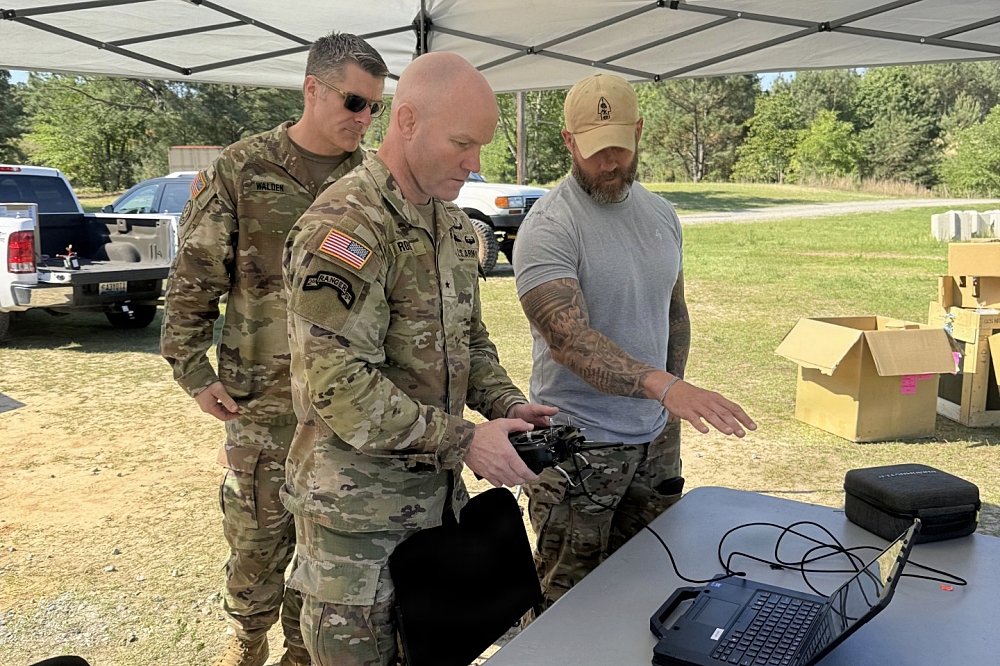
Army Brig. Gen. Matt Ross, Joint Interagency Task Force 401 director, flies the Bumblebee V2 drone interceptor during a training exercise at Fort Bragg, N.C., May 14, 2026.
These systems integrate detection, tracking and engagement capabilities using computer vision, radio frequency sensing, jam-resistant communications and autonomous targeting, while retaining warfighter decision-making authority over the use of lethal force.
“[The task force] continues to advance our counter-drone capabilities by fielding systems that can operate across multiple domains and integrate with existing command and control architectures,”
said Army Brig. Gen. Matt Ross, JIATF 401 director.
“This partnership provides the joint force with state-of-the-art, counter-UAS capability to remain lethal on today’s modern battlefield.”
“Drones are the defining threat of our time. The proliferation of inexpensive unmanned aerial systems allows nonstate actors and individuals to access intelligence, surveillance, reconnaissance and precision strike tools in ways that were previously only available to state actors. We must be proactive with creating a layered defense that deploy and scale low-cost, attritable air-to-air drone interceptors at all our facilities at home and abroad.”
The contract accelerates the acquisition of operationally proven systems and ensures that top-tier technologies can be rapidly scaled and sustained in response to evolving threats. By leveraging a flexible, enterprise-wide contracting approach, the task force continues to synchronize counter-UAS capabilities across the joint force so warfighters can protect themselves and critical infrastructure from adversary drones.
This award deepens the existing strategic partnership between Perennial Autonomy and DoW that was built on demonstrated results and responsiveness.
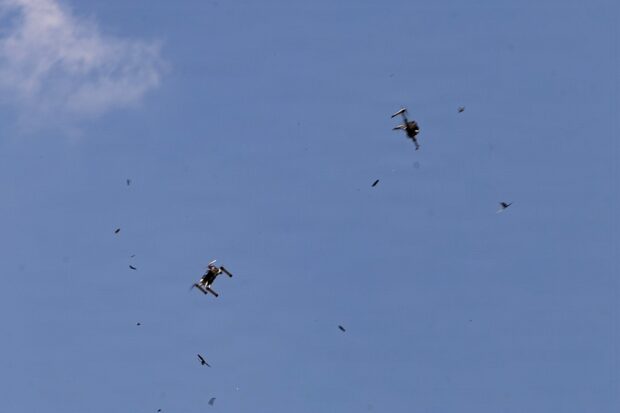
Top Photo: A Bumblebee V1 drone under manual control intercepts practice targets at Fort Bragg, N.C., April 23, 2026. The Bumblebee has been fielded as an autonomous ground-to-air and now air-to-air interceptor designed to make contact with and incapacitate enemy drones.
Sources: Department of War; Perennial Autonomy