
Unmanned Aerial Systems (UAS) have emerged as essential tools not only for surveillance and reconnaissance, but also for territorial defense, thanks to their ability to serve as countermeasures by shooting down other UAS or acting as decoys capable of protecting manned aircraft and other surveillance UAS.
Decoy UAS are designed to simulate the electronic and radar signatures of manned aircraft or other high-value UAS. However, their utility goes beyond just imitation: their mere presence in the operational space poses a tactical challenge to the adversary, who is forced to identify them and react to the uncertainty regarding their true nature.
In doing so, enemy defence systems must invest resources and time in neutralizing potential threats, increasing their operational burden and reducing their effectiveness. This ability to create confusion and divert attention from defensive countermeasures allows real assets to operate with greater safety and effectiveness.
This tactic not only protects manned aircraft and surveillance UAS but also poses a strategic challenge to the adversary. By forcing the adversary to invest resources in detecting and neutralizing threats that might appear dangerous but are actually low-cost decoys, it inflicts both economic and psychological wear and tear on their forces.
This sustained erosion reduces the enemy’s operational capacity, diverting their attention from real assets and forcing decisions under pressure. Furthermore, if these decoy UAS are equipped with small explosive payloads, they can further increase the impact in terms of attrition and disruption.
For decoy UAS to effectively fulfill their role, flight control systems specifically designed for this purpose are essential. These systems must enable complex maneuvers such as deployment from mother ships in flight, coordinated swarm flight, and the execution of autonomous missions without relying on continuous communication links or GNSS signals, making them less vulnerable to interference and countermeasures.
Decoy platforms require optimized guidance, navigation, and control systems capable of managing multiple UAS simultaneously, ensuring precise coordination, the maintenance of tactical formations, and operational safety in dynamic environments. However, their design must reflect the trade-off between their limited lifecycle and the need for cost-effective production, as it is essential to strike a balance between technological sophistication and economic viability. This entails the use of robust, optimized solutions that maximize effectiveness without incurring the costs associated with systems designed for long operational lifespans.
Coordinated Flight and Swarm Capabilities
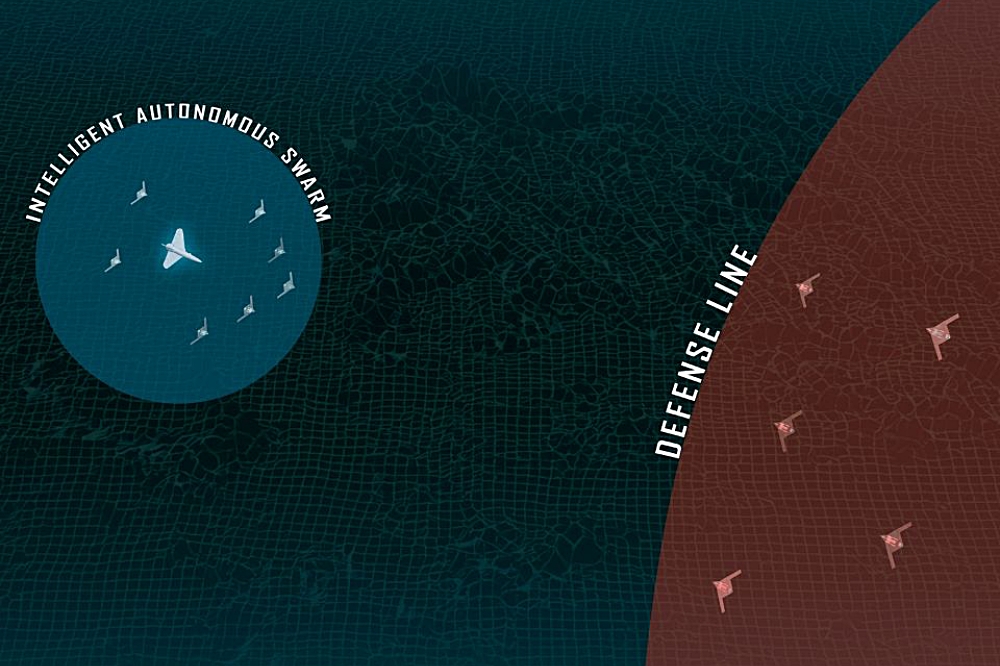
Swarm flight operations enable multiple UAS to act in a synchronized manner, dynamically adapting their formation to maximize their tactical impact. Through coordinated grouping and separation maneuvers, they can generate radar echoes that mimic larger aircraft or confuse tracking systems by constantly changing their spatial configuration. This dynamic movement causes signals to appear and disappear on the radar, creating the illusion of intermittent targets and making them difficult to track.
As a result, enemy defences can become overwhelmed, forced to make decisions under pressure, making them prone to errors in identification and response. Furthermore, the activation of their UAV defence systems reveals key information about their location, range, and operational capability, providing valuable data for planning future missions against these assets.
Deployment Algorithms in Flight and from Manned Mother Ships
Another key feature of a decoy UAS is its ability to be launched from manned mother ships, using algorithms for deployment and the initiation of in-flight operations, also known as air-drop or air-launch. This launch method allows the UAS to be rapidly deployed in the operations area, without the need for runways or additional infrastructure. Flight control systems must be capable of managing the launch under adverse conditions and ensuring safety by incorporating advanced logic for mission initiation reliably and securely, given the proximity of the UAS to the manned platform during the initial stages.
Deployment and in-flight mission initiation algorithms are essential to ensure that decoy UAS activate and begin their missions immediately after launch. These algorithms must be capable of adapting to different operational scenarios, adjusting flight parameters as necessary to maximize the effectiveness of the decoy. Additionally, they must include autonomous navigation capabilities to ensure that the UAS can operate independently in the event of a loss of communication with the mother ship.
Conclusion
The use of decoy UAS in air defence is an effective and cost-effective strategy for protecting manned aircraft and surveillance UAS, while also having a significant impact on enemy forces. Beyond diverting attention and overwhelming defenses, these systems force the adversary to invest resources and reveal the location and capabilities of their UAV detection and neutralization systems, providing valuable information for future missions.
The success of this strategy lies in the balance between functionality and operational viability. To achieve this, decoy UAS must be equipped with optimized guidance, navigation, and control systems that allow them to operate autonomously, in swarms, and be deployed from mother ships in flight. These capabilities allow for maximizing their impact without incurring unnecessary costs, ensuring their mass production and deployment without compromising the sustainability of the operation.
With this approach, decoy UAS can not only protect high-value assets but also actively contribute to wearing down the adversary and gathering critical intelligence, and thus become a key tool in modern air defence.
Source: UAV Navigation-Grupo Oesía