
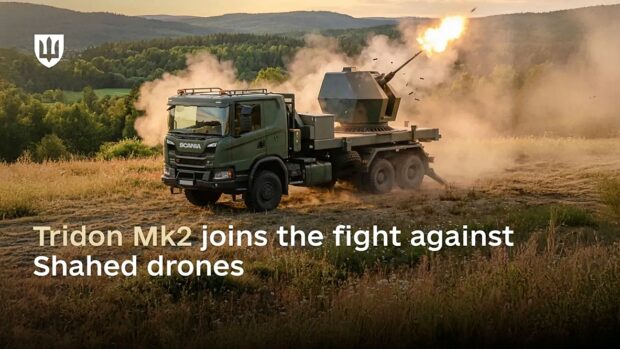
The Defence Forces of Ukraine will receive advanced BAE Systems Tridon Mk2 air defence systems from Sweden. These systems will enhance Ukraine’s air defence capabilities in countering Shahed drones and other aerial threats.
Sweden will allocate €400 million to procure these systems, nearly one-third of the new €1.2 billion military assistance package announced in February.
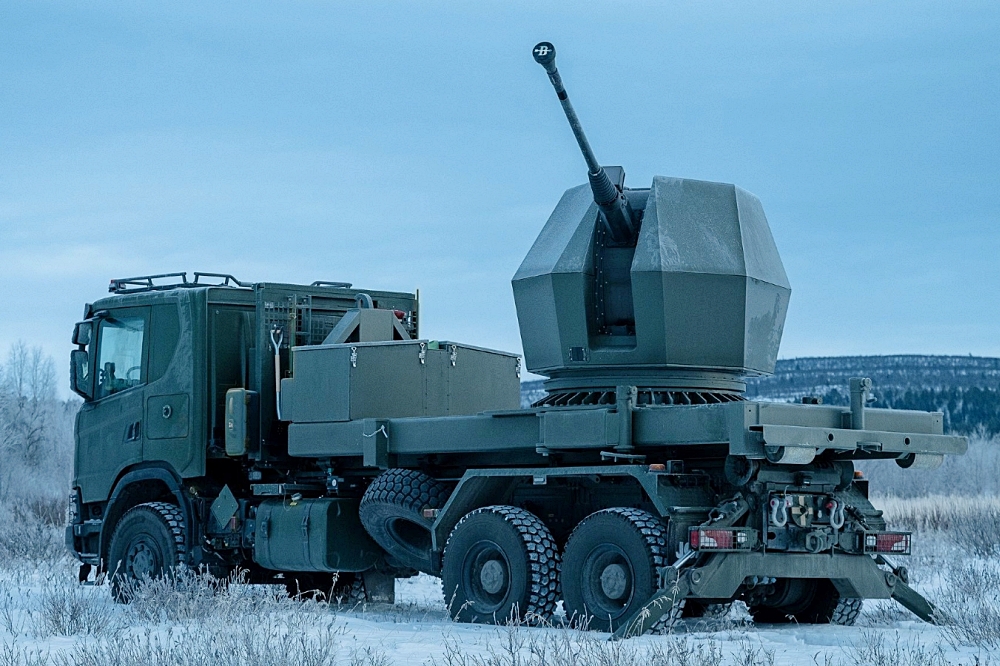
The TRIDON Mk2 is a truck-mounted 40 mm anti-aircraft gun system that addresses a gap in today’s air defence. The system has multi-target capability and can engage a wide range of aerial threats, including drones, cruise missiles and aircraft.
Additionally, it can target ground threats such as armoured vehicles, providing protection and security for both military forces and civil infrastructure.
“We are more committed than ever to providing our customers with protection from ever-evolving aerial threats,” said Lena Gillström, president of BAE Systems Bofors. “The TRIDON Mk2 has been designed for today’s warfare, and we will continue to deliver cutting-edge solutions to put our customers in the best position to meet future challenges.”
In February, on behalf of Sweden and Denmark, the FMV procured TRIDON Mk2 systems from BAE Systems under a $180m contract to donate to Ukraine, as part of a package to bolster Ukraine’s air defence capabilities.
Able to combat multiple threats quickly, TRIDON Mk2 is a high-precision, cost-effective system that is easy to deploy and simple to maintain. Its modular design allows it to adapt to changing needs and to evolve with new technologies.
Tridon Mk2 is equipped with a 40 mm Bofors 40 Mk4 automatic cannon capable of engaging targets at distances of up to 12 km, with a rate of fire of up to 300 rounds per minute. The system supports reducing the rate of fire to 200 rounds per minute, optimising ammunition expenditure and enabling adaptation to specific fire missions.
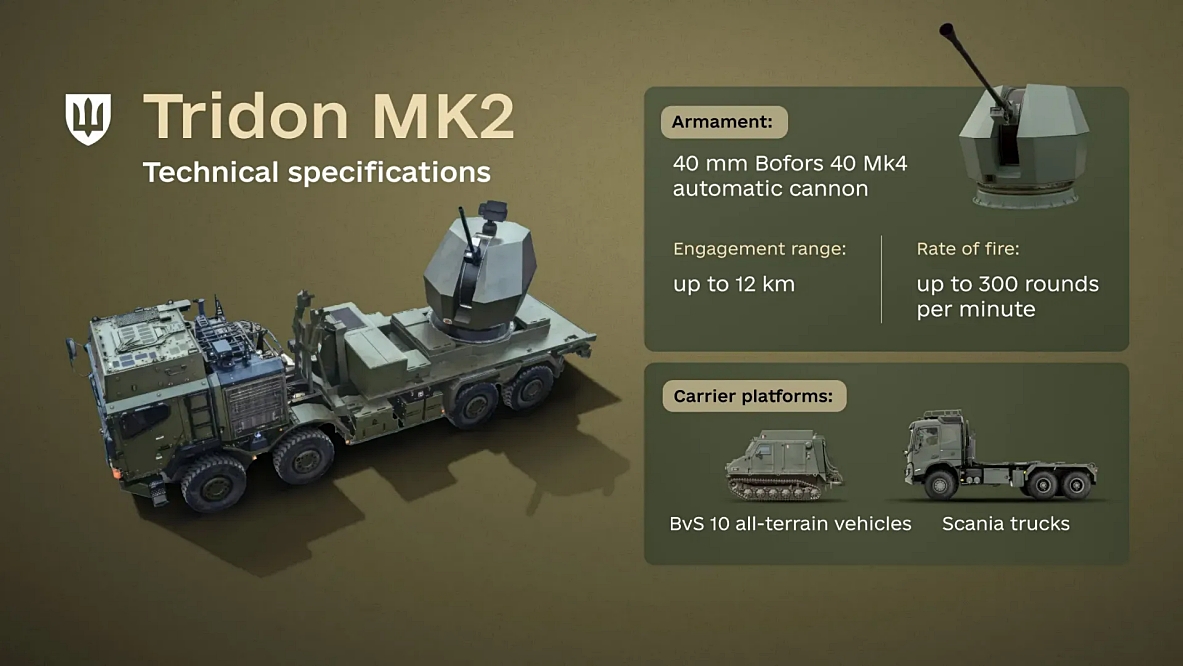
Ammunition and Carrier Platforms for Tridon Mk2
The Tridon Mk2 gun fires programmable airburst ammunition. The rounds detonate immediately in front of the target, creating a cloud of fragments. This significantly enhances effectiveness in countering unmanned aerial systems and cruise missiles.
The system can be mounted on BvS 10 tracked armoured all-terrain vehicles or Scania trucks. The system is equipped with electric drives, enabling seamless integration with a range of platforms, unlike systems that rely on hydraulic drives.
The Tridon Mk2 is a versatile air defence system combining high effectiveness, broad applicability, and low operating costs. The system is capable of simultaneously countering multiple threats, including strike and reconnaissance UAVs, aircraft, helicopters, and cruise missiles.
Sources: BAE Systems; Ministry of Defence of Ukraine
Why This Matters:
The delivery of the TRIDON Mk2 system to Defence Forces of Ukraine represents a critical shift toward cost-effective, layered air defence in modern conflict. As low-cost threats like Shahed drones continue to saturate Ukrainian airspace, high-end missile systems alone are insufficient and economically unsustainable. Systems like TRIDON Mk2—developed by BAE Systems—fill this gap by providing a cheaper, rapid-response solution capable of engaging multiple targets simultaneously.
Strategically, this strengthens Ukraine’s ability to defend infrastructure and frontline units against mass drone attacks, which are designed to overwhelm traditional air defences. The use of programmable airburst ammunition significantly increases efficiency against small, fast-moving UAVs, improving interception rates while conserving resources.
Sweden’s substantial investment also reflects a broader European commitment to Ukraine’s long-term defence resilience. Beyond immediate battlefield impact, it signals a shift in air defence doctrine toward scalable, modular systems that can adapt to evolving threats.
Ultimately, TRIDON Mk2 underscores how modern warfare is driving demand for flexible, high-volume defensive solutions—where affordability, mobility, and adaptability are just as important as raw firepower in maintaining control of contested airspace.