
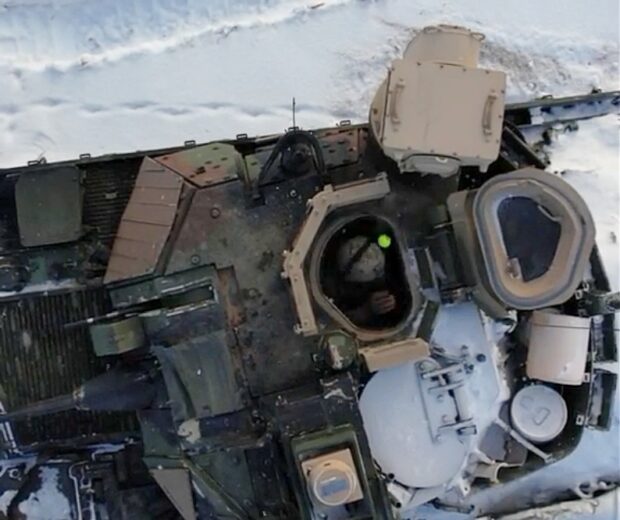
U.S. armoured vehicle crews remain unprepared to counter drone attacks. Footage from training exercises was published on Reddit.
The video shows an M2 Bradley infantry fighting vehicle with a drone hovering above it and dropping an improvised “munition” — a tennis ball.
This training method, using tennis balls, was used during NATO’s Joint Viking 2025 exercises in Norway and has since been adopted in the United States.
In the footage, the Bradley crew leaves the turret hatch open, allowing the “munition” to be dropped directly into the vehicle. Russian armoured vehicle crews made similar mistakes early in the full-scale invasion. Ukrainian quadcopters dropped improvised munitions, including modified 30 mm and 40 mm grenades, into open hatches, killing crews.
Despite Ukrainian combat experience and the introduction of anti-drone protective structures on armoured vehicles in NATO countries, including the Netherlands and France, the United States has yet to take systematic steps in this area.
The Pentagon plans to improve the protection of M2 Bradleys by installing the Israeli Iron Fist active protection system.
Its effectiveness against mass drone attacks remains uncertain, as drones can strike from multiple directions at once.Ukrainian M2 Bradley vehicles use several types of passive anti-drone protection. These include foldable cage armor and fixed overhead structures.
Such measures reduce the effectiveness of attacks by bomber drones and FPV drones, as warheads may fail to detonate or lose effectiveness on impact with protective structures.
This significantly improves the chances of survival for the vehicle, its crew, and embarked troops on the modern battlefield.
Source: MILITARNYI
Why This Matters
This event exposes a gap between evolving battlefield threats and the preparedness of even advanced militaries to handle them. The vulnerability of platforms like the M2 Bradley to simple drone attacks is not a theoretical concern—it has already been demonstrated in real combat, particularly during the Russian invasion of Ukraine. What makes this especially significant is how low-tech and inexpensive the threat can be: small drones dropping improvised munitions into exposed نقاط like open hatches.
The use of tennis balls in exercises such as Joint Viking 2025 reflects an attempt to simulate this danger, but the training footage suggests that basic procedural discipline—like keeping hatches closed—is not yet ingrained. That points to a deeper issue: adapting human behavior and doctrine can lag behind technological change. Even the most advanced vehicles are vulnerable if crews are not trained to operate under new threat conditions.
There is also a broader institutional challenge. While some NATO members have adopted practical, low-cost solutions like cage armor and overhead protection, the United States Department of Defense appears to be leaning toward more complex systems such as active protection technologies. Systems like Iron Fist may offer value, but they are expensive and not necessarily optimized for swarms of small, low-flying drones attacking from multiple angles.
The contrast with Ukrainian adaptations is telling. Battlefield necessity has driven rapid innovation, with improvised but effective defenses significantly increasing survivability. This highlights a recurring pattern in military history: those actively engaged in conflict often adapt faster than those preparing for it.
Ultimately, this matters because it underscores a shift in warfare where cheap, accessible drone technology can neutralize billion-dollar platforms. Without rapid changes in training, doctrine, and protective measures, even well-equipped forces risk being outmatched by simple, asymmetric threats.