
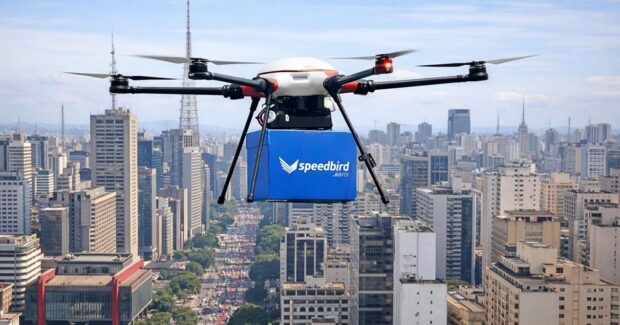
Brazil’s civil aviation authority (ANAC) has authorized Speedbird Aero to operate delivery drones over areas with population densities of up to 5,000 people per square kilometer, marking a shift from route-by-route approvals to a scalable national framework for beyond-visual-line-of-sight (BVLOS) operations.
Announced March 16, the decision allows Speedbird’s DLV-2 A25 model to fly over densely populated urban areas under pre-approved conditions, significantly expanding its commercial scope. Previously, each route required individual approval.
Speedbird, headquartered in Brazil and Portugal, develops and operates cargo drones under a “drone-as-a-service” model. Since 2018, it has completed nearly 40,000 missions across 14 countries, supporting food delivery, medical logistics, and postal services.
ANAC said the new framework enables scale, predictability, and sustainable industry growth. For Speedbird, it signals a transition from pilot projects to repeatable logistics networks. The company emphasized that drones are beginning to follow regulatory models similar to trucks and aircraft.
The approval builds on earlier validation under the Specific Operations Risk Assessment (SORA) framework, including a SAIL III authorization in Sergipe. ANAC also assessed safety features such as parachute recovery systems. While the DLV-2 A25 can operate over dense areas, smaller models like the DLV-1 remain limited to regions with up to 500 people per square kilometer.
Speedbird credits its certification-first strategy—working closely with regulators from the outset—for enabling international scalability. This approach, executives say, prioritizes practical deployment over experimental features.
The company’s fleet includes the smaller DLV-1 for rural and medical use and the larger DLV-2 for urban deliveries such as e-commerce, industrial goods, and biological materials. A longer-range DLV-4 eVTOL is in development, alongside a redesigned DLV-3 aimed at higher payload and offshore logistics missions.
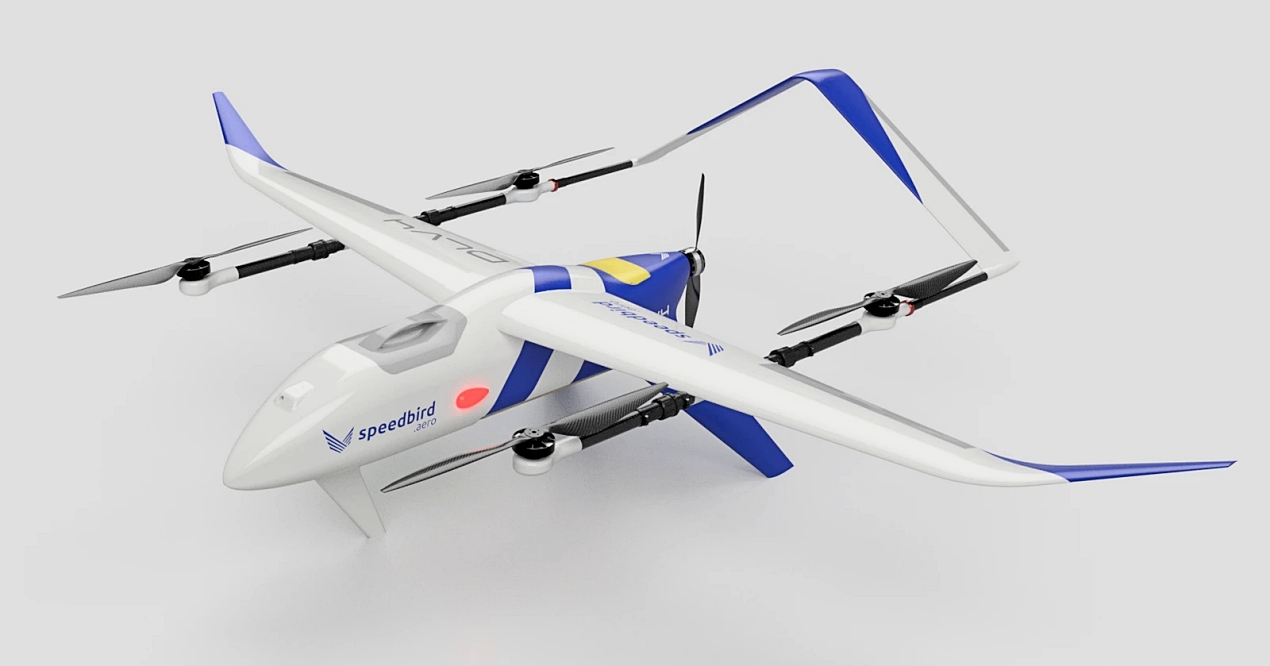
Speedbird Aero is developing larger lift-plus-cruise drone platforms to support longer-range missions
Operationally, Speedbird combines fixed “droneports” with flexible delivery methods. Drones may land autonomously, use winch systems, or transfer cargo to ground transport hubs. Flights are managed through centralized, cloud-based control stations, allowing remote pilots to operate from anywhere in the country under BVLOS rules.
The company views cargo drones as a stepping stone toward advanced air mobility, including passenger eVTOL services. Early operations are helping define airspace integration and infrastructure, with trials conducted near airports and in shared airspace, including in Italy and Israel.
With Brazil serving as a proving ground, Speedbird is now targeting expansion into North America and Europe. Executives point to evolving regulations—such as the FAA’s upcoming Part 108 rules—as a key opportunity, positioning 2026 as a pivotal year for broader drone adoption.
Source: AIN