
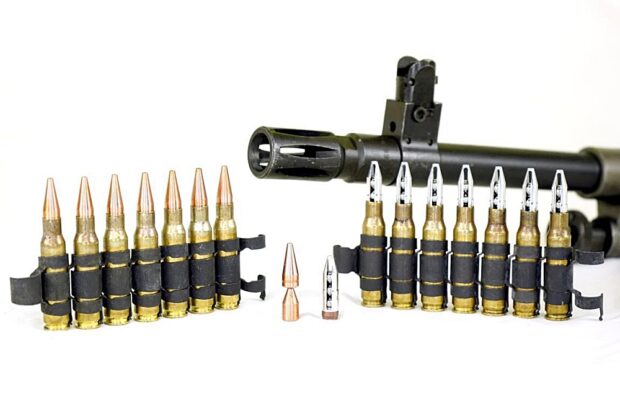
The U.S. Navy has developed a new ‘Drone Killer Cartridge’ (DKC) designed to significantly improve small arms-based defence against unmanned aerial threats. Developed by the Naval Surface Warfare Center, Crane Division, the DKC is a family of specialised ammunition that enhances the ability to destroy hostile or nuisance drones using standard rifles and machine guns already in service.
Unlike conventional rounds, the DKC uses a shotgun-style distributed pattern that increases the hit probability against small, agile targets such as drones, even when aim is imperfect. The system delivers a broader terminal coverage, helping operators neutralise unmanned aerial systems (UAS) regardless of range or movement.
According to Colonel Andrew Konicki, Program Manager of Ground Based Air Defence, the DKC represents a “pivotal shift” in counter-drone capability. It expands the defensive options available at the infantry level, allowing warfighters to engage UAS threats without relying entirely on complex or expensive sensor and interceptor systems.
The technology was demonstrated at Camp Atterbury in Indiana, where users unfamiliar with the system achieved a 92% success rate against drone targets in live tests. This suggests that the cartridge can be effective even in hands with minimal specialised training.
The DKC family includes segmented and pelletised variants, each engineered for specific engagement profiles. Segmented rounds split into multiple stabilized projectiles, while pelletised versions disperse spherical pellets to cover a wider area. Both types aim to maintain high velocity and lethality, giving ground forces a flexible tool for close-in drone defence.
Although initially conceived for military operations, the technology may find broader applications in homeland security and allied defence against rapidly evolving autonomous aerial threats.
Source: U.S. Naval Surface Warfare Center, Crane Division