
Japan is moving to open government-approved ‘sky paths’ for drones above the power lines that span the country, as utilities seek safer, faster ways to inspect infrastructure in mountainous regions.
Efforts to build these aerial routes are accelerating as power companies and technology firms modernize inspection work and address labor shortages. Some routes are already in operation, allowing drones to patrol transmission and distribution facilities. The goal is to expand the network nationwide to 40,000 kilometers by fiscal 2035, with future applications in disaster response and logistics.
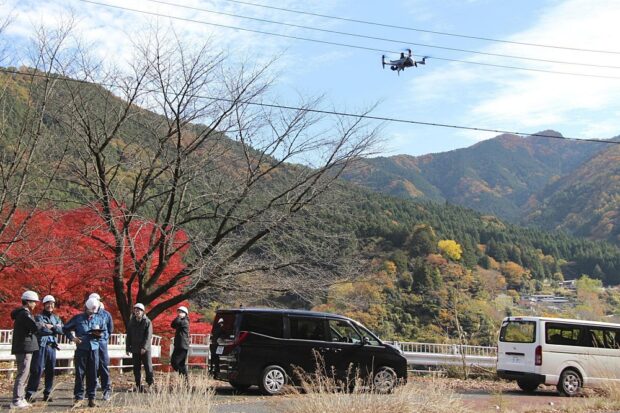
During a test in the mountains of Chichibu, Saitama Prefecture, a drone rose to about 140 meters and completed a 500-meter round trip along a power line, its camera focused on cables and towers. Workers monitored live footage on a tablet, analyzing images to identify optimal flight paths for routine inspections.
The initiative is led by Grid Sky Way LLP, a Tokyo-based company backed by utilities along with NTT Data Group and Hitachi. It addresses a longstanding challenge: inspecting equipment in remote mountainous areas, where workers have traditionally hiked difficult terrain and climbed towers.
Such work is physically demanding and time-consuming, especially as Japan faces labor shortages tied to its aging population. In one demonstration, inspecting two towers required two workers and over eight hours using conventional methods. With drones, the same task took about three hours and only one operator.
Drones also offer advantages over helicopters and airplanes, which risk collisions and cannot approach lines closely. Operating with precision, drones rely on digitally defined routes in shared airspace.
The government has approved pilot zones and plans further expansion, including routes for river monitoring. Officials say drones could help solve a wide range of social and infrastructure challenges.
Source: Japan Today